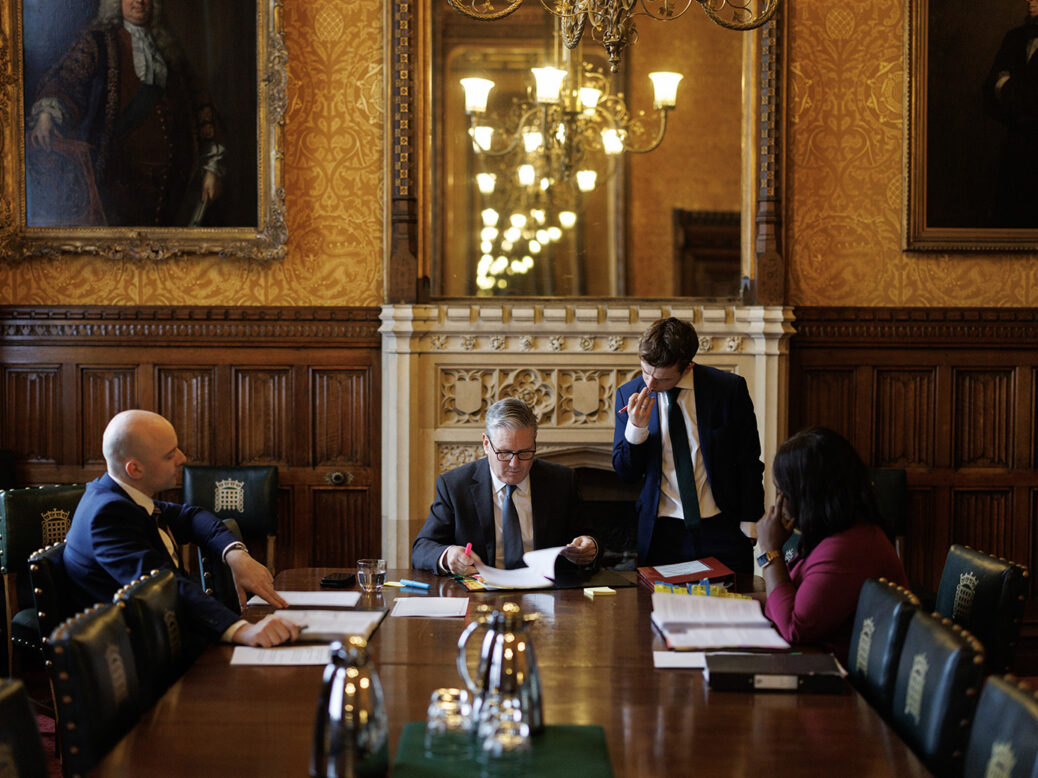
Mia was 21 when she joined a minister’s parliamentary office in August 2025 and had never worked in parliament before. Her role was not clearly defined when she started, and within weeks she was managing the MP’s diary, coordinating security arrangements, and sorting policy correspondence – alongside the work she had originally been hired to do. By her final month, she was working overtime every day. “Every time we had an office meeting, it was so clear that everyone was underwater or on the verge of being underwater”, Mia says. “I tried to work harder and just made myself sick”. She was ultimately forced to take reduced responsibilities after the workload and stress led to her burning out and nearing a breakdown.
A week ago, at GMB’s annual congress voted to back One Parliament One Employer – a campaign calling for parliament to become the single employer of all MPs’ and peers’ staff, replacing a system where 650 individual MPs each act as separate employers with no central oversight. GMB is the largest union in parliament, with more than 1,500 active members. Lisa Gillmore, its MPs’ and peers’ staff branch president, who proposed the motion, described a system where “every MP finds themselves running a small business with its own rules, practice and office culture” – meaning that when something goes wrong for a member of staff, “how that is dealt with is complete luck of the draw because it depends entirely on their MP”. It isn’t hard to see why the campaign is gathering momentum.
An analysis of the parliamentary staffing registers between October 2024 and May 2026 supports this picture, finding that MPs’ offices lose staff at roughly double the national average: around 35 per cent annualised, against a national rate of 15-20 per cent. That figure does not reflect a handful of poorly managed offices pulling up the average. Even after removing the 20 worst-performing MPs, the remainder still average 29 per cent – suggesting the causes are structural rather than a matter of individual failings.
The system that might offer support when things go wrong, however, is not designed for the people who need it. “If an MP wants to manage someone out, parliament will help them do that – it’s stacked in their favour, not ours”, says one veteran staffer who has worked across eight MPs’ offices. Technically, staff can seek HR guidance from parliamentary officials (the Members’ HR Advice Service). In practice, they’re often directed elsewhere, or their MP is given the same advice in advance. “I’ve never felt comfortable with HR,” another staffer said. “They’re there to look after the MPs, not the staffers…. How can they be impartial?”
Gillmore reiterates this: “MPs can even hear grievances about themselves, which is a completely inappropriate way to run a modern workplace”. The consequence, for many, is that concerns go unvoiced. “Everyone’s got a list of who they shouldn’t work for”, a staffer added. Mia had no idea of this background before she arrived. What she encountered instead was a role that expanded faster than she could have prepared for. There is also no standard induction for parliamentary work. “I didn’t know what my weak spots were going in,” she says.
Part of what makes that so difficult to navigate is that Ipsa, the body that oversees MPs’ finances, maintains a rigid set of job descriptions – a fixed list of roles that MPs cannot deviate from in job ads. “There’s a set list of roles, and you have to fit into one of those buckets”, one person explained. “Staffers spend a significant amount of their time outside of their job descriptions, and there’s no way to get that reflected in your role”. As the newest member of the team, Mia absorbed the work without a clear home, which, over time, became unmanageable. The backlog formed and compounded. “Chaos begets chaos”, she says, “I started letting tasks drop when I knew they wouldn’t immediately blow up in my face.”
What exacerbated the pressure was the absence of any institutional backstop. “From an HR perspective, what I struggled with was lack of oversight,” Mia said. “Mistakes got made… that never would have gotten through the civil service, never in a million years.” The contrast became clear when meeting with her MP’s ministerial team, which included a significant number of private diary staff. The MP’s parliamentary office, by contrast, had a handful of people to cover everything.
“Junior staffers are making high-stakes political judgement calls in a way no other junior employee would be expected to,” she adds. “I constantly felt an almost existential level of stress over the consequences my mistakes could have.”
This is, multiple staffers suggest, closer to the norm than the exception. Offices operate in a way that is, as one long-serving staffer puts it, “very start-up-y – if you see something, you’ve just got to do it”. “It’s incredibly reactive”, another adds, “it’s just putting out fires left, right, and centre”. The pressure is felt most acutely in the roles that face outward. An analysis of job adverts posted on parliamentary recruitment site w4mp between October 2024 and May 2026 found that, of 650 MPs, 547 advertised at least one role during the period. A third of those adverts were for caseworkers, the staff who handle constituents’ housing crises, immigration cases, and benefits appeals. These are also the roles with the highest turnover.
Underlying all of this is pay. Ipsa sets pay bands staffers regularly describe as inadequate and poorly reflective of a job which is never a nine-to-five. Progression, where it exists at all, depends entirely on the MP’s discretion. “You work longer, but that doesn’t get you a pay rise,” said one person who spent six years in parliamentary offices. The staffing budget forces a choice between fewer staff on higher salaries or more staff on low pay. This absence of a central employer has consequences beyond individual offices. GMB’s own research has found that female staffers in parliament earn on average £1,128 less than men, and women from minority backgrounds nearly £6,000 less than white men. Parliament is exempt from mandatory pay gap reporting because each MP’s office falls below the 250-staff threshold.
One Parliament One Employer proposes that while MPs retain the right to hire and manage their own teams, contracts, pay, training, and grievances would sit with a central institution. The model already operates in the European Parliament, in Australia, and in New Zealand. Following the passing of the motion on Monday, Gillmore said, “this has helped to add more momentum behind the campaign because we know we have the support of the whole union behind us”.
Parliament may function as a single institution from the outside, but employs people as 650 separate institutions, with 650 different standards for pay, training, oversight, and what happens when something goes wrong. The junior staffer who spent her final month working overtime every day is not an outlier. The veteran who has worked across eight offices and has never felt protected is not unusual. “You’ve always got your guard up, because you know you’re not protected – but they are.”
Names have been changed
[Further reading: Westminster’s WhatsApp deletion drive]
Content from our partners



Related