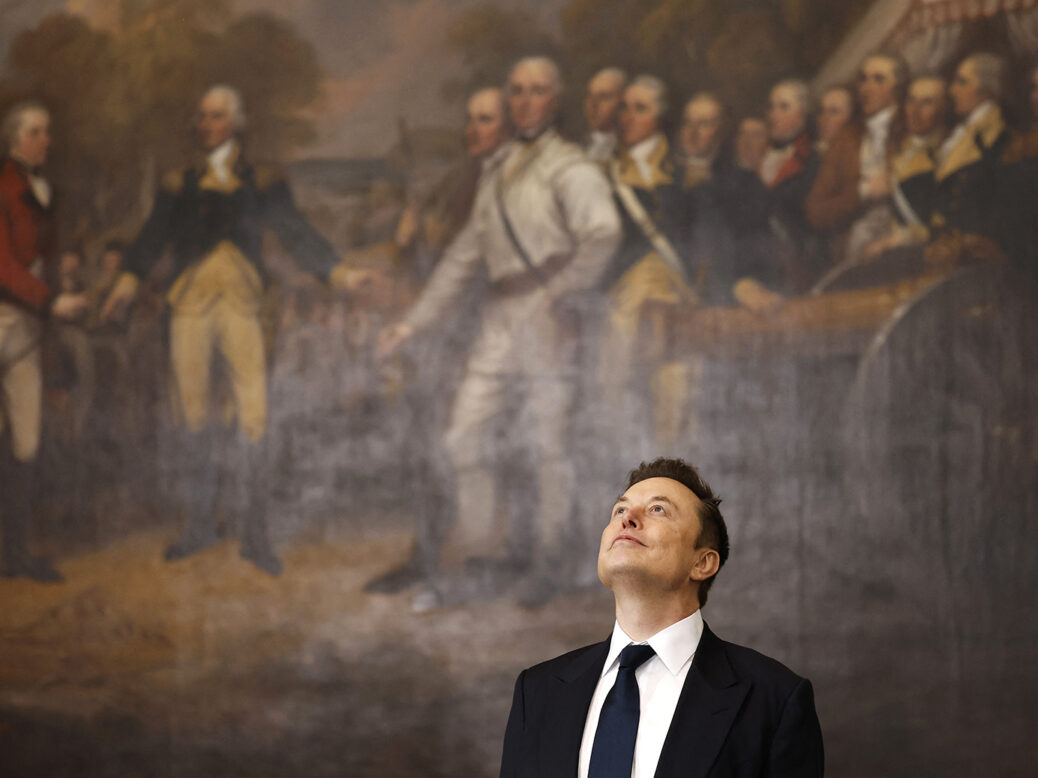
Elon Musk is modern capitalism’s first trillionaire – although the situation is not entirely without precedent. History tells us that, adjusting for inflation, other individuals have managed it, at least notionally. They were, however, Song or Mughal emperors, whose dominions’ economies accounted for 25 per cent of global GDP.
Musk has achieved this thanks to the SpaceX IPO on 12 June, which was less an investment in a company – which commands a valuation exceeding $2trn despite losing billions of dollars in 2025 – and more an investment in Musk. Investors are not purchasing current earnings. They are purchasing on faith: in Musk’s judgement, his vision and his ability to bend governments, markets and public attention to his will.
Most people who call themselves liberals will see this as a bad news story, since for them Elon Musk is the exemplar of a Very Bad Man. But it’s worth remembering that this basic accord – investing in entrepreneurs, even semi-megalomaniacal ones – was all swell for global liberalism for decades after the fall of the Berlin Wall, for those who believed that globalisation, technological progress and progressive politics were mutually reinforcing. Be they British Blairites, Clintonian Democrats, or those high on techno-Obamium. A Bangladeshi garment worker, a Berlin software engineer and a Californian venture capitalist were all supposedly heading towards the same future. In 2014, the Observer profiled Musk under the headline “The new It Boy of Silicon Valley” and glowingly detailed how he had inspired Robert Downey Jr’s portrayal of Tony Stark in the Iron Man films. And it’s understandable. Musk embodies virtues that much of the left, from Leninist electro-communism to Wilsonian white heat, used to admire: ambition, disruption, risk-taking, futurism. But Silicon Valley’s relationship with Obama and liberalism was always conditional. It worked only if both sides wanted the same things.
If these investments are less shares held in a business than a personal vote of confidence in one man, then what of the “It Boy”? Well, he is a 21st-century oligarch who increasingly sounds like a 19th-century imperialist. Somehow, the extraordinary wealth understates Musk’s power. He exerts profound influence over wars through his internet service, Starlink, sways public discourse through his ownership of X, and will now decide the future of humanity with SpaceX. The Great Man theory of history is back and so are the attitudes that shaped it. Like the Victorian industrialists, Musk and his tech bros believe they are a superior class destined to shape society. And he isn’t an aberration produced by a healthy system. He is the consequence of untrammelled industrial capitalism. Liberals mistook a temporary alliance for a law of nature.
Cecil Rhodes thought empire was a civilising mission. His “philosophy” of “equal rights for all civilised men” became the blueprint for South African apartheid, under which Musk was born and which his father has described as “not oppression”. Today’s tech elite speak of “optimising civilisation”, “saving humanity” and colonising Mars. The language changes, the underlying assumption doesn’t: extraordinary wealth becomes evidence of extraordinary wisdom.
Mars occupies a similar place in Musk’s imagination to Africa in Rhodes’s: an empty frontier awaiting conquest, settlement and transformation. The mechanism is Musk’s business interests. As the journalist Karen Hao recently told me: “[AI companies] have consolidated an enormous amount of economic and political power. They do so through the dispossession of the majority and they are developing a controlling influence on every single facet of our lives.” Unlike Rhodes, who needed armies and (British) state support, Musk has something more efficient: an algorithmic amplifier that rewards outrage, demotes dissent, and is personally curated by a man with 240 million followers and no editorial accountability. The platform doesn’t just host the new far right – it incubates it.
He has accused a senior Labour politician of being a “rape genocide apologist”. Addressing a recent far-right rally in London by video link he criticised “uncontrolled migration” and later instructed the assembled mob: “You either fight back or you die.” That march was organised by Tommy Robinson, a man once banned from Twitter, before Elon Musk bought it. During Northern Ireland’s latest bout of race rioting, in which the Center for Countering Digital Hate said Musk played an “instrumental” role, he argued that “murderous migrants beheading innocent people in their home town is what’s making people angry, not ‘social media’!”
Musk’s trillionaire status undermines one of the central myths held dear by post-Cold War liberals: that modern capitalism reinforces the liberal order. Instead, the richest man in history spends his days talking about demographic decline, racial grievances and civilisational collapse.
The mistake is to treat Musk as a corruption of capitalism rather than its product. Vast concentrations of private power do not create liberals. Why would they? They create people with unlimited confidence in their own judgement, and freedom from democratic constraint. They create oligarchs. That is why Musk is not the exception. He is the proof. The real shock is not that Elon Musk thinks this way. It is that so many people assumed he never would.
Listen to Karen Hao in conversation with Oli Dugmore on our interview podcast The Exchange
[Further reading: The Bank of Canada is quietly running out of room — and Carney knows it]
Content from our partners



Related