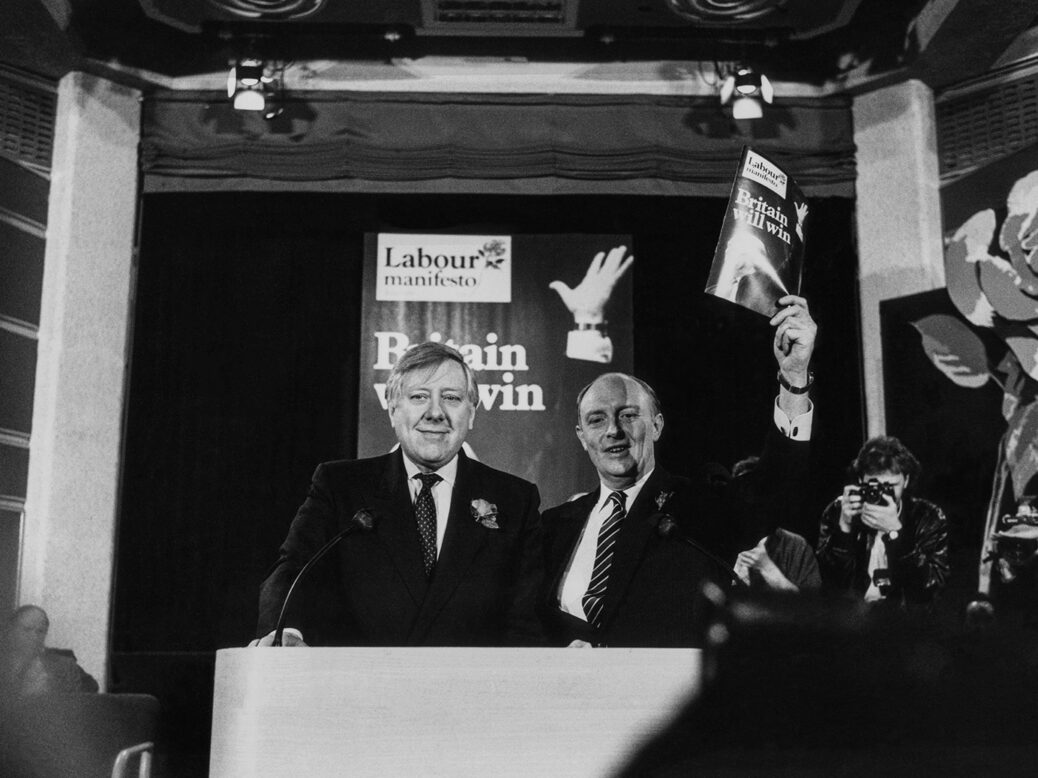
Roy Hattersley and I were elected deputy leader and leader of the Labour Party on 2 October 1983. Thus began what I called “my mid-life crisis” and he called “an interesting period of responsibility with a complete lack of power”. We had both stood for both of the positions. I proposed that as a way of demonstrating that we had the shared objective of uniting what was then, to say the least, a poisonously fissiparous movement. He was initially reluctant, but John Smith, his campaign manager, proved to be persuasive. When the result was announced, Roy – in a gesture suggested to him by the guileful Gerald Kaufman – grabbed my wrist and raised my arm aloft, boxing match style, to signify my victory. The cameras flashed and the photos provided front-page evidence of our common endeavour. It surprised me and, as he later admitted, embarrassed him. “It goes to prove that not all pictures are worth a thousand words”, he told me . “You were very generous”, I said. “I was very pissed off,” he replied.
It is no secret that at that time our history and attitudes in several of the existing policies and preferences were regarded to be divergent. Unknown to each of us then, however, both of us were determined to secure cohesion in the Labour movement. The beginning of what became our joint work began to become apparent in the discussion we had – our first-ever real conversation – over a rather uneasy breakfast the next morning.
Over the following months, in the wake of the shattering election defeat, he gradually became aware of my determination to change policies and to overcome factions in the party. I became conscious of his great capacity for dedicated loyalty to both of those objectives. Our views and actions became convergent. Both of us recognised, however, that the almost religious devotion of many members to some 1983 Manifesto commitments, including unilateral nuclear disarmament and hostility to UK membership of the European Community, meant that our aspirations for change would require long and arduous persuasion. The fact that I also lacked a majority on the National Executive Committee also prohibited progress at that vital level. Early public declarations of ambitions for change therefore had to be avoided. Both of us disliked the stealthiness. Both of us adhered to it. As the time passed, through the turmoil of the miners’ strike, our confederacy became a bond and functional comradeship became a friendship that was never demonstrative but always solid.
Typically – and often usefully – the politically and intellectually confident Hattersley was argumentative. But his complete commitment to our shared objectives ensured that he became the most dependable and trustworthy lieutenant that any political leader could wish for. In nine years of office we only had one really serious quarrel. It arose from his outrage on discovering that Glenys, my wife, and I had had Salman Rushdie to supper at our home. Rushdie was then under an Iranian fatwa as the author of Satanic Verses and that had generated unrest among several Muslim communities in the UK. Roy told me that his Kashmiri constituents in Sparkbrook, like many other followers of Islam, would “rightly” be furious and alienated. In my “comfortable monocultural” seat in South Wales, he raged, I had no idea of what religious devotion and division meant. In response, I could only apologise for any difficulty for him. He then stormed out of my office. Months later, I asked him warily about any lasting effects and, with characteristic candour tinged with irony, he said: “Fortunately, not – people proved to be more tolerant of your ignorance than I was. But please don’t do it again…comrade.”
Roy was a committed – he said “mother’s milk” – democratic socialist. He believed in the substance and potential of collective action and universal contribution to enable individual liberty and fulfilment. And it was never a quiet, confidential conviction. He articulated it in writing and speech to audiences of every kind with boldness, wit and, often, brilliance. He expressed his ideas and insights in over 20 published books of ruminative essays, polemics, histories, biographies and novels, and in countless newspaper and magazine columns. In much of that output ran the theme of advocating freedoms made real and effective by public rights of access and enablement. That was central to his being. That love of useable liberty meant that he was tolerant of just about everything except intolerance, especially the bigotry of misogyny and racism. He preached – not too strong a word – for equality and against inequality which “harms by pampering on the one side and vulgarising and depressing on the other”. When he was accused by critics of being “stridently libertarian” he responded by quoting Martin Luther King: “Extremism in defence of liberty is no vice. Moderation in pursuit of justice is no virtue.” His urbane delivery and genial disposition usually meant that he won grudging acceptance and even a few converts. Diehard opponents were dismissed as being “made stupid by fanaticism”.
Included in his political literary output was the “Labour Aims and Values” document which he wrote at my request in 1988. He returned the completed work within a month and, sadly, it attracted only anorak attention. When we discussed that, he ruefully reflected, “Maybe I should have attacked Tony Benn or you or someone to get noticed,” and then broke into a version of Gershwin’s I Got Rhythm: “I got schism, I got hatred, I hit my man, who could ask for anything more?” We had a drink to celebrate the flop.
In his political convictions and conduct, Hattersley’s great quality was constancy. His advancements at an early age were recognitions of ability and he was far from the pole-climbing opportunist of crude caricatures. That was demonstrated on many occasions, not least – and with some courage – when he resisted intensive pressure to defect to the Social Democratic Party in 1981. It was led by his admired friend, Roy Jenkins, and by other very close associates like Shirley Williams. Those who did form the party, with initial great success, regarded his refusal, together with Denis Healey, John Smith, Gerald Kaufman and others viewed as being on the right of the Labour Party, with great regret and resentment. I witnessed his ecstatic delight at the ignominious defeat of the SDP at the Bootle by-election of 1990 and the subsequent dissolution of its final form.
He showed similar fortitude in strongly supporting the efforts to defeat entryism and other attempts to abuse and contradict the integrity and generosity of Labour as a broad, non-sectarian alliance of progressive values and people. And he showed that resolute dedication in innumerable statements and – more prosaically – in the interminable meetings of the National Executive Committee which considered evidence, heard the accused, and eventually agreed upon the expulsion of proven members of Militant. I can’t report that he did it without complaint at the endless hours of due process, but he was a fastidious attender and a vital vote, with his ire increasing with each passing week.
Fortunately for Roy, for me and for quality journalism, he was able to combine presence at these and other NEC and Shadow Cabinet meetings with writing his “Endpiece” columns for the Spectator, the Listener and the Guardian. As controversy raged, or ennui endured, at these gatherings, Roy wielded his fountain pen and Tipex to compose his illuminating and entertaining articles, occasionally interspersed with (usually acidic) interventions which showed that he was somehow following the proceedings. When a shadow cabinet member whinged to me about this literary practice I retorted that it was good to have “at least one genius at work” in such conclaves. When he heard about that, Roy was pleased. He laughed and said that it was “a refined response”. I felt complimented.
After we both – without coordination – announced our resignations from our leadership positions days after the 1992 election defeat, Roy increasingly preoccupied himself with writing. Over the next 25 years he completed his historical trilogy and published a series of historical analyses, several well-received biographies, and a diary of his dog.
He left the Commons in 1997 – “Just in time for victory”, he said. Then, with growing intensity he began to express his doubts and then his antagonisms to aspects of the policies and attributes of those who, he thought, were using the adjective in New Labour to obscure or dispose of Labour’s collectivist purposes and advance. He admired the public expenditure policies of Gordon Brown and Tony Blair and celebrated their victory. But he argued, in ways that were consistent with the teachings of his favourite socialist thinker, RH Tawney , that the Labour Party had to constantly show that “ its idealism is not lunacy, nor its realism mere torpor”. He had used the same argument against the SDP defectors and to repel the ultra-left earlier and he deployed it against Corbynism later. Not surprisingly, he thought that New Labour’s apparent focus on “style over substance” and its accommodation of great wealth satisfied neither of Tawney’s requirements. And – naturally – he said so trenchantly. He probably took some satisfaction from the fact that some who had detested him as an inveterate “right winger” were forced to revise their prejudices. Even cursory examination would have told them that his socialism always emphasised the reality that the only practical way secure the democratic power to put values into legal effect is to make a broad, relevant appeal to the electorate. Without such earned authority, he believed, “principles can be empty pleasantries.”
Happily, Roy was good but never saintly. On the contrary, he never disguised the fact that he enjoyed the “Good Life” (bon viveur is too pompous for Sheffield Hattersley).
His torrent of stories, gossip, and continual commentary, sometimes “appropriate”, sometimes not, provoked thoughtfulness and uproarious laughter (which he appreciated most). He was, consequently, a convivial and stimulating companion in company of any kind. He became serious when showing his obsessive and encyclopaedic enthusiasm for Yorkshire County Cricket Club and Sheffield Wednesday (“the only blue thing about me”) and the fortunes of either would dictate his early morning mood, often well into the afternoon. He was therefore euphoric or deeply depressed at regular intervals. It never got in the way of work. He was a political and literary Stakhanovite. That was further proof of his strength of character.
All of these qualities of steadfastness, creativity, forthrightness, irreverence, and much else made Roy Hattersley an incomparable asset to the Labour Party, to British democracy, and – with internationalist breadth and dedication to enlightenment and emancipation – to the security and opportunity of humanity. He would, of course, detest and dismiss such flattery. But only a little. He was very normal, after all.
[Further reading: Remembering Roy Hattersley, Labour titan]
Content from our partners



Related