The first human sound in the morning was a journalist talking to another journalist over the breakfast table. We were in Makerfield for the election, voyeurs with London accents, following a high-wire political drama unfolding against the backdrop of “real” England.
It was a pub with rooms near Haydock Park, owned by a time-honoured British brewer, itself owned by a company based in East Asia but incorporated in the Cayman Islands. England, my England! The restaurant served ten types of burger and three types of loaded fries. A jumbo screen played the BBC News channel. Once it cut from an interview with the drugged-seeming presenters of Springwatch to the broken-glass aftermath of a pogrom. Events that would have seemed dystopian even five years ago were filmed, condemned, filed away; normality and the by-election ground on.
A season of superlatives was dawning over Makerfield, a collection of peri-rural suburbs, former pit villages and obscure towns spread beneath Wigan. The vote was seismic. Historic. Make-or-break. The chance of a lifetime. Andy Burnham had staked his political future and the future of the Labour Party on a single vote against Reform UK’s Robert Kenyon, a plumber and former army reservist, burdened by a digital fossil record of embarrassing remarks about women. Makerfield was a constituency that, like Wigan itself, like so many other places with largely white, Brexit-voting, working-class populations, was speeding to the right. Win or lose, mayor or prime minister, Burnham was being run close – terribly close, given he was the most popular Labour politician in the country up against a man who as one union apparatchik put it to me acidly, was “only as good as the last podcast he listened to”.
The world noticed what was at stake: five Japanese news crews had peeled through Makerfield in the past two weeks. Le Monde called the vote “unprecedented”. An Australian press pack had, apparently, become lost somewhere in a field near Billinge. From a window in Wigan town hall, an American reporter was overheard speaking to a cabbie: “Hi, can you take me to Wins-TAN-ley, please.” And so, an existential political battle was playing out alongside a broad comedy of manners beneath a torrential downpour of hyperbole.
Yet it wasn’t hyperbole to say that the constituents of Makerfield – trying their best, frowning at their bills, staring at Facebook, feeling uneasy in blunt ways that were hard to articulate in front of journalists – had woken up one morning to find themselves the most psychoanalysed population in Europe. Greater claims began to be made as the race went on. Makerfield was not simply Makerfield. It was, a prominent pollster argued, all of Britain: “A snapshot of the country in miniature.” And what kind of country was that?
I knocked on doors for several weeks. I drank in dust-furred community clubs and backstreet pubs. I ate half a dozen meat pies. I tried to speak to the Afghans and Kurds who adorned Wigan town centre in the middle of the day. I bumped into a squad of absurdly young men canvassing for Restore in the poorest parts of Abram. I watched the crowds at the women’s rugby league in Orrell and spoke to formidable local dignitaries who had spent decades trying to keep the area’s head above water. Burnham and Kenyon didn’t really interest me. Makerfield would be forgotten in a few weeks’ time. The circus, self-involved and self-serving, would move on. Yet the people here matter. The longer I spent with them, the more representative of the rest of us they appeared. What interested me was not the election, but what was happening in people’s heads in Bickershaw and Platt Bridge and Hindley – what was happening to all of us right now that meant you could meet people seized by apocalyptic fears of race war and depressed social democrats living next door to each other.
I have been sent all over the country in the past two years, trying to take its temperature, check its symptoms, diagnose its ills. I found that it was becoming harder to speak about the surreal things I saw and heard in a straightforward way. Every reporter I knew who was not too blind to see what was going on was struggling in the same way. They suffered from the same queasy, plunging intimation about where we were heading. I was tired of writing and speaking about the country like it was a “normal” place full of happy “normal” communities and cheeky “normal” Brits. Nothing I saw or heard seemed “normal”. Everything was changing. Every time I returned to London and my silly, narrow life, gossiping with writers and eating multi-course tasting menus, I felt the most ignoble feeling of all: relief.
Britain is a country where it’s easier to imagine where the next pogrom will happen than how a new high-speed rail line will be built. I am sick and tired of the six-figure salary newspaper columnists who deny the country is broken on X.com while masked men go door to door in grand old cities, looking for homes and people to burn. Were they daft? Did they think they were clever?
No wonder journalists are hated. You have to talk people down from a high ledge of hostility these days in a way you didn’t have to a few years ago. When people know you are a journalist they assume you want to garrote them with printed words. Something was twisted in the wires between these places, these people, the media and the politicians. It is getting harder to communicate. Sometimes it felt personal. Nobody wanted what we did in this business. Facts? Interviews? Analysis? Long-form literary reportage? Can you make it a video? You want me to read all that? Lol. Lmao. Rofl. Scum. They think we think they are racist conspiracy theorists, and they think we think they shouldn’t be allowed to vote. They wanted slop and they increasingly wanted violence and they wanted to be alone, to be themselves. And who could blame them?
In the bitter early months of 1936, George Orwell heaved himself north to write The Road to Wigan Pier, a famously grotesque depiction of northern industrial unemployment and poverty in the same towns and villages where Labour and Reform were battling over the future of the country today. Was there anything left of Orwell’s Wigan?
It’s worth knowing that there was nothing left of Orwell in Wigan. The Orwell-centric pub and visitor centre near the pier closed in 2007. The tripe shop where he stayed in 1936 is now an HMO with a pretend wooden plastic door. In the Waterstones in Wigan town centre, where all the books seemed to be about princesses having sex with dragons, they sell three copies of The Road to Wigan Pier each month. “It’s about average,” said the cashier, bored out of her mind. Had she read Orwell? “Nah, and I probably won’t to be honest.” Nothing he described in its pages remained intact. This was a fragile place, where everything could be washed away in less than a century.
After a few days, I stopped thinking about Orwell. Instead, with each day that passed in Makerfield, I was reminded of a headachy line from VS Naipaul. He was writing about some slum-dwelling Muslims he met in Bombay a long time ago, but it could have been written about us on these islands at this exact moment. “I knew that… the grimmer things became, the more you insisted on being what you were.”
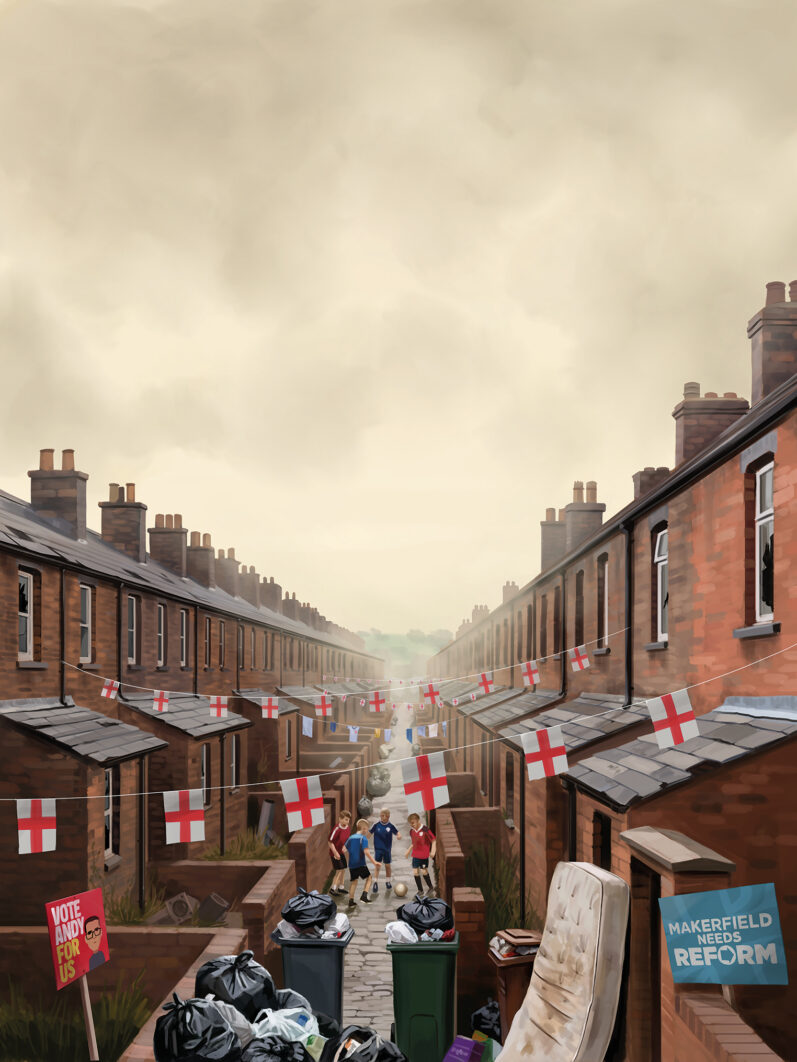
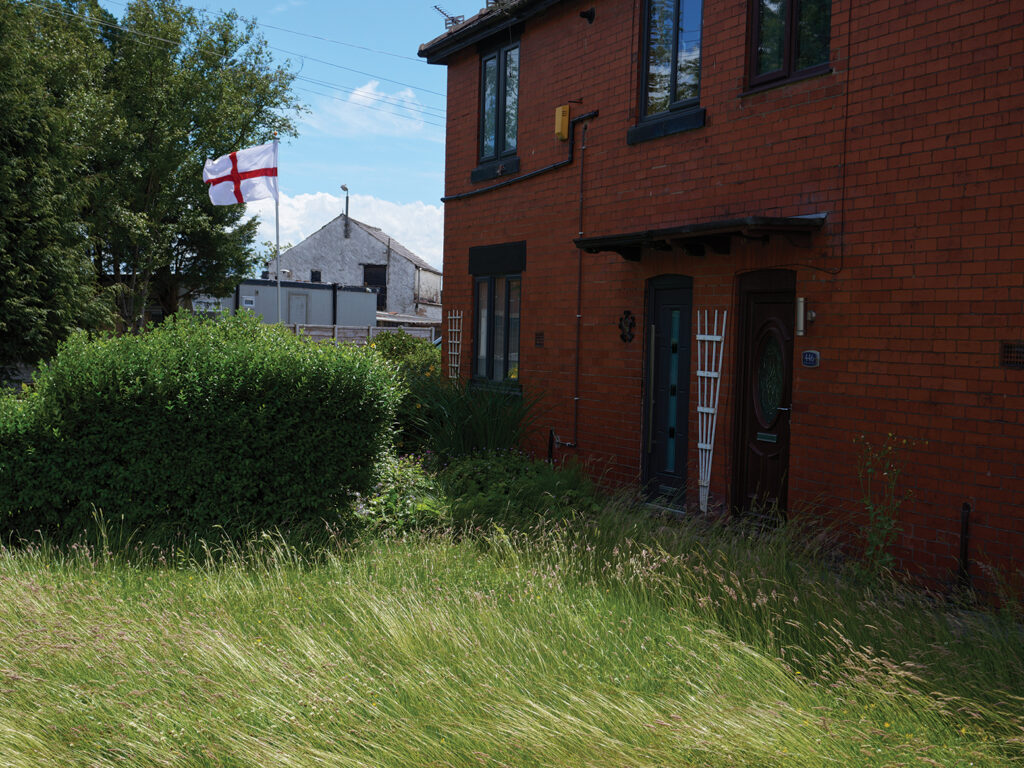
You won’t read anywhere that Makerfield is beautiful, but it is. The constituency is a patchwork of peaceful green fields creeping up on red brick rows of miners’ terraces, gathering grassy yellow fields, ready to abolish anything human. You might hurry through these places, halfway between Liverpool and Manchester, proud of their sporting heritage, on the way to brighter lights. Makerfield is 97 per cent ethnically white, a mining area that did not experience the same postwar migration as mill towns such as Oldham. Yet Makerfield is illustrative in one important way. It was a once rock-solid Labour seat now threatened by Reform; the battle for it prefigured dozens and dozens of races at the next general election.
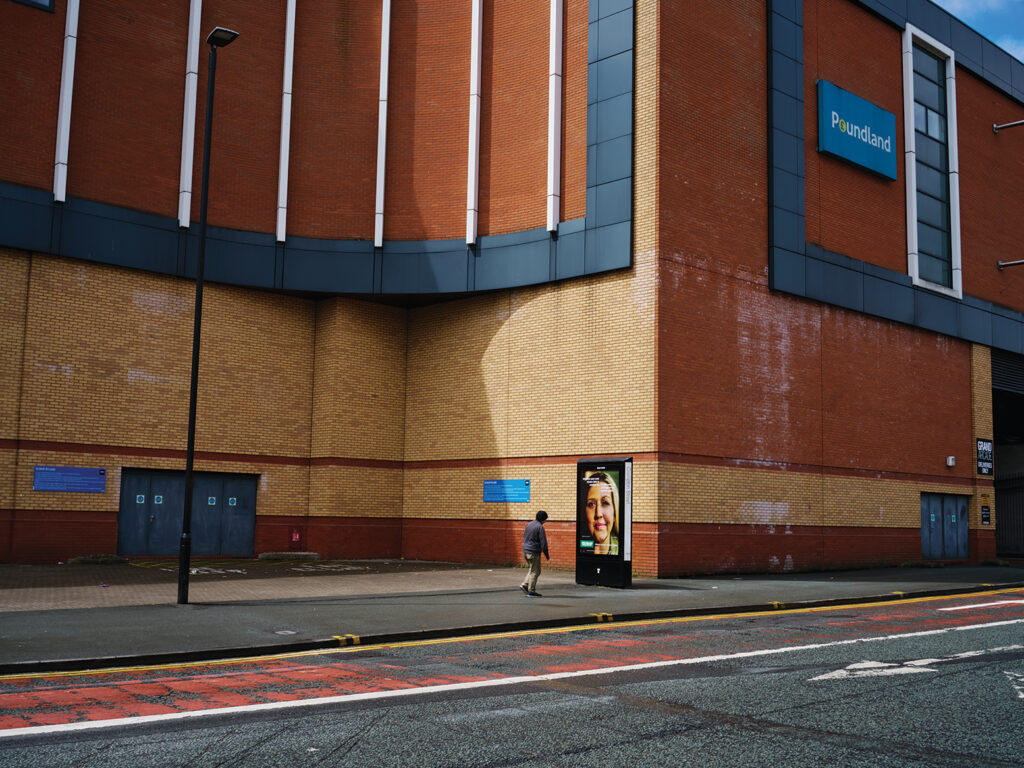
In the old, astonished 19th-century screeds describing what officialese now call “Greater Manchester”, the skies are bitumen black and the rain falls from above as acid. “Hast thou heard, with sound ears, the awakening of a Manchester, on Monday morning, at half-past five by the clock; the rushing-off of its thousand mills, like the boom of an Atlantic tide, ten-thousand times ten-thousand spools and spindles all set humming there…” (Thomas Carlyle, 1839). Now there is silence. The English, having shaken the world, are sleeping. Their greatest endeavours are over. Look around Makerfield: their workshops, mines, mills and factories are now nature reserves and garden centres. They are no longer modern; they can no longer build anything bigger than a retail complex with a cinema attached.
“People down south wouldn’t be able to tell you how green it is,” David Molyneux, until April the Labour leader of Wigan Council, told me. So many of the four decades the 72-year-old spent in local government revolved around clearing up industrial refuse in the borough, collecting waste, fighting off new developments, shaping and healing the land. Molyneux’s father was part of the 1926 General Strike. Then, Labour politics was a collective, often violent, public struggle for rights, wages and jobs. Molyneux, living on the far side of immense changes to work and life in Wigan, dedicated himself to a different kind of Labour politics, where public money was used to block harms and alleviate private pain. He had done the best he could with the resources to hand. “There’s no white charger over the hill coming with sacks of money for Wigan.”
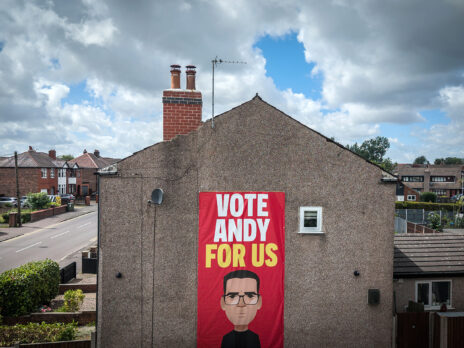
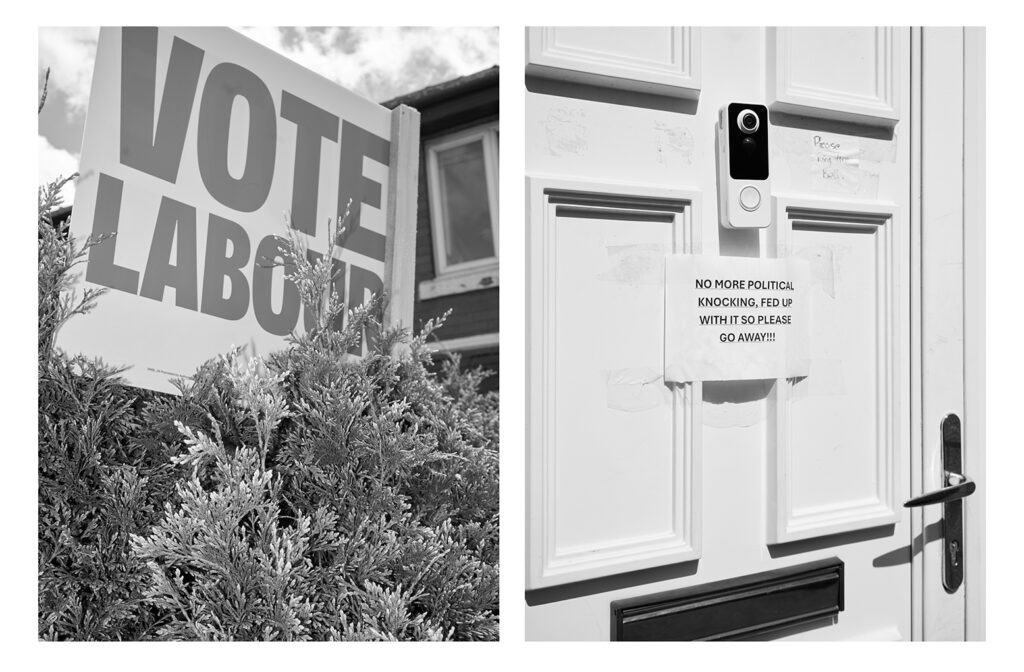
Molyneux was not the only one who liked the greenery. Proud members of Wigan Borough Council past and present talked to me about Makerfield’s “biodiversity”, dire scientific phrasing that does not capture the rich, stagnant sadness of post-industrial English life in places like this. It’s like walking through the set of a film that takes place centuries after a nuclear war, when nature has reclaimed what is hers by right from feckless humanity. “Beautiful!?” He looked at me like I was having a right laugh. I’d told him – a man whose door in Platt Bridge I’d knocked at teatime; a man who was making chicken dippers for his shrieking granddaughter; a lifelong Labour-voting man who had put a “Vote Andy For Us” sign up in the window to keep Labour canvassers away because he was voting Reform this time; a man in his early sixties whose left hand was fused into a brittle claw because of a work accident; a man with the shakes who was likely to get shakier; a man who had seen the attempted beheading in Belfast in the morning and started posting that video on Facebook in the afternoon; a man who said that sooner or later the English would have to take it into their own hands if you know what I mean; a man who said Wigan was dead, dead, dead and had the word “love” tattooed on his knuckles – I’d told him that Makerfield was beautiful.
“You’re mad, lad… I wish we could go back to the Seventies, the Eighties, the Nineties. That were my England. If I had any money, I would leave.” He was in some disarray. Politically it made no sense. Rupert Lowe or Nigel Farage might have told him that he could go back to the Nineties. Andy Burnham, like a lot of people in the Labour Party, might have told him he could go back to the Seventies, turn back “neoliberalism” and return to the last period when Britain can be described as social democratic. Emotionally, I knew what he was asking for, though: all the grief of life to just go away. He wanted to be left alone with his paranoia. He slammed the door and returned to the chicken dippers and the sound of tears.
A few days earlier, I walked from Platt Bridge to Bickershaw to see a criminal waste dump. People were paranoid on the eastern edge of the constituency, and they had good reason to be. The dump had become a local attraction orbited by politicians and journalists; it never moved; the jagged heap was felt to have great symbolic weight. At the end of 2024, 18-wheel lorries crashed down to the end of the road and illegally dumped enough waste there to cover eight acres.
The land was partly owned by the Duchy of Lancaster – that is to say, part of an extensive portfolio of properties and estates belonging to King Charles III. On the day I spoke to residents around the dump, I read on my phone that the same Duchy had paid the rent for the former prince Andrew’s children to live in London palaces. The residents I spoke to believed that if the King knew this was here, he would have already cleaned it up. (In reality, Channel 4 News reported in January that the Duchy “is, in effect, exempt from regulations and duties to clean the site on account of an ancient feudal legal framework dating back some 750 years”.) Twice in recent months the waste had caught fire.
I spoke to residents I shouldn’t name. They were depressed. They had strong ideas about who to blame for the dump. Their home was one of many in the area that was flooded in January 2025. They still lived in the chaotic aftermath of the deluge, with tools and pots of paint spread across their living and dining rooms. When they contacted the environmental protection agency about the dump, begged them to do something, they said they were told that “fears of potential violence” meant they couldn’t tackle the rubbish. Agents of the state feared the criminals more than they feared the residents. What kind of country was it where the government was more scared of organised crime than voters? They were going to vote for Reform. The grimmer things became, the more you insisted on what you were.
On a wet morning in early June, I visited Dr Sanjay Arya. His office was part of a confusing, higgledy-piggledy collection of Portacabins, car parks, cancer support hubs, Amazon lockers and sick women in fluffy dressing gowns smoking outside A&E that together made up Wigan’s Royal Albert Edward Infirmary.
Short, prim, controlled, courteous; thin-framed spectacles resting low on his nose; at 62, Arya was nearing retirement. He first came to Wigan in 1991, leaving behind Bihar, India, with its largely rural population of 130 million for a British medical school in 1982. Arya’s father, another doctor, remained in Bihar and still practises there today, in his early nineties. Both were proud of their British medical training. “The NHS practises the best medicine in the world,” Arya said softly as I sat down. His father taught him a lesson: distinguish between the “art” and the “science” of medicine. Anybody could learn the science, but the art – “what you would call bedside manner”, Arya suggested – of serving patients required the greatest effort to acquire. “The person in front of you has to have trust and faith in you.”
Arya specialised in cardiology. Cardiac problems are the biggest killer in the north- west. He spoke of progress being made in small increments – fewer smokers, less diabetes, less death – in the towns and villages of Makerfield. Yet there was an undercurrent of unease flowing through him.
What he called “health inequalities” remained. He knew that the NHS had to be closer to its patients. Those who served them would have to sacrifice more, be selfless, work even harder. Wigan has one of the highest male suicide rates anywhere in Britain. Arya acknowledged the problem, though it was not his area of medicine. He had been in Wigan long enough to speculate about the town. He thought the social structure had changed in the decades he had served this place. Not only were men becoming more isolated, but they were also more competitive, he said. The tension between loneliness and social expectation pulled men apart and broke them. There was no one to pick them up when they failed. So they perished.
Arya’s words reminded me of something one of Burnham’s team told me: “In Makerfield, if you’re a man, you’re either working as a tradie, working in the public sector, or a failure.” There was a feeling among observers of these towns that men had adapted inadequately to post-industrial life compared to women.
Wigan is arguably run by women. The formidable chief executive, Alison McKenzie-Folan, and the leader of the council, Nazia Rehman, are both women. The managing director of Wigan Athletic (Sarah Guilfoyle), the head of the biggest NHS Foundation Trust (Mary Fleming) and the chief executive of Wigan and Leigh Hospice (Jo Carby) are women, as are many of the best head teachers in the area. Wigan Warriors Women are outperforming their male counterparts in the Rugby League, both teams owned by this magazine’s publisher, Mike Danson. When I watched the women play in Orrell, they beat Leigh by more tries than I could count.
The men of Makerfield, it was sometimes observed, were more fragile, more fraught, less resilient, less willing to hope that their lives could be better. Burnham’s team found that women supported him by a large margin. Men not so much.
In Ashton-in-Makerfield, I sat and watched the pressure group Reform Watch put up what they called the “Robert Kenyon Totem of Truth”: a colourful pillar printed with the candidate’s social media comments about women. (“I’m sexist, sorry, but I am.” “Women can’t ref, drive, or give instructions.”) I watched as the town’s shoppers looked at the totem poll. Men, older, often with walking sticks or in mobility scooters, dismissed the comments. Kenyon was a lad and a scally; bawdiness was part of English life – always had been, always would be, they thought. A woman working in the pie shop opposite came out and read the pole. “Did he say all that? Really?” The Reform Watch guy nodded. She was furious. “What a prick.”
“You can overplay the gender thing, but it’s not far away from the kind of politics you’d get in North Carolina,” said the Labour source who worked with Burnham.
The North Carolina-style poverty in the north-west motivated Arya even now towards the end of his service. “The north-west is underdeveloped and deprived. The population is elderly, with many co-morbidities.” Could he have had an easier life in medicine somewhere else? “You could go to an affluent area, of course. But then you would not be serving the people.” He took after his father, wanting to be close to those who needed him most.
I had to leave, but there was something he insisted on telling me. In January 2025, Arya was nominated for an OBE. A colleague showed him reactions to the news on Facebook and Instagram. Hundreds and hundreds of comments from Wigan people, telling stories about the doctor, about the lives he had saved in three decades of service.
“There was not one adverse comment. No one saying, ‘He’s this or that, we shouldn’t have him in this country.’ No one. People appreciate the work you do. If you work hard with kindness and compassion they will appreciate you, and that’s the beauty of this country. I know we are hearing things that are sad, but the way to remove that is by being together.” He sounded sadly proud, almost confessional. “Reading all this, my eyes were filled with emotion.”
Up until that point we had not spoken about politics at all. It would have been painful to tell him about the people I met in Bickershaw, Hindley or Platt Bridge, where the same white rage you could find across Britain was building up. (And when you scratched away at this anger, it was almost always about housing. “They” took it from us.) People hardly even softened their words. They didn’t say, “I’m not racist, but…”, they told you their darkest fears, without hesitation. The grimmer things became, the more people insisted on being what they were. But neat, prim, composed Dr Sanjay Arya OBE insisted that he had seen the truth inside people’s hearts, the same hearts he had tended to for so long. “Wigan is a beautiful place. It’s not London, right? It’s not even Manchester or Liverpool… but the people of Wigan are amazing. They’re very forgiving, very honest, and nice people.”
“I don’t care about the buses.” I was speaking to a voter whose face was set in a permanent expression of don’t-get-me-started-on-that in Hindley, on the eastern edge of Makerfield, which was generally poorer and angrier than the towns and villages to the west. Behind us a Bee Network bus, the glory of Andy Burnham’s Greater Manchester, wheezed past. “They’re scraps from the table. And we’re supposed to be grateful, are we?”
Labour was throwing everything at this contest, even Tulip Siddiq. Practically the only person left on the bench was Peter Mandelson. Labour people said every door in the constituency had been knocked four, five times. It was an overwhelming effort. Burnham was trying to appeal to the better part of people’s natures. The fantasies of revenge and rebirth that were a mainstay of other campaigns in this by-election were not his style, and they never could be. I kept speaking to people who had worked with Burnham, or interacted with him in small, memorable, revealing ways. A couple of women in their early sixties in Ashton ran a food bank. Burnham had helped them secure more funding.
On the day the rejuvenated food bank opened, Mayor Burnham was there, not to cut a ribbon (there wasn’t one) but to pour the tea. He was ever so decorous. Before he poured the brew for anyone else, he poured a cup for the 97-year-old mother of one of the ladies, who was as proud as punch to be meeting the mayor. It was the kind of personal touch that lodged in your mind. They, and everyone who knew him, and fretted about him, and lovingly followed his movements, and hoped against all hope that he really could change things, never, ever called him “Burnham”. He was Andy. He was the last card – the only card – the Labour Party had left to play.
But something wasn’t quite right, was it? Not in Makerfield, not in Britain. There was a white rage in the air and one by-election wasn’t going to change that. Too much had gone wrong for too long. I kept thinking about Naipaul’s line, the slums of Bombay, the slums of Platt Bridge. People didn’t have much, nor did they expect much. Around Makerfield, those I spoke to were cynical about everything except themselves, their hot feelings of rage and dejection.
One of the food bank ladies was just back from Berlin. She visited the Holocaust memorial there and overheard a guide talking to a school trip about the Weimar Republic. The Germans had a democracy and they threw it away. They didn’t want to vote. They wanted to be themselves. They wanted revenge. She had listened to this story – one that she already knew – a good woman who worked in a food bank, who paid all her dues and more, who went to church, who would be voting for Burnham, for “Andy”. She had listened to that story being told in Berlin and felt a chill of recognition. “That is us today, isn’t it?” It was the sort of analogy that would have made me roll my eyes ten years ago. But now, hers was a question I didn’t want to think about any more. Should he enter No 10, it will be Andy Burnham’s job to answer.
[Further reading: Andy Burnham’s door-knock to Downing Street]
Content from our partners

Related