
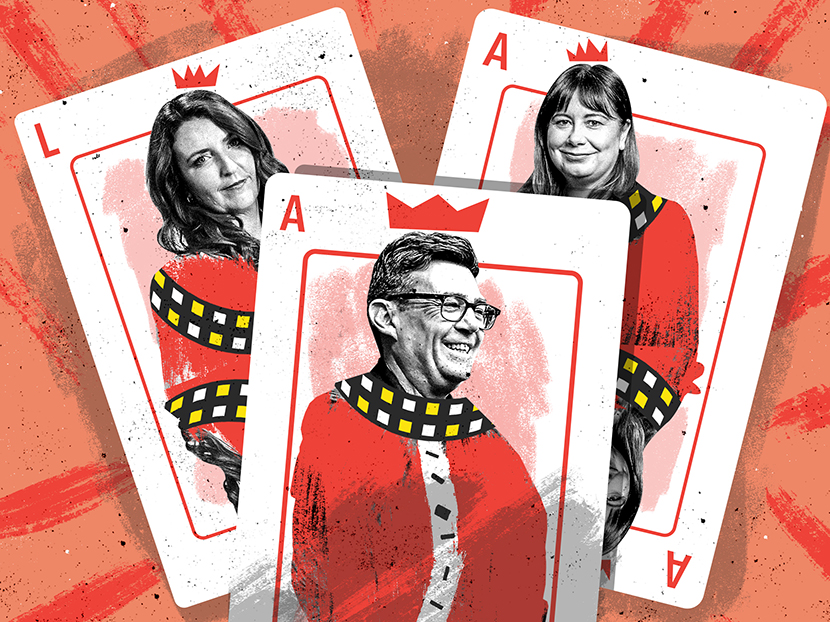
To Andy Burnham’s campaign HQ in Makerfield, where onlookers to this extraordinary, strange campaign are experiencing a sense of poetic justice. Here, at Stubshaw Cross, the working men’s club near Wigan – which is, at least for the next two weeks, the real seat of power in the Labour Party – people arrive every day to help with the door-knocking effort, voice their support, and, in the case of many, angle for a job in the likely new regime. And when they do, they find they have to go through two figures in particular who were once dismissed by Keir Starmer and his team. One is Louise Haigh, the former transport secretary who is now wielding more power than many of the colleagues she left behind in cabinet. The other is Anneliese Midgley, the Labour MP for Knowsley who is quickly becoming one of the most influential figures in Labour.
It is a change of fortune for two women who were once sidelined by Starmer and his former chief of staff Morgan McSweeney – a fact certainly not lost on the many people from across Labour factions who are watching. Haigh was one of a dwindling number of “soft left” figures in Starmer’s cabinet, but resigned from her position in 2024 after it emerged she had a historical fraud conviction. She has apologised for the mistake she made when she was in her twenties, but friends felt she was mistreated by Starmer and his team, who, they say, were made fully aware of the details years before she was appointed. When Haigh was sacked, No 10 said “new information came to light” about her conviction but has never said what that information was. In the latest tranche of the Mandelson files, which was released last week, the former US ambassador appears to have agreed, writing to her at the time: “It seems harsh given you were appointed in full knowledge.” Allies felt that the transport secretary was thrown under the bus. Even before Haigh’s sacking, Downing Street made it clear that she was not a favourite, publicly reprimanding her for tough language about boycotting P&O ferries while insiders briefed that she might soon be out of a job. She was one of the most prominent figures to criticise a “boys’ club” culture in No 10 and anonymous briefings against women in the cabinet.
At the time, Haigh’s sacking was written up as yet another show of strength from McSweeney and his faction, yet another example of their ever-tightening grip on the top of the party and of government. She was one in a long line of people who was, as a former Starmer adviser reflects now, “pushed out, shot, or made clear they weren’t wanted”. “Keir probably didn’t realise it, but every time that happened he became weaker, more brittle,” they added. As Starmer stands at what is probably the beginning of the end of his leadership, with Labour MPs alienated and few loyalties left, few could disagree that this has been the unintended outcome of his chief of staff’s factional warfare.
Now, Haigh appears all-powerful. One cabinet minister who recently turned up at Burnham HQ found that they weren’t able to have a private word with the Manchester mayor without one of this influential pair sitting in on the conversation. “Andy doesn’t even go to the bathroom without Lou waiting outside,” has become a joke among Labour MPs.
But before Haigh, or Sue Gray, or any of the other people sidelined by Starmer, there was Midgley – or “Midge” to her friends. This no-nonsense Scouse political director from Unite was appointed senior special adviser to Starmer soon after his election as Labour leader in 2020 – given a plum job by Starmer’s team so she would not stand to be Labour’s next general secretary, for which she had been seen as a front-runner. She was forced out of Starmer’s operation months later by McSweeney, who mistrusted her and saw her as belonging to a rival faction, given that she had worked briefly for Jeremy Corbyn and was coming from Len McCluskey’s Unite. “She wasn’t in the clique,” a friend says, even though she was widely respected across Labour’s factional divides, and had demonstrated a pragmatic, non-factional approach in saving Tom Watson from being ousted as deputy leader under Corbyn, and in refusing to help Corbyn’s office deselect moderate Labour MPs.
“She was pushed out because of her way of doing politics,” a friend says, less about a clash between political factions and more between factionalism and non-factionalism. She is “pragmatic” and outcome focused, prepared to make compromises and build coalitions, which friends contrast with McSweeney’s more attritional approach: “We’ve got the numbers, we’re going to bully this through and we’re not prepared to compromise,” as one friend summarises it.
McSweeney and co may not have given more thought to the political operator they pushed out until a few years later, when she outmanoeuvred them to be selected as the Labour candidate in the safe seat of Knowsley. The leader’s office retained tight control of candidate selections, but she comfortably beat the machine’s favoured candidate, Ryan Wain of the Tony Blair Institute. “I think for some people who hadn’t clocked how formidable an operator she is, that was a bit of a turn up for the books,” a friend smiles. As a Labour backbencher, this deadpan, “steely” character with her working-class roots and trade unionist pedigree, has used her time to fight for her constituents in Knowsley – one of the most deprived constituencies in the UK – about which she speaks frequently and powerfully. She has been the figure behind the scenes pushing Starmer to introduce the Hillsborough Law and the workers’ rights reforms, and to deliver Olivia’s Law, named after the murdered nine-year-old Olivia Pratt-Korbel, to compel serious offenders to attend their sentencing. (Haigh, too, has used her time on the back benches to campaign against the use of non-disclosure agreements to cover up workplace harassment.)
If Andy Burnham becomes prime minister, it will be, at least in part, because of Haigh and Midgley. In their different ways, they have been the true power brokers of the past several years of the Labour government. Haigh, the higher-profile former cabinet minister, revived and grew the Tribune group of MPs, turning it into a serious organising vehicle within the Parliamentary Labour Party. She is now well-known for orchestrating the welfare rebellion that heralded the moment in which the McSweeneyite approach began to fail. Surprised and outmanoeuvred again, Starmer’s team weren’t even exactly sure who had coordinated this rebellion that they hadn’t seen coming. In fact, as well as Haigh and a few others, it was Midgley.
When the Labour Party was stuck in stasis, going round and round about whether to replace Starmer – who it should be, what to do about Burnham not being in parliament – it was Midge more than any other who did the hard, delicate work of fixing a seat for him to stand in. This took everyone by surprise when Josh Simons (ironic, given his connections to McSweeney and the Starmerites) announced he was stepping down as Makerfield’s MP; the details of which are still shrouded in mystery. “You can either be a good fixer or a famous fixer,” Midgley told a friend recently. Her relative anonymity might not last much longer, however. “Anneliese is a rainmaker when it comes to the Labour Party,” one senior Labour figure put it to me. “That’s not been understood within Westminster. But I suspect that’s about to change quite quickly and dramatically.” Haigh, too, is admired even by some Starmer allies for the sheer guts of her high-stakes manoeuvring to take down a prime minister. Neither woman is averse to risk taking.
Now Haigh and Midgley make up Burnham’s inner circle, along with Kevin Lee, Burnham’s long-standing and closest adviser in Manchester, and Grace Pritchard, the communications adviser seconded from Ed Miliband’s team to Burnham’s by-election campaign and who has impressed her colleagues with her media handling and her adept roleplaying of Fiona Bruce in Question Time preparation sessions, Yorkshire accent included.
Haigh and Midgley share influence on the Burnham campaign “completely 50/50”, one insider says, with Haigh working closely with Burnham on his political positioning and strategically planning his interventions with Pritchard, while Midgley oversees the day-to-day running of the campaign. As Burnham navigates fighting the by-election alongside an implicit Labour leadership contest, Haigh has been a key influence in ensuring he “grounds everything in the change offer” he is making, and in “keeping things localised” despite the glare of the national spotlight.
Haigh and Midgley are credited with bringing a more hard-headed efficiency to Burnham’s operation. Before the Gorton and Denton by-election, for example, Burnham was seen as “arrogant” by some Labour colleagues down in London; his offence was not calling trade union general secretaries to ask for their delegates’ support in the NEC vote that would decide whether he could be a candidate. Haigh and Midgley ensured he did not repeat this mistake. Both have also provided the “Westminster link” he needed, namely establishing new relationships with Labour MPs, given he has been away from parliament for nearly a decade.
It seems likely that Haigh could make a cabinet return if Burnham becomes prime minister, while Midgley would be a smart choice for political secretary in Burnham’s No 10, managing the relationship between Downing Street and MPs. Yet, there are others who believe Midgley could begin to step out of the shadows. “It was a very conscious decision to become an MP,” a friend says. “She is slowly making that journey from fixer to public figure. She is very careful about her public interventions, but she is doing it.”
At Stubshaw Cross, the Burnham team is proud of the difference in tone and approach that the operation represents. “It’s run by northern queens,” laughs one insider. “It’s the complete opposite of the boys’ club,” says another. Burnham has spoken a lot about changing the Labour Party, and one of the changes, they hope, is made manifest in the team around him. The women once spurned by Keir Starmer and Morgan McSweeney are now at the heart of the operation to remove him. Their job isn’t done yet. But if every action has an equal and opposite reaction, we are seeing the reaction to McSweenyism in Makerfield, and we could yet see it in Downing Street.
[Further reading: Could misogyny decide Makerfield?]
Content from our partners

Related
This article appears in the 10 Jun 2026 issue of the New Statesman, How Britain lost control