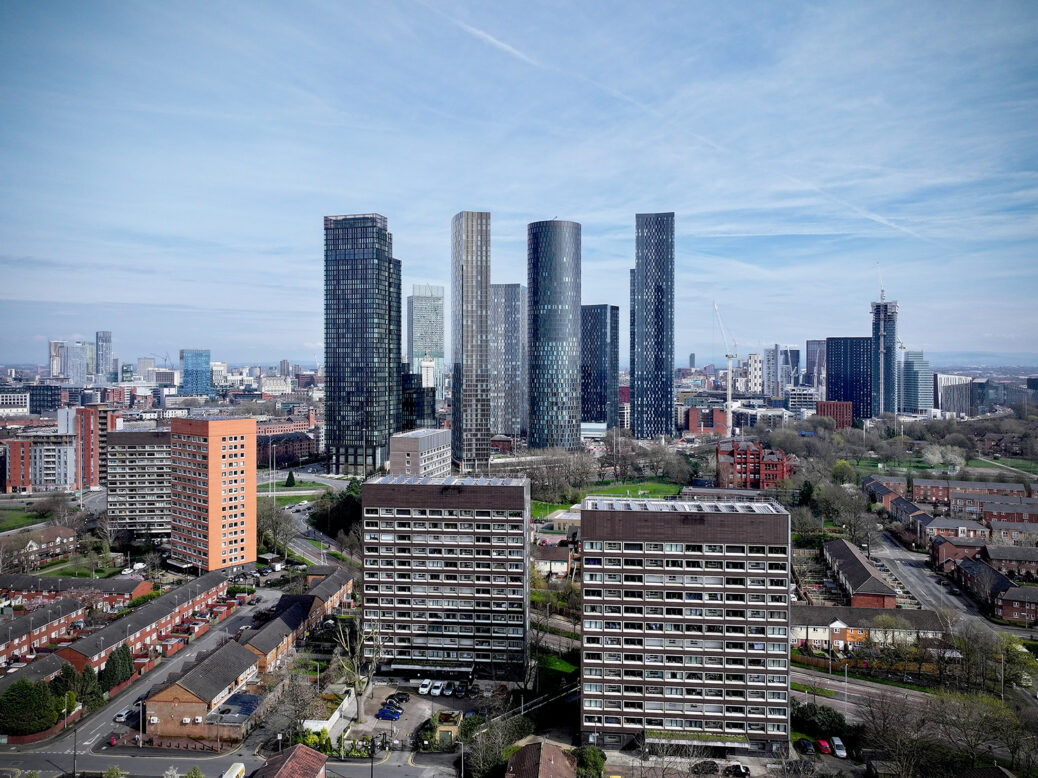
“I knew in my heart politics in this country had to change. And that’s what I came back here to do. And that…” says Andy Burnham in his campaign launch video, taking in the surroundings of Manchester’s St Peters’ Square, the yellow trams and, in the distance, the gleaming glass of Renaker’s skyscrapers, “… is exactly what we have done. Working side-by-side with business we’ve built the country’s fastest growing economy. Manchesterism is the end of neoliberalism.”
Since speculation began that Andy Burnham would seek a route back to parliament, the term “Manchesterism” has come to be used to frame his future, and apparently radical, political programme. In January Burnham described it as a “modern and functional response to the high inequality, low-growth trap that came from the 1980s drive to privatise economic power and overcentralise political power in the Treasury”. Drawing on his record in office as mayor, in particular his signature policy of bus re-regulation, “Manchesterism” is being explicitly framed as a repudiation of 40 years of economic policy since Margaret Thatcher.
Building on this, Mathew Lawrence has described “Manchesterism” as concerned with the construction of the “Productive State”, the investment of “public assets for public provision of the essentials required for a dignified life”. This platform admittedly feels not too dissimilar from the range proposed by the pro-public ownership left over the last decade, except today it is Greater Manchester that is being held up as the model. “The most advanced practical demonstration of this approach in Britain today,” Lawrence claims, “is Andy Burnham’s Greater Manchester programme.”
In substantiating this claim, the re-regulation of the buses does a lot of heavy lifting. To be clear – this has undoubtedly been a good thing. Fares are cheaper and the system is more coordinated and reliable than when the bus network was run by competing private operators. But while this has been a marked improvement, it only takes the system to a level with that operated by TfL in London. Significantly, the buses are not publicly owned, just regulated by a more empowered public authority.
And the problem with holding up “Manchesterism” as a lesson in the power of public control is that this does not map onto the recent history of the city’s political economy. Instead, the actually existing Manchester model has been to use the state to de-risk profitability for a particular kind of rentier capitalism, in the aim of agglomeration. By leveraging its planning authority, public land assets and subsidies, Manchester has been able to create a real estate-led regeneration of the post-industrial city, repopulating the city centre and creating productivity gains in the urban core.
Yet the redevelopment of the regional core of Greater Manchester has not been an unmitigated good. Rent rises and demolition programmes in the inner city have driven displacement and unaffordability. The development has been uneven, with the regional core seeing productivity gains and the picture for the rest of the city-region far less rosy. And many of the productivity benefits have been captured by capital, not labour, absorbed by increasing rents.
“Manchesterism” is a contradiction. Rather the city representing a break with neoliberalism, Manchester appears in many ways to be an exemplar case. In the 19th century the Germans had a term for laissez-faire free trade liberalism. They called it Manchesterthum, or “Manchesterism” – the ideology of the factory owners and shopkeepers who ran the city in the interests of industrial capital. Far from a new vision of socialism, might today’s “Manchesterism” instead be a cousin of that ideology?
The roots of modern Manchester are contemporary with neoliberalism in Britain as a whole. In 1984 Manchester City Council was taken by the left, one of a wave of councils of the time that took a similar turn. The first three years of Graham Stringer’s leadership of the council (Stringer is now a Manchester MP) were spent in opposition to central government, a centrepiece of which was participation in the so-called “rate capping rebellion” of 1985, in which local councils refused to cut budgets in a bid to force the government to withdraw restrictions on councils’ spending powers. The defeat of that, and then, two years later, the third Thatcher election victory, foreclosed a strategy of opposition. In response to these defeats the council leadership came to accept it would have to work with the Thatcher government, and the politics it represented.
What followed was a remarkably successful embrace of the core principles of neoliberal urban governance. Partnerships with the private sector were sought, with control traded for investment. “Grant coalitions” were assembled to bid competitively against other cities, for central government and European investment. A network of “new Manchester Men”, a cross section of the local business and political elite, won bids for programmes such as the Central Manchester Development Corporation, the Hulme City Challenge and the development of the Metrolink tram system. The city embraced the politics of urban entrepreneurialism and deployed its cultural and sporting histories to sharpen its brand and attract investment. A “post-rave urban growth coalition” emerged, rapidly chronicling and mythologising the city’s cultural scene in films like 24 Hour Party People, adding to the momentum around this urban change. By the early 2000s, Richard Florida himself had bestowed his approval on Manchester’s embrace of the so-called “creative class”.
Out of this 1990s milieu were built the careers of two men who would have a critical role in shaping the trajectory of the city – Richard Leese and Howard Bernstein. Their joint leadership, as council leader and chief executive respectively, deepened the city’s embrace of private capital. This was accelerated in the aftermath of the 1996 IRA bomb, which saw the city centre rebuilt. The master planner, architect Ian Simpson, would go on to design most of the city’s skyscrapers. By 2001 around 10,000 people lived in the city centre, up from a few hundred in the 1980s. That decade saw branding rolled out such as Factory Records’ designer Peter Saville’s “Original Modern”; the 2002 Commonwealth Games and the regeneration of East Manchester, with the Millennium New Deal for Communities and Urban Splash clearing inner-city estates in Ancoats to make way for newbuild developments by “starchitects” such as Will Alsop. By the end of his time as prime minister, Tony Blair held Manchester up as an exemplar of New Labour’s urban agenda for Britain, praising the city’s pace.
The global financial crisis of 2008 threatened to blow the strategy off course. In response, the council doubled down. Planning policy was relaxed, in particular Section 106 levies on developers. Manchester City Council’s 2012 Local Plan lowered the target for affordable housing from 30 per cent to 20 per cent for all new developments, and included multiple clauses where developers could avoid making contributions in cases of “significant development proposals critical to economic growth”. Targets went unmet, with analysis over showing that only 2 per cent of all homes built in Manchester between 2012-2022 were for social rent.
Second, public-private partnerships were sought, whereby the council would dispose of its land assets and find private sources of capital – pension funds, sovereign wealth funds – to get projects off the ground. A notable example of this was the Manchester Life partnership with the Abu Dhabi United Group, which has seen ownership of sections of the city ceded to the investor, and the rents of city-centre tenants – around £10m per year – flowing offshore. Third, direct public subsidy was granted to developers. The Greater Manchester Combined Authority’s Housing Investment Fund (HIF), negotiated as part of the devolution package, was a £300m loan facility that was loaned to developers to plug liquidity gaps in their balance sheets. In the first round of loans in 2016, £167m was lent to five build-to-rent schemes, forms of rental accommodation owned and managed by institutional capital as a form of financial asset. A total of 3033 units or 67.7 per cent of the total units built in that round assisted by the HIF were build-to-rent.
Post-crash, international and institutional capital played a growing role in the Manchester property market, particularly with the proliferation of the build-to-rent model. For certain the local state has been highly interventionist, but it has not been one investing in the foundational or productive economy, rather one de-risking the conditions for private rent extraction.
Recent research by academics at the University of Sheffield has questioned the positive impacts of Greater Manchester’s rapid development. Framed as a “reappraisal” of agglomeration and supply-side urban development, their critical analysis of actually existing Manchesterism is essential reading. The paper critiques the idea that the impact of investment, productivity and population growth in the urban core is centrifugal – that it gradually trickles down into the periphery, an area, as it happens, that includes the Makerfield constituency. In contrast, they argue agglomeration is centripetal in character, pulling in skills, capital and resources into the urban core, hollowing out the peripheries, and leading to the productivity gains generated being captured through higher rent and funnelled out of the region. This, they argue, is primarily a development model for capital, not labour.
The same researchers analysed data on population growth and productivity for the ten boroughs of Greater Manchester. What emerges is a picture of undeniable growth in the regional core (Manchester, Salford) but low growth or even decline in the peripheral areas. Net population growth between 1981 and 2021 is below the British average in all boroughs aside from Manchester and Salford. Growth in outer boroughs such as Tameside (5.8 per cent), Wigan (0.8 per cent) and Bolton (0.1 per cent) remains modest-to-negligible, while other areas have seen a decline in economically active population, such as Bury (-0.1 per cent) and Rochdale (-4.3 per cent).
The analysis of gross value added per hour worked, once adjusted for inflation, shows a similar pattern. Between 2004 and 2022, Manchester and Salford have seen a growth of 12.6 per cent and 11.6 per cent respectively, while areas like Stockport (2.6 per cent growth) and Oldham (5.7 per cent growth) have experienced very low growth. Trafford (-2.5 per cent) and Bury (-8.2 per cent) have seen decline. This is a picture of very uneven development. Some areas have continued to decline, the result of ongoing deindustrialisation. The development of Greater Manchester appears to be primarily the creation of a high-wage, skilled job “new town” of nearly 100,000 people at the centre of what remains a deindustrialised region.
The report also analyses who is capturing the value from increased productivity in the core. Noting that Manchester and Salford both have more renters, and that rent is higher in these areas than elsewhere in the conurbation, it analyses net household income after housing costs have been subtracted. What it shows is that real household net income in the core is lower than in some outlying towns, despite gross income being higher, implying that productivity gains generated by the agglomeration effects in Manchester are captured by rent and sucked out of the region. In short, they are captured by property investors and landlords not by households.
This picture of the development of Manchester and the wider city-region over the past 40 years is, as others have commented, clearly a bigger story than the nine-year mayoralty of Andy Burnham. Indeed, the devolution deal – including bus re-regulation – negotiated in 2014 by Leese and Bernstein was conceived of within the framework of accelerating the dynamics of agglomeration. Coming at the time of the Northern Powerhouse agenda, the plan was that the mayoralty and expanded powers for the Combined Authority would strengthen the economic model of inward investment and property-led regeneration.
Burnham’s mayoralty didn’t neatly map onto this plan. During his election in 2017 the city’s housing crisis became a major political issue. Street homelessness was highly visible, and in the context of a boom in cranes and construction across the city centre, the contradictions were glaring. These issues came to a head at a public hustings in April 2017, organised in Salford by the city’s housing movement, which Burnham described as “the most explosive I’ve ever seen”. Reflecting on it later he said, “there was an anger about housing policy in Greater Manchester and a sense that Greater Manchester hasn’t been focused enough on affordable housing. I agree, and that’s got to change. There’s cranes in the sky building luxury apartments while the numbers in the doorways are going up all the time.”
This seemed to move Burnham to a critical position towards the trajectory the city was on. He pledged to end street homelessness by 2020, called for increased emphasis on social housing and argued that the economic model of the city region ought to be rebalanced towards the peripheries. His election disrupted the status quo within the city’s leadership, causing tensions to emerge between Burnham at the Greater Manchester Combined Authority (GMCA) and Leese at the Town Hall. Burnham’s “A Bed Every Night” scheme, as has been documented, was initially successful in reducing the number of street homeless, but the impact of the pandemic and cost of living pressures since (including runaway rents) have served to undo much of the early progress.
Early hopes that Burnham might make a sustained challenge to the developer-led economic model of Manchester faded in the 2020s. The example of the Greater Manchester Land Commission serves to underline this. In 2021, shortly after his second election as mayor, there was a grassroots push from over 60 civil society organisations calling on Burnham to implement a Land Commission modelled on the lines of the one that Steve Rotherham had launched in Liverpool the year before. The Liverpool Commission had sought to review the use of public land to promote Community Wealth Building, rather than de-risk private development. A Commission was ultimately formed in Greater Manchester, but rather than the public land assets being used as a way for the state to support alternative models of ownership and economic development, it rather serves to coordinate land assembly for private development.
The clearest example however that the GMCA has ultimately reinforced, not challenged, the economic model that had been pioneered by Manchester City Council since the 1980s has been the use of loans from the Housing Investment Fund. The majority of the first round of this fund, approved before Burnham’s election, went to build-to-rent developments in the regional core. Since then, the pattern has continued, with the fund continuing to support developers such as Renaker, the firm responsible for much of the recent high-value skyscraper development in the city. Earlier this year, the GMCA published a report that reviewed the impact of the fund over an 11-year period. It revealed that between 2015 and 2024, the fund invested £983m in loans into Manchester’s property sector. Two thirds were invested within the Manchester City Council area, while more than half of that amount – over £500m – was lent to Renaker alone. None of the housing delivered by Renaker has been affordable. Across the near 11,000 units supported by the HIF, only 503 – under 5 per cent – have been classed as affordable. Given the fund was never designed to fund affordable housing, these small numbers represent a small shift in approach under Burnham, but in the last analysis the main function of the fund to de-risk private high-end development remains intact.
If we are, like the architectural historian Manfredo Tafuri, to understand skyscrapers as “real live ‘bombs’ with chain effects, destined to explode the entire real estate market”, then the GMCA-backed fund has been one of the principle financial aids to the bombardment of Manchester over the last decade. The role this fund plays in de-risking private development and rent-seeking continues. This month the fund approved a loan of £50m to Salboy, a developer co-founded by Betfred billionaire Fred Done, to ease their plans for a 246m-tall skyscraper. The ripple effect of all this development has been rising rents – up 40 per cent in Manchester in the last three years – and ultimately displacement from the inner city.
“Manchesterism is working,” Burnham and, in a sense, he is right, but perhaps not in the way he wants us to think. Reflecting on recent research from Centre for Cities that showed Manchester coming top for decline in inner-city deprivation, Burnham tried to link the figures to his policy agenda. Yet here lies the contradiction. These findings are consistent with the picture of indirect and direct displacement in the inner city laid out in the Sheffield report. The idea, presented by Burnham in his leadership pitch, and by policy outriders such as the pressure group Mainstream’s upcoming report, that “Manchesterism” represents a repudiation of neoliberalism, seems at total odds to the real trajectory of Greater Manchester over the last four decades.
What emerges once one considers this history is a picture of an active and engaged local state, but one that has used its powers not to kickstart a productive economy through expanding public ownership of the foundational economy but one that has used its powers over land, planning and financial loan-stock to de-risk the conditions for private rent seeking. The state has been used to facilitate private accumulation by dispossession. Greater Manchester, far from representing a story of a dynamic break with the neoliberal consensus, instead represents a crystallisation of it.
The role of Burnham’s mayoralty within this has been contradictory – at times calling out its excesses and seeking to redress them, at other times basking in the glow of a real estate boom. He, and the policy makers that have clustered around him, may be sincere in their desire to now move Britain out of its neoliberal period. But that won’t happen without a sober assessment of what has happened in Manchester, and any definition of Manchesterism that derives from it.
Isaac Rose is a writer and organiser living in Manchester and author of The Rentier City: Manchester and the making of the neoliberal metropolis (Repeater, 2024).
[Further reading: The limits of Andy Burnham]
Content from our partners



Related