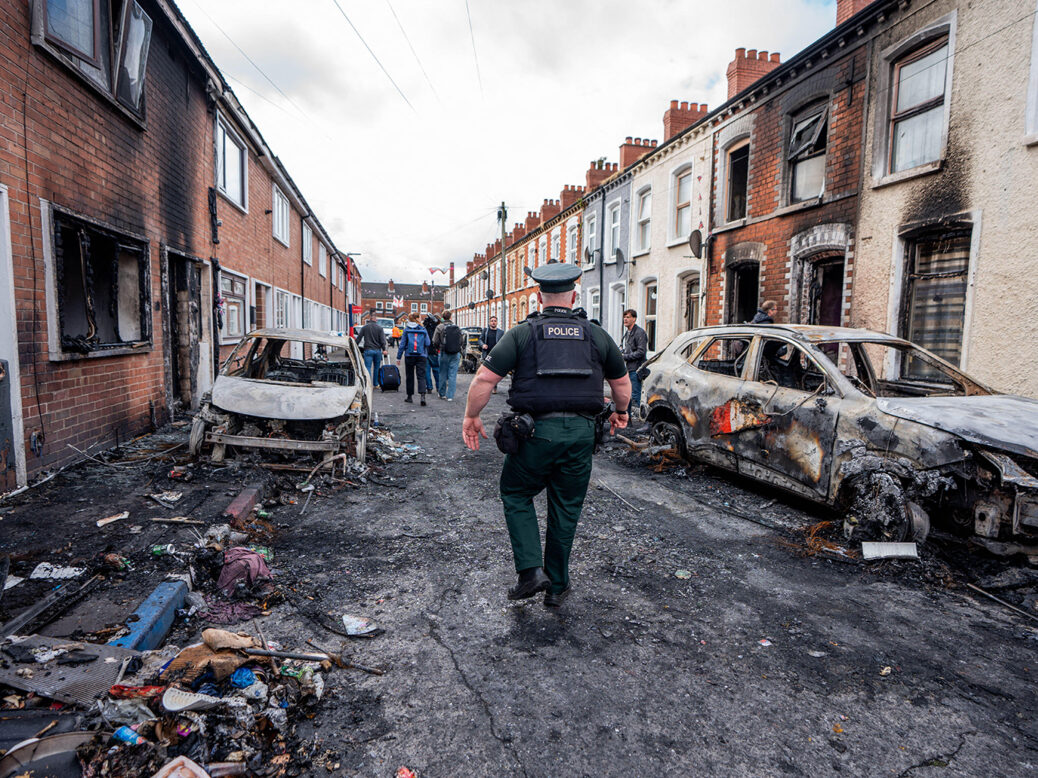
Several nights in a row of disorder and violence. Untold damage to buildings, cars, buses and infrastructure. Twelve injured police officers. Dozens of shops, stalls and businesses belonging to migrants or non-white owners, attacked and burned. Live footage, taken from helicopters, of people being chased from their homes. A two-month-old baby rescued by police as masked thugs go door to door ousting any foreigners they can find, leaving at least 27 people homeless. A nurse “of a different skin colour” chased by masked men into the hospital in which she was shortly to begin her shift.
The past few nights in Belfast have been depressing and terrifying in equal measure, and many are asking just how we got here. Most answers to this question have begun with the appalling act of violence allegedly committed by a Sudanese national on Belfast man Steven Ogilvie. It’s certainly true that this horrific crime has been used by protesters as a rallying cry, just as other heinous acts have been cited as trigger-points by far-right thugs from Ballymena and Dublin to Southport – in each case, directly against the wishes of the victim’s family. It’s just that, as a way of explaining everything that’s come since, it falls far short of coherence. It is asinine to take the far-right’s word for it when they claim an alleged crime by a single Sudanese man justifies, or even credibly explains, carrying out a pogrom against every migrant or non-white person they can find. So, too, is it demeaning to have to point out the lack of uproar evoked by innumerable, equally senseless, acts of violence carried out by local people, not least the campaign of wanton destruction the rioters themselves have engaged in over the past few nights.
Some prefer to step two degrees away from the above conclusion, blaming the violence not on one discrete crime, but rather on long-simmering discontent about “unfettered immigration”, to use the words offered by loyalist MP Jim Allister, in the wake of last year’s Ballymena riots. Such riots are appalling, the argument goes, but their anger reflects a legitimate concern; that immigration has simply gone too far.
Again, we risk demeaning ourselves by pointing out that rates of migration into Northern Ireland have never been connected to any rise in crime, and represent a tremendous benefit to the economy, from workers in hospitality and agri-business sectors to manufacturing and academia. Migrants are most beneficial in the health and care sectors, with 22 per cent of carers in the state coming from outside the UK and Ireland, without whom Tracey Reid, chief executive of the Northern Ireland Social Care Council, says the sector “could not survive”. Such statistics are, of course, broadly similar throughout the UK and Ireland, and were regarded as truisms until it became seemingly gauche for any prominent newspaper or politician to repeat them, in favour of contorting gymnastically to flatter the perceptions and prejudices of those who just hate migrants for entirely racist reasons. No matter how much they contribute to society, and no matter how few of them there are.
A compelling argument that this is the case can be found in the demographics of Northern Ireland itself. Its current population is just shy of two million. According to the most recent figures available, net migration in the state between 2001 and 2023 amounted to around 62,000 people, including less than 2,400 refugees in secure accommodation. Ballymena, which until this week had been the most prominent site of anti-immigrant violence in the state, sits in the Mid and East Antrim council area, which has seen fewer than 5,000 international migrants settle there this century. Only 3 per cent of Northern Ireland’s population belong to any ethnic minority at all.
For those of us who find the constant discussion of “the immigration problem” dehumanising and dishonest in any context, it’s revealing to see it deployed in places where immigration barely exists, not least for what it might suggest about such legitimate concerns everywhere else. We are left to presume that any number of non-white faces, no matter how few, is a salient enough horror for locals that their concerns become legitimised automatically. Even one, it would seem, is one too many.
It’s true that virulently anti-immigrant rhetoric on social media has seen a vigorous uptick in recent years. Much ire can, and should, be heaped specifically on Elon Musk. While he deserves contempt for allowing racist narratives to proliferate on his platform, and amplifying them, he’s gamely aided by the many more moderate and sensible people who have refused to offer his world view any meaningful challenge, as illustrated by the BBC News website heading its rolling coverage of three nights of rioting with the words “Belfast Knife Attack Latest”. And while Hillary Benn might be offered some mild praise for calling out the racism of the rioters this week, we should also note that his government’s most notable official response has been Thursday’s pledge to crack down on illegal immigration into Northern Ireland.
Most confusing of all has been the near-total absence of any context regarding who, exactly, is committing all this violence. The reluctance among media outlets to specify that these pogroms are the work of far-right loyalist gangs is particularly odd, given that such groups are fond of signing their work. The LVF, and associated gangs, have for decades sprayed their tags on the houses of the people they burn out, whether Catholics, economic migrants or refugees. Even now their graffiti proudly adorns walls and estates, demanding they be reserved for “locals only”. I’m old enough to remember when the LVF attacked the specially modified home of a severely disabled child because his family was insufficiently Protestant. I’m old enough to remember it because it happened less than two years ago.
When loyalist gangs burned Catholic families out of their homes in past years, there were few stern and sombre pleas that we should understand the arsonists’ concerns. Nor was there a reflexive jolt to place such acts in a context the perpetrators themselves might have liked, perhaps by drawing direct links between their violent acts and the existence of alleged crimes committed by disconnected Catholics many miles away. That this same logic is no longer applied to vast acts of violence against dozens of non-white people of all nationalities in Belfast, purportedly due to the actions of a single man from Sudan, is as preposterous as it is repulsive.
Their targets have changed, and social media has doubtless modernised their methods, but this is a story of a hardcore loyalist element which has stewed for decades in far-right ideology, newly emboldened at a time when the sensible moderates have abandoned any attempt to tell them they might be bigots. The same old cohort, in the same old places, who long ago calcified their repulsion toward “non-local” Catholics into active and proudly professed racism.
So, how did we get here? I’m not sure we ever left.
[Further reading: Belfast’s violence, Britain’s rage]
Content from our partners


Related