At 10.30pm on Monday night, a man was filmed attempting to decapitate a 40-year-old Northern Irish man on the streets of North Belfast. On Tuesday, a 30-year-old Sudanese immigrant was charged with attempted murder. Not much else is known of the incident, but that blurry video was sufficient: an attack of the most visceral nature, by an immigrant, against a local, flung into the world via Telegram, X and Facebook.
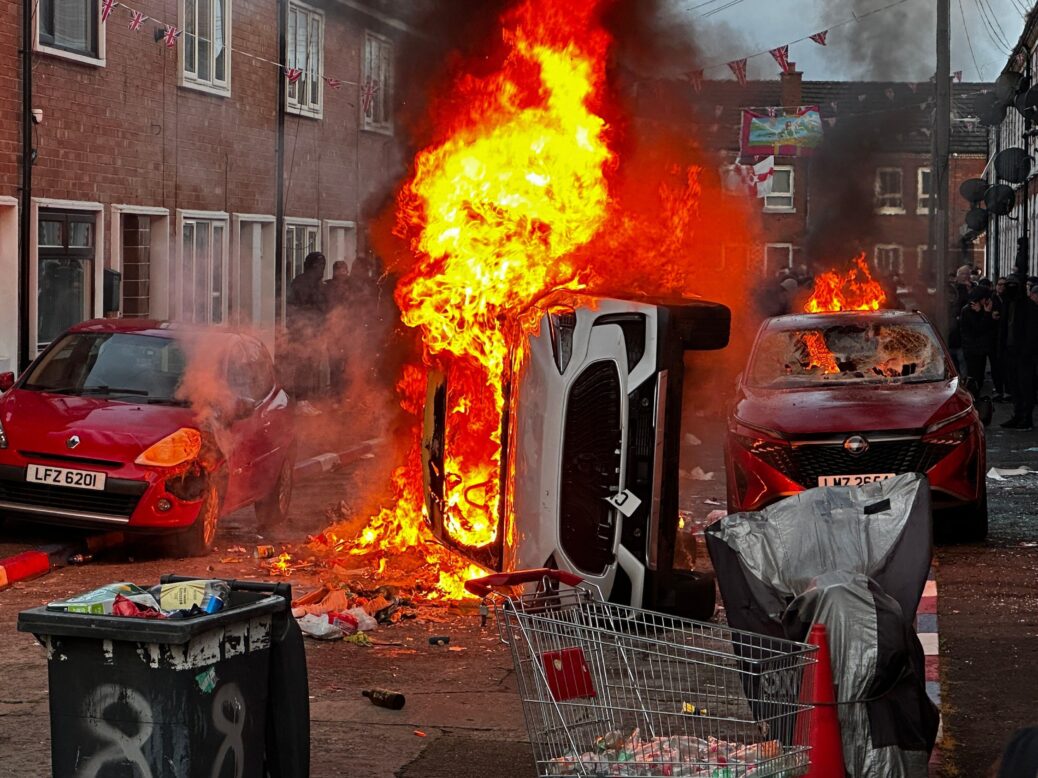
By evening, houses, cars and buses had been set alight by protestors; the familiar chant “foreigners out” rang through the streets, according to several reports; near the burnt carcass of one bus, graffiti read “fuck Islam”; the leader of the Social Democratic & Labour Party described the events as a “race-based pogrom” on the BBC. Near Belfast, there were protests in Antrim, Bangor and Ballymena. In England, protests formed on the streets of Southampton too – which just last week saw the same, in response to the death of Henry Nowak.
There is a dark, poetic symmetry: On 9 June 2025, precisely one year ago, the streets of Ballymena (about 28 miles from Belfast) were mobbed and set ablaze for two days. This time, the preceding incident was the court appearance of two Roma boys, accused of attempted rape of a minor. It started – as it so often does – as a peaceful vigil that quickly descended into petrol bombs and brick missiles. Protestors were dispersed with a water cannon – the PSNI has long known how to use them.
In 1998, the Good Friday Agreement provided Northern Ireland with an imperfect resolution to the decades of violence euphemistically dubbed “The Troubles” – but it was unable to stem a series of Republican-Loyalist clashes and attacks on police services in the succeeding years (in 2001, 2005, 2011, 2012, 2018 et al). No piece of paper could exorcise all that sectarian angst, and Northern Ireland transformed into a region clinging on to fragile and episodic peace, a long way off true reconciliation.
But this is a new type of civil disobedience for the province – born out of the inchoate anti-immigration feeling spreading across England and the Republic of Ireland too. The anxieties of the Falls Road and the contours of the Shankill are, perhaps for the first time in a long time, not features of a particular Northern Irish rage. No, that has been traded in, for now, for a more straightforward form of ethnic conflict.
The sectarian angst of Northern Ireland was always local to the region, and alien to the sensibilities of England. But last night was a familiar scene to anyone on these islands, as Northern Ireland, the Republic of Ireland and England have come to resemble each other – each with their own nativist force, each railing against immigration.
Dublin’s “Ireland is Full” riots came after an Algerian-born naturalised citizen stabbed schoolchildren in 2023; just like the Southport riots in the wake of the stabbing and murder of girls at a Taylor Swift dance class in 2024. In the Republic there have been semi-regular arson attempts on asylum centres; last autumn young men on horses charged police officers during a protest outside an asylum hotel in West Dublin, who responded with pepper spray.
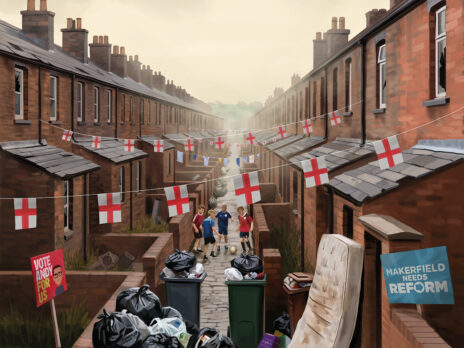
No, far from local, this civil unrest is symbiotic: what happened in Dublin in 2023 precipitated England’s summer of 2024, which in turn saw solidarity marches in Belfast. And those Belfast protestors were joined by angry nativists who had travelled north from the Republic. Outside Belfast City Hall in August of that year, tricolours were mixed in with Union Jacks, in relative harmony – an unusual scene in these parts at least. In Northern Ireland, glibly put, flags have always been potent symbols. In England, Operation Raise the Colours in 2025 borrowed the sensibility and saw St George’s crosses strung up in regional towns and in leafy enclaves of the capital city alike. Tommy Robinson from Luton encourages men from Belfast to “not make peace with evil.”
This is, first, a small but furious civil uprising against immigration. Ireland’s demographic change has been precipitous: in April 2023 immigration reached a 16-year-high of 141,600; one poll conducted that summer by the Business Post/Red C found that 75 per cent of people believed Ireland was accepting too many refugees; in the shadows of the Grand Canal Dock – Ireland’s Silicon Valley – there were until recently rows upon rows of young asylum seekers camped out in tents.
In Belfast, like in the Republic, a housing crisis has met increased immigration and created a tinderbox. In England, the Boriswave, asylum hotels, the X accounts chronicling every instance of urban decay, have tumbled into one throbbing ball of energy. When Nigel Farage said last year that no one realised how close the country was to civil disobedience “on a vast scale”, perhaps he was right, though, it is important to say, we are not there yet. Rioting is now regular, but it is not – yet – widespread.
More than anywhere, Northern Ireland should have a readymade rhetorical framework to describe ethnic conflict, though its establishment was quick to try to deflect the crisis elsewhere. “The horrific scenes in North Belfast should not be used by the English, right-wing politicians to further their own end” said one centrist Northern Irish MP; “This has nothing to do with community” said Michelle O’Neill, the First Minister. Meanwhile, the burning cars of the previous night’s pogrom continued to smoulder.
Ireland – North and South – is unique in its absence of a coherent political force on the right to channel all this energy at the ballot box. Sinn Féin has long departed from its republican, working-class roots – embracing the liberalism of its political rivals in the Republic, at least. Without anyone to ventriloquise the rage, protesters on the island will keep searching for political expression they can’t find in the mainstream – for now, in stochastic, sporadic episodes of pitchfork-wielding on the streets.
But one thing is clear – moments of extreme violence, like the attempted beheading in North Belfast on Monday night or the Southport stabbings – are having a flattening effect. England is not just transforming into a flag-wielding, rioting nation, but Northern Ireland looks like England in its own ways too. A burnt-out bus in Dublin looks remarkably like a burnt-out bus in Belfast. For the first time in its existence, Northern Ireland may be parsable to an England that has long found it alien, weird and foreign.
In 1968, facing profound civil unrest, Prime Minister of Northern Ireland Captain Terence O’Neill remonstrated the state with a BBC address. “But this I say to all Protestant or Roman Catholic, Unionist or Nationalist: Disorder must now cease”. “What kind of Ulster do you want?” he asked, “a place continually torn apart by riot and demonstrations?” Call his statement plangent, irascible, defiant, exasperated – a direct precursor to the Troubles, perhaps. Whatever it was, it was futile.
Three decades of the Troubles later, followed by more years of mob skirmishes, Northern Ireland is still a place apart, marked by riots and demonstrations of a sort not seen elsewhere on these islands. And yet it is connected now, too, bound to north and south, east and west, by the new atavistic rage of our time.
[Further reading: Will Henry Nowak’s death lead to a summer of disorder?]
Content from our partners


Related