Danny Bones is doing rather well for a young, white, working-class rapper. Last time I checked, his top track sat close to 500,000 Spotify streams, with 29,000 monthly listeners, and the clips had collectively been viewed nearly three million times across TikTok, YouTube Shorts and Instagram Reels.
The main issue I have with Danny Bones, though, is that Danny Bones doesn’t exist. Danny Bones is an AI character created by an opaque outfit called the Node Project, which used artificial intelligence to build the ideal scrappy, authentic white “lad” rapper. He was designed in the knowledge that he would come across as more trustworthy to this audience than a politician or a mainstream news outlet would, giving their grievances a face, a beat and a working-class voice. The far right can still take to the streets, as we’ve seen once again with the unrest in Belfast. But it’s also finding new and insidious ways to draw attention to itself.
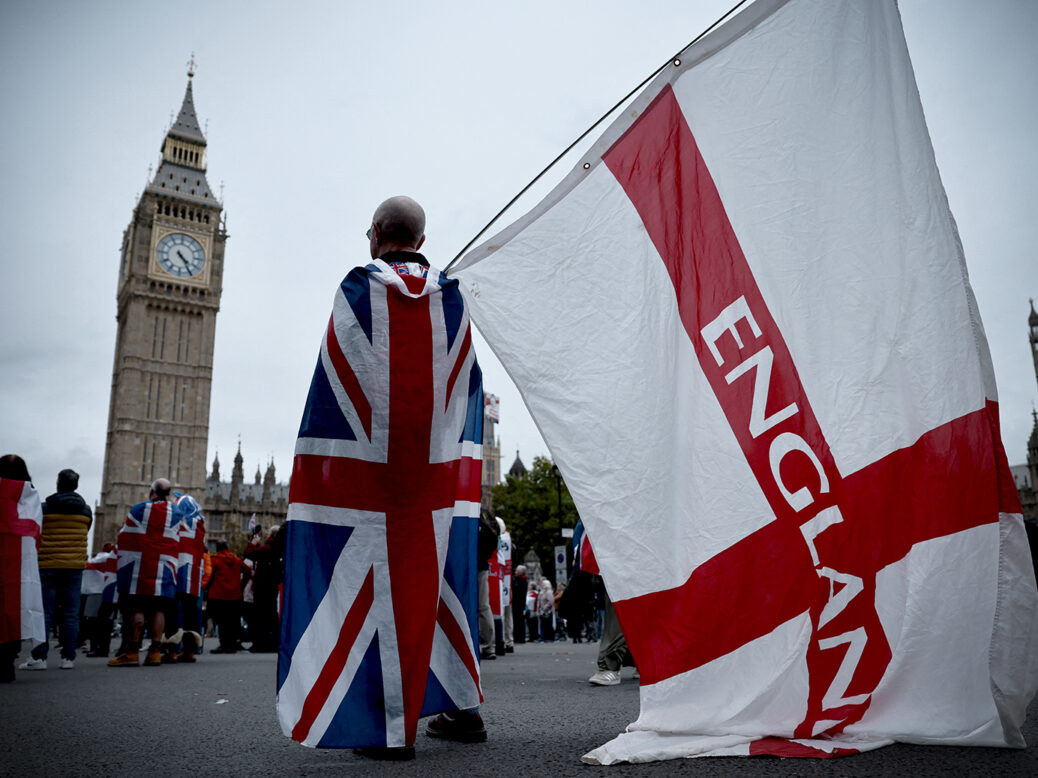
So what does an imaginary man stand for? Bones raps about immigration, national decline and a Britain he says has been handed away by its own leaders. In his most streamed track, “This Is England”, he leads a crowd of men carrying St George’s Crosses, fists in the air. In another, he wears black fatigues with “Mass deportation unit” across the back. In a third, an Asian man says, “We are here,” and Bones replies, “Not for long.” The targets are the predictable ones: migrants, Muslims and the supposed managed decline of white men. Annoyingly, the tracks are slicker than most AI music, the videos glossy enough to catch the eye; Danny himself has been carefully constructed, with credible imperfections. (Acne scars? Or street-fighting bottle scars? Hard to tell.)
He is also, it turns out, available for hire. As the Bureau of Investigative Journalism revealed, the Node Project was paid by Advance UK – Ben Habib’s party, pitched ever so slightly to the right of Reform – to produce a video for the Gorton and Denton by-election. A montage of Anglo-Saxon warriors, Second World War nostalgia-bait, combined with the Beatles on the Abbey Road crossing under the slogan “a culture worth defending”, the video was watched around a quarter of a million times. Is this the first time a registered British political party has paid an AI influencer to make its campaign material? For all that, it didn’t really work. The Greens took Gorton and Denton, and Mr Bones spent the aftermath sulking that the winning campaign had “campaigned in Urdu and Bengali, not a Union Jack in sight”.
Nevertheless, welcome to the hate economy. Within hours of the Bureau’s exposé, the Node Project had monetised the coverage: a £100 “Founding Member” tier, a £20 tier, a donation link, and “YooKay”, a new and even more extreme track. Not to miss out on the fun, here comes the parade of crypto-speculators (unconnected to Node) to spin up a Danny Bones coin. Spotify confirmed the tracks were eligible to earn streaming royalties. Brilliantly, during all of this, Elon Musk’s AI engine Grok was advising X users that Danny Bones was “a real person – not AI”.
This week, Bones is campaigning in Makerfield. On this occasion, he’s come out for Rupert Lowe’s Restore Britain, posting videos that set a Champagne-swigging, elite sell-out Nigel Farage against a stern, no-nonsense Lowe – and, pleasingly enough, widening the split between Reform and Restore in the comments sections. Bones is cheap, though, and he is effective and fast – all those little pesky things those of us on the other side tend to struggle with. But we have one thing he doesn’t: coherence. His talking points of flag nationalism, military deportation fantasies, and Second World War nostalgia montages are all undermined by the contradictory aesthetics the AI has chosen for him.
The Node Project’s AI constructed a perfect form of a far-right rapper, but every musical style it selected for its Übermensch is brilliantly international, exhilaratingly mixed heritage and – where it counts – historically anti-fascist. It selected sub-par breakbeat drum-and-bass (a genre built from Jamaican soundsystem culture and black British innovation), a stab at UK drill posturing (again, a black, diasporic youth movement), then a fleeting visit to CBGB and the Roxy to pick up some punk credentials (if only Joe Strummer and Poly Styrene could witness it). Put a gun to my head and make me pick a single favourite Danny Bones video? Has to be the one where he lists Britain’s “good eras”: a found-footage montage of D-Day (an international coalition assembled to defeat fascism), mods (whose sound came straight from black American R&B, soul and even Jamaican bluebeat), punks (Buzzcocks: “Ever fallen in love with someone you shouldn’t’ve fallen in love with?”), acid house and pirate radio – a line-up of some of the most multicultural, internationally rooted movements the UK has produced, most of them vocally anti-racist.
It seems that every musical reference the AI reached for to build its pinnacle right-winger comes from a record collection generously gifted to it by Britain’s borrowed inheritance. The Node Project has assembled Danny Bones from exactly the lineage and pedigree a real Danny Bones would, in fact, despise, fear and seek to deport. He is built from the very culture he claims to be defending Britain against. The Node Project may very well have unwittingly created the finest distillation of 50 years of British culture we’ve ever heard. Change the lyrics and let’s see. The music a real Danny Bones would make would be plainsong, crumhorn and sackbut, close-harmony male-voice choirs, a pipe and tabor, and a sheep’s horn blown belligerently into a dark wood at night.
Unfortunately, these mental gymnastics don’t seem to matter much. A recent analysis of the 2025 German and Dutch elections found that the emotional impact of AI content persists even when people correctly identify it as AI generated, even with a transparency label attached. You can know the video is fake and still feel exactly what it was built to make you feel. Credibility and coherence aren’t really the point of a six-second vertical TikTok video, though. Repetition, gut feeling and emotional reaction do the work that used to take far longer. This is the slop paradox Danny’s overlords are playing on: the content doesn’t need to be believed to work, and now that the barrier to entry has collapsed, the zone can be flooded. The Bureau of Investigative Journalism knocked up stylistically similar tracks in minutes using off-the-shelf tools. What used to take months now takes an afternoon.
The whole Danny Bones project is generative AI in miniature, a working example of the pitfalls of context-free association. It assembles fragments it does not understand into an object that, at first glance, looks useful but is, on closer inspection, the wrong thing entirely to quite an astonishing degree: diaspora music wrapped around a nationalist avatar. The AI has no concept of what an Amen break, Sleng Teng or a “Funky Drummer” beat means; it does not understand 808s, 1210s, Telecasters or theremins, only that the engagement historically associated with these ones and zeros is likely to be high. That blindness to meaning is how these models work, and it runs through almost everything users ask AI to assemble for them.
Only an AI would have the effrontery to build a white nationalist persona entirely out of black, international, anti-fascist culture. Every genre the Node Project co-opts is the culture it claims Britain needs defending from. Take a peek up Danny’s skirt, and you’ll find a messy junk of half-formed ideas, incoherent associations and imperfect memories, all packaged up under a shiny fake fur coat. When I was organising for Love Music Hate Racism, the neo-Nazi group Blood & Honour would come and find us in the streets. Now they just need a 20-quid AI subscription and a half-decent phone.
Ned Mendez is head of research, insights and counter-disinformation at 411. Previously, he was a national organiser for Love Music Hate Racism. He writes the weekly End Hits newsletter on AI, politics and the infrastructure of deception.
[Further reading: Belfast’s violence, Britain’s rage]
Content from our partners



Related