
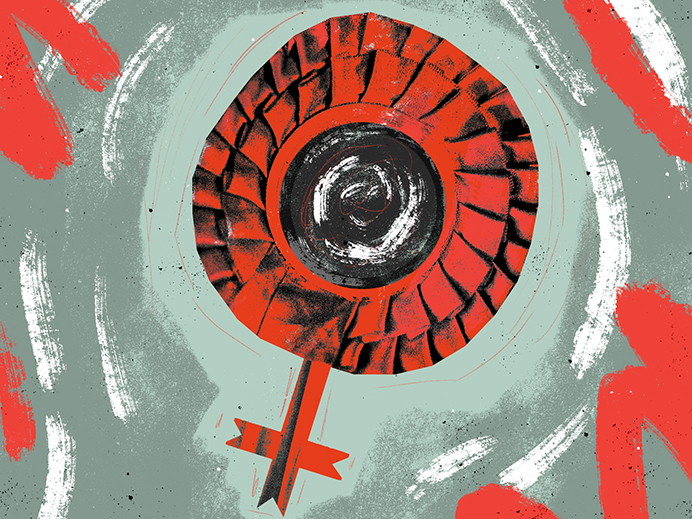
Labour has never, in its 126-year history, had a woman leader. The Conservatives are on their fourth elected female leader, and Labour hasn’t managed one. And it’s happening again, as the party changes leader in slow motion. For all of the insistence since Keir Starmer’s election that next time it will have to be a woman, the shadow contest is emerging, and the frontrunner (Andy Burnham), the other challenger (Wes Streeting), the incumbent (Starmer) and the wild card (Al Carns) are men. In exasperation at this state of affairs, last week a senior Labour figure pulled Bridget Phillipson to one side and told her to stand if there is a contest.
I’ll come back to Phillipson shortly. But first, why did this senior figure intervene? Many in the Labour Party pay lip service to the importance of having a woman leader “soon” or “next time”, or acknowledge it is overdue and an embarrassment for the party. But they, ultimately, are supporting their man – Starmer, Streeting or Burnham – in the belief he is the best candidate this time. Many of Labour’s women fall into this category. But there is a significant contingent of Labour women and men who feel it isn’t good enough to defer the question, and they want to have the debate – and find the solution – now.
“Labour was the political wing of the women’s liberation movement,” a party veteran reminded me recently. Those with a keen sense of Labour’s history see their party, and their party alone, as the force that won many of the rights and liberties we now take for granted. Labour, they believe, dragged the Conservatives kicking and screaming into the future. “There was no consensus,” said the Labour veteran. “It was a sharp ideological divide that we had to navigate every day.” While the Conservatives worried about undermining family life and the role of the father in the household, and about encouraging waywardness if women could earn and contribute equally, Labour championed childcare as a public policy issue and legislated for equal pay in Barbara Castle’s Equal Pay Act in 1970. When Labour was struggling to ensure equal representation of women among its candidates in the 1990s, it used all-women shortlists and then again felt it had put the Conservatives to shame when hundreds of women were elected on the Labour benches.
Labour still congratulates itself today on being the party that champions equality, diversity and inclusively across class, race, gender and sexuality. It is painful, embarrassing and confronting to Labour’s sense of self that it looks at its talent every few years, asks who should lead and decides, without fail, that it should be a man. While some Labour figures speculate as to the cause (too many pints and football chat? The old boys’ trade union culture? Or plain old-fashioned structural misogyny that the men are unwilling to address?) a growing chunk of the Parliamentary Labour Party (PLP) and senior party figures want to stop talking about it and get on with fixing it.
There is certainly no shortage of senior Labour women. Until recently, Angela Rayner was seen as a shoo-in for the leadership if she ever stood. But many of her own natural supporters in the middle of the party have started to favour Burnham instead. Her tax affairs cast a shadow, but it goes deeper, appearing to be a question of character. “We have to be serious. Is she seriously someone we should make prime minister?” one figure who should, on paper, be a Rayner supporter remarked to me a few months ago, as the herd moved towards Burnham. Some Labour people compare Rayner to Boris Johnson; others say she would be their Liz Truss. Many are mistrustful of her partner, Sam Tarry, a former MP who hails from the left of the party.
Rayner is not oblivious to any of this and has not hidden her frustration when she is among friends. She is the former deputy prime minister, who delivered house-building reforms, the employment rights package, the minimum wage rise, renters’ rights reforms – many, if not most, of the things Labour is now pointing to as its most significant achievements in office. She tells allies she knows how to drive transformation, how to get the civil service to work for her. How, essentially, to wield power.
Rayner’s long-standing position is that she is not wedded to standing for the leadership and wouldn’t trigger a contest, but is prepared to put herself forward if required. Indeed, she deliberately delayed the announcement that she had been cleared over her tax affairs so that it could serve as a “warning shot” to Streeting that if he launched his own leadership challenge, she would be free to launch her own. She had no idea that Burnham would shortly afterwards announce his own plan to return to parliament – she was not told or involved. The story of Burnham’s return to parliament is also the story of Rayner – once dubbed the “Red Queen” – being quietly skipped over for the leadership of her party.
Labour women occupy the three great offices of state: the positions from which a new prime minister is often found. Shabana Mahmood, although widely admired, including by Burnham, is seen as too right-wing to succeed with Labour MPs or party members. Rachel Reeves’s allies appear focused on fighting a rearguard action to retain her position as Chancellor, arguing that only she can retain the confidence of the markets at a volatile time, and that keeping borrowing costs as low as possible will be fundamental to whatever any future leader would want to do with power. Yvette Cooper, meanwhile, is vastly experienced and seen as a potential “caretaker” leader.
Lucy Powell, Labour’s deputy leader, is a close ally of Burnham but could yet be encouraged to stand if things go awry for him in the Makerfield by-election.
But back to Phillipson. She is one of Starmer’s most loyal cabinet ministers, deeply worried about the public reaction to a leadership contest, or a very public bout of Labour introspection. It may be too late for that. But if a contest has to happen, allies are urging her to stand.
There’s a case for Phillipson that hasn’t been much heard: she delivers. Starmer singled her out for specific praise at a recent cabinet meeting in which he urged attendees to focus on delivering, whatever else is going on. Allies argue that against Labour’s manifesto targets, Phillipson has delivered more than anyone else in government. Beyond the manifesto, she was the key figure who pushed for the government’s decision to scrap the two-child benefit cap; she brought back maintenance grants; she has expanded free school meals to half a million more children. She also imposed VAT on private school fees, sparking loathing from the conservative right. Labour MPs say they like her because she gives them something to campaign on – breakfast clubs, free childcare – and because she takes the time to engage.
Phillipson is a rare consensus-builder across the fractious PLP. After months of fevered speculation as to whether her reforms to Send provision in schools would spark a major backbench rebellion, the announcement came and went with barely a peep, the product of months and months of engaging with Labour MPs of all traditions, along with the schools minister Georgia Gould. When the guidance on single-sex spaces came out on 21 May, again there was no public backlash from the Labour backbenches. “Even if the journalists haven’t noticed, the ministers have,” one supporter notes.
Now Pat McFadden’s team have sought her advice on engaging with the PLP as they prepare to roll out fresh welfare reforms. Phillipson’s team was recently invited to address “Spad School” to share their account of how they landed the Send reforms with the PLP (one attendee said it was “clearly” aimed at the Home Office, which has been struggling to achieve a similar reception on Shabana Mahmood’s immigration reforms). Phillipson is the only cabinet minister to have addressed the Socialist Campaign Group – the Corbynite grouping on the left of the party that is often dismissed by the Labour leadership. She received a warm reception from the Tribune Group. She has sometimes been inaccurately pigeonholed as a Blairite, but has confounded labels in government, instead proving herself to be genuinely respectful of diverse opinions from across the Labour Party, and a conviction politician rather than a third-way one.
The counterargument is clear: compared with Streeting and Burnham, two of Labour’s best communicators, Phillipson may lack the common touch and is often described as “robotic” in media appearances. She acknowledged in an interview with my colleague Pippa Bailey earlier this year that she “often get[s] written up as a rather joyless, serious figure” and that her public persona doesn’t match how she sees herself. She can have a laugh. But, as she told Pippa, she also resists the expectation that “women are expected to be smiley, happy, there to please people” in a way men aren’t. She charms many colleagues with the charisma of a thoughtful politician, while others worry she is simply too shy or would fail to connect with voters.
And yet Phillipson’s biggest obstacle to becoming leader is much simpler than that. “To say she isn’t plotting is an understatement,” one supporter says. She has been genuinely focused on the job of being Education Secretary, frustrated at certain colleagues who seem more focused on becoming prime minister rather than focusing on the current one. Many Labour members will see that as a virtue, but the unfortunate reality is that the contest has begun without her.
When the starting gun was sounded on the Labour leadership race in 2020, Lisa Nandy, Emily Thornberry and others found Keir Starmer was ahead of them even at the starting line, and they could never catch up. This time, Burnham and Streeting have let their intentions be known since late last year, and have been unapologetically planning ever since.
Maybe one simple lesson about Labour’s glass ceiling is that those who wait until a contest is triggered rarely catch up. And those who don’t wait are typically the men. If a Labour woman wants to smash the party’s glass ceiling, the best time to start would have been a year ago. The second best time is now.
[Further reading: Will Brexit ruin Andy Burnham’s campaign in Makerfield?]
Content from our partners


Related

This article appears in the 27 May 2026 issue of the New Statesman, What Britain won't face