
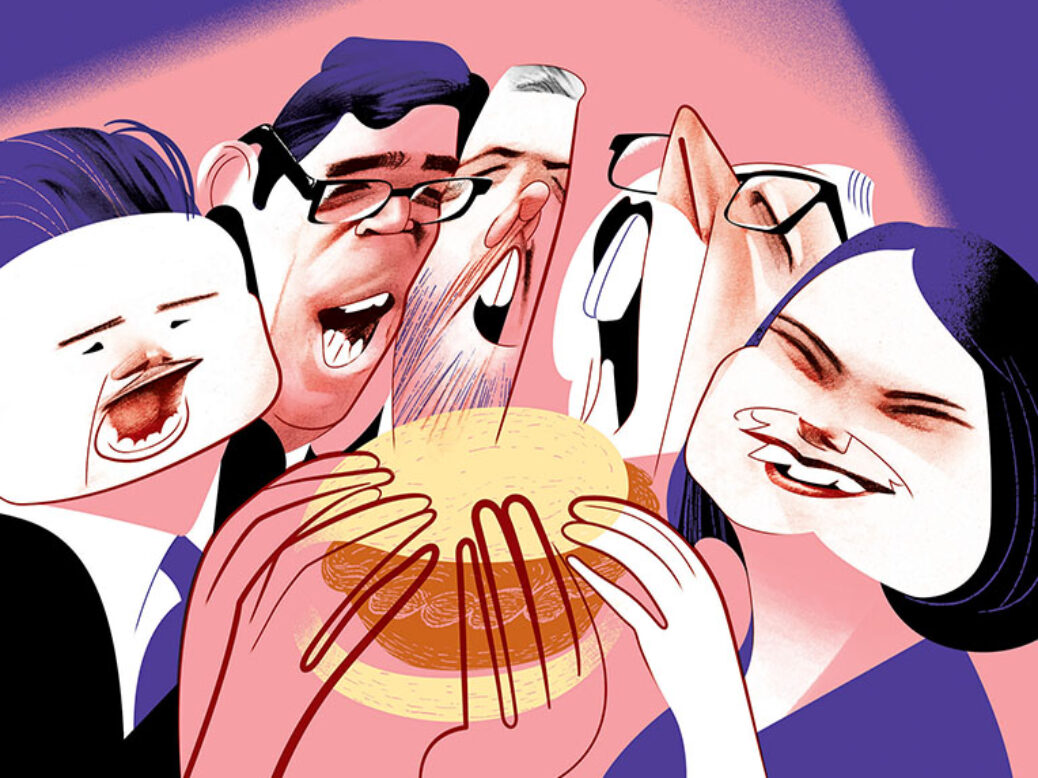
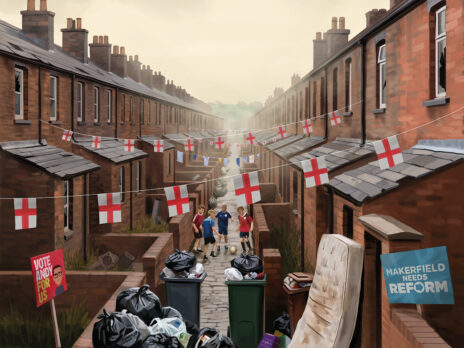
When a photographer is present, Nigel Farage will order a pint of ale, but in private the Reform leader drinks gin and tonic. Harold Wilson, who puffed on a pipe in public, was a cigar smoker behind closed doors. Since the Representation of the People Act 1918, the ruling class has been compelled to at least act as if it represents the people. And so if you are standing for the seat of Makerfield, you have to sound as if you are made of Makerfield: you have to talk, as Andy Burnham does, about where your kids went to skewel, to express dismay at the pot’oles in the roads. But as the televised debates for the Makerfield by-election have revealed, the other candidates are at least as Wigan as Burnham is – and maybe muhhr.
At the BBC’s by-election debate on 8 June, Burnham headed immediately for his safe place: the yellow Bee Network buses that have brought cheaper, more frequent transport to Greater Manchester, a change brought about not by spending more money but by exerting more state control. The wider problems of the state could be addressed in the same way, he thinks, giving as an example the disaster of our privatised water system. This, he said, is “a situation… exactly like buses in Greater Manchester when I came in as mayor”, although there is arguably an important difference in that you can suspend a bus service without everyone dying. Burnham wasn’t the only one who wanted greater state control of utilities. “We need to get drilling again in the North Sea,” said the Conservative candidate, Michael Winstanley, boldly ignoring the fact that no part of the Makerfield constituency is within 100 miles of the North Sea.
The Liberal Democrat candidate, Jake Austin, had his hair swept back and his eyebrows permanently raised, as if he’d just emerged from a heated argument in a wind tunnel. He had a question for Burnham: what if a Reform candidate becomes the next mayor of Greater Manchester? It’s a good point: in all the chat about Burnham’s opportunism, there hasn’t been much recognition of just how much he is gambling in Makerfield. There is a non-zero chance that he wins the seat but not the Labour leadership and spends three years on the back benches, watching both his party and his city being run into the ground.
Before that, though, he also runs the risk of being humiliated by Reform’s Rob Kenyon, who considers himself very much a Makerfield man, and who is a plumber, which worked for the Greens in Gorton and Denton. Kenyon’s Wigan accent is much stronger than Burnham’s woolyback lilt. Kenyon says things like, “I’d teck it on a ward-be-ward basis.” He had, he said, been “shopping at a certain German supermarket, beginning with A, all me life”. (Same: I fly to Berlin twice a week to shop at Alnatura, my favourite German eco-market, to stock up on organic Fischstäbchen and zwei-minuten-reis.) “I know how much things cost,” Kenyon added, with a real sense that this might be an achievement.
At intervals during the debate, the BBC showed short videos made by candidates who were too mad to allow into the studio. These included: an asthmatic libertarian in a luminous orange hoodie who believed that “the government has no right to infringe our freedoms” (counterpoint: yes it does, that’s what laws are); and an independent candidate who asked, “Why am I dressed as a fox?” – although he had to take off his fox mask to say this, which immediately defeated his argument; and Rebecca Shepherd from the far-right Restore Britain, who described herself as “not a career politician”.
In his campaign launch video and during the earlier Question Time debate on 4 June, Kenyon had also distanced himself from “career politicians” who do elitist things like going to university and learning about politics, then “get a job at a think tank or as an assistant to an MP” before becoming a candidate. “You can read a book about something but you don’t understand it until you actually do it,” he said, proudly affirming that he has not read a book and does not intend to. There is, obviously, no such thing as a “normal person”: everyone is different and this is a term used exclusively by mean, narrow-minded twats who want to imply that other people are abnormal. What these clowns are actually proposing is that people with zero qualifications should be allowed to win positions of political responsibility, because they don’t understand the job and have no interest in doing it properly. They think it’s a bad thing that a lot of people in British politics study the same thing at university. Wait until they find out how many people in British medicine did the same degree! Oh, we don’t want career doctors, we want normal people who have just decided they fancy having a go with a scalpel.
Is it normal to be Facebook friends, as Rob Kenyon was, with a well-known fascist who has dressed up in a fascist uniform? Do you know any normal people who have had their X account suspended? How normal is it to publicly defend another man’s right to send very explicit, sexually aggressive comments to Carol Vorderman? During both debates, Kenyon was asked by the only female candidate present (Sarah Wakefield of the Greens) if he’d like to apologise for doing just that; he declined both times, saying it happened a long time ago (it happened in 2021).
At last the host, the BBC’s Annabel Tiffin, asked the question that would sort the normal people from the career politicians: what is their favourite Wigan delicacy? The Lib Dems’ Austin made a strong start with a chunky steak pie. The Greens’ Wakefield ruled herself out by picking a hard-boiled mint, which, though made in Wigan, is just a mint. Now it was Burnham’s turn, and a hugely confident choice: a “babbie’s yed”, which sounds exotic but is just what Wigan chippies call a steak and kidney pudding, because they think it looks like a baby’s head (it doesn’t). So it’s a dish you can get anywhere, the same stodge you’ve been eating for years, just marketed with a northern accent. On second thought, this might not have been the best choice for Burnham.
For a moment Kenyon seems to have fumbled the all-important food round. He’s talking about a chunky steak pie, just copying the Lib Dem, but then he plays his trump card: he’s putting it in a barm! A pie sandwich! The fabled Wigan Kebab! He might actually have won this. Off camera, Burnham’s people are surely punching each other: a barm! Why didn’t Andy stipulate a fooking barm!
Last of all comes Winstanley. Is he Wigan enough to order a “smack barm pey wet”? This is a dish so performatively northern that it demands its own, conjunction-free language (conjunctions are too fancy for the likes of us, lad). It comprises a disc of battered potato in a bun covered in the watery dribble from some mushy peas (actual peas are too fancy for the likes of us, lad). Nope: Winstanley picks the same meat pie as the other men, with a mint for pudding, the most derivative possible choice. His political career lies in tatters, and deservedly so. And that’s it, the debate is over, and the audience has learned but one thing: none of these people are even remotely normal. But then again, who is?
[Further reading: The women standing by their XL Bullies]
Content from our partners
Related
This article appears in the 10 Jun 2026 issue of the New Statesman, How Britain lost control