The argument over whether the Green Party should stand a candidate in the upcoming Makerfield by-election intensified this weekend. On Sunday, a letter coordinated by the cross-party political organisation Compass, and signed by several senior Greens, urged the party not to run a full campaign in Makerfield.
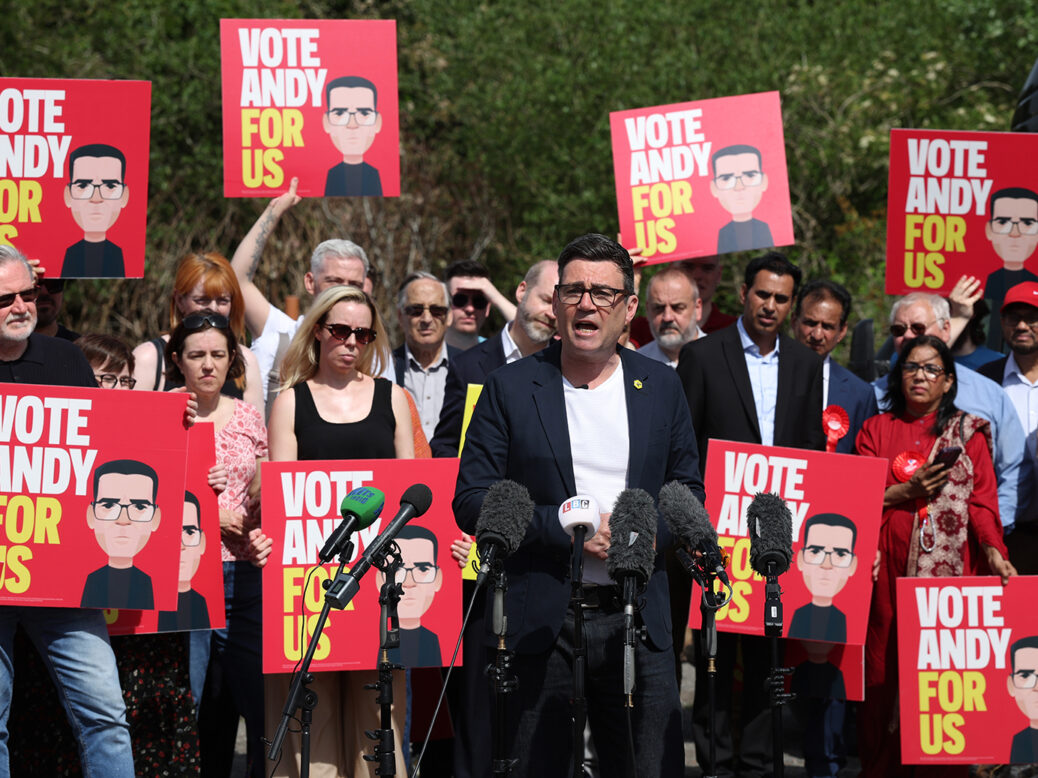
It said that if Andy Burnham “will commit to backing proportional representation (PR) for the next general Labour election manifesto so that it is in place by the election after next, then on this unique occasion we don’t think Greens should run a full campaign against him.” The letter was backed by the party’s former co-leader Jonathan Bartley, as well as long-standing Green figures such as Rupert Read.
(It is significant, too, that the letter was released via Compass. Both Caroline Lucas and Burnham are speaking at the organisation’s annual conference this weekend, while its founder, Neal Lawson, is an ally of the Manchester mayor.)
But the timing of the letter was odd. When it was released on Sunday evening, the Green Party had yet to select a new candidate after Chris Kennedy, the party’s original choice, dropped out on Thursday afternoon. (After the party initially said Kennedy had withdrawn for family reasons, it soon became apparent that offensive social media posts were behind the decision.)
With just over three weeks left until polling day, a new candidate, Sarah Wakefield, was announced this morning. The idea that the Greens could run a “full campaign” at this stage in the race, when the battle lines between Andy Burnham and Robert Kenyon have already been drawn, seems unlikely. Right now, there is little momentum behind the Green campaign in Makerfield – and with less than a month remaining, it is difficult to see that changing.
Wakefield was elected as a Green councillor on Manchester City Council less than three weeks ago. In a statement following her selection, she said: “We showed in Gorton and Denton we can take on and beat Reform,” before adding: “Don’t vote in anger, vote in hope.”
The choice of a candidate who was part of the party’s sweep of Manchester City Council wards is an interesting one. It suggests that the party’s model for winning is still very much based on the successful election of Hannah Spencer in February. But Makerfield is not Gorton and Denton. Its history, demographics and electoral trends are very different. It is clearly shaping up to be a straight Labour–Reform contest.
There is no clear sign that voters considering backing Wakefield would automatically switch to Labour were the party not to stand a candidate. Senior Greens – even those who have publicly argued for the party to run a full campaign – privately concede that they do not expect to win. They also hope to pressure Burnham on the introduction of proportional representation, but believe they are more likely to do so by running a public campaign that squeezes him from the left. “We’ll be asking which version of Andy Burnham is going to show up,” one party source told me. “We’ve not been impressed with what we’ve seen so far on public ownership, settled status, fiscal rules and PR.”
It is a significant indication of things to come that the party is now having these debates in public, rather than privately. This discussion was started, after all, by an intervention from the party’s former leader, Lucas, shortly after the by-election was called.
The Green Party, unlike the Labour Party, does not have a long history of factionalism. But the fact that senior Greens – many of whom do not come from Zack Polanski’s eco-populist tradition – are beginning to criticise the party’s new direction could signal the start of a broader public debate about who, and what, the Green Party is for.
This piece first appeared in the Morning Call newsletter; receive it every morning by subscribing on Substack
[Further reading: Andy Burnham is a Starmerite]
Content from our partners

Related