There are two broad schools of thought about what has gone wrong for Labour since the 2024 election. The first is that the premise of that election victory was all wrong: voters did not back Labour so much as they resoundingly rejected the Conservatives, with Labour as the default beneficiary. Since then the government has been far too focused on voters who never liked them all that much anyway, at the expense of Labour’s core supporters who want things a party chasing voters tempted by Reform and the Tories would never countenance – higher taxes on the wealthiest, a more open immigration policy, the rights of trans people to use the spaces and services they choose, rejoining the EU. If Labour is to get a new leader, that leader will only succeed by switching strategies and refocusing on the party’s base.
The second is that the failure is not about the message but the messenger. Keir Starmer is so disastrous at communicating what he is doing and why he has managed to alienate left and right alike. Success stories – like the fall in NHS waiting lists or, for a government that has focused so heavily on reducing immigration, the news last week that net migration has been virtually halved – get missed. No one feels like the prime minister “gets” them, or understand what his vision of Britain actually is. With a sharper communicator, the same sort of policies derived from the same sort of ideological approach would win over the British public.
I don’t know which view those who have been agitating for months for Andy Burnham to return to parliament and take the helm subscribe to. But the conclusion Burnham himself has embraced puts him squarely in the latter camp.
On the EU, which Burnham said in September he would like to see the UK rejoin in his lifetime, his current position is that it would be damaging to “re-run those arguments”. On immigration policy, he supports the “broad thrust” of Shabana Mahmood’s controversial reforms that have caused such consternation within the Labour left, and said at his launch on Friday that net migration “needs to fall further”. After a Reform attack video flagged comments the Manchester mayor made in 2022 calling concern about single-sex spaces a “minority view”, the tone he struck in response to the EHRC’s latest guidance was markedly different: “I think the time has come to take the Supreme Court ruling and the guidance and implement it.”
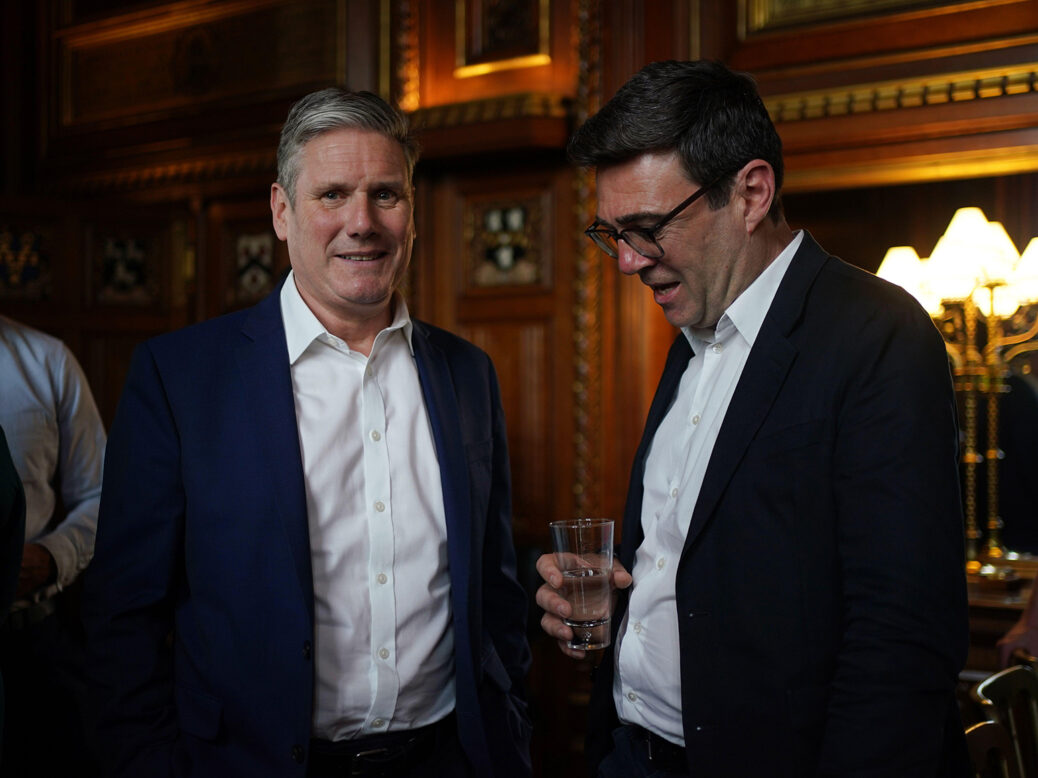
Imagine, for a moment, those words on the gender debate or immigration or the EU spoken not in a rousing Scouse accent, but in nasal and slightly robotic Surrey drawl. Would you be able tell them apart from lines delivered by Keir Starmer? Are you sure? All of those Burnham comments have been hedged in language about “balance”, “respect”, “compassion” and “fairness”. I’m quite sure you could listen in and get the impression his stance is wholly different to that of the current prime minister. Or not stance perhaps, but attitude. He understands your point of view, he shares your concerns. He thinks you’re fully entitled to feel the way you do. He just isn’t going to do anything about it.
The continuity Starmer approach is most obvious when it comes to the economy. Eight months ago, Burnham told the New Statesman’s editor Tom McTague that Britain has “got to get beyond this thing of being in hock to the bond markets”. The bond markets were not impressed. He appears to have learnt his lesson, promising last week to commit to the same fiscal rules Rachel Reeves has clung to, which Labour MPs privately feel are tying the governments hands. His official by-election campaign launch on Friday broadcast similar adherence to the other big Reeves pledge: no increases to income tax, national insurance or VAT. This was balanced by the insistence there was space to be “more radical” within those constraints.
If a radical, non-rule-bursting, and yet still cash-raising solution exists, one wonders why Reeves and her Treasury team haven’t found it. The most eye-catching tax pledge of last week actually came from Wes Streeting, who has proposed equalising capital gains tax with income tax (badged up as a “wealth tax that works”), which is endorsed by economists across the political spectrum. This idea is something Burnham apparently wants to look at “in detail” – which is politician-speak for being squarely on the fence. You could argue, of course, that Burnham’s messaging is focused on the people of Makerfield, whom he has to win over against a fierce challenge from Reform if he is to get anywhere near Westminster, let alone Downing Street. But it’s hard to go back on pledges made during an election campaign once you’re actually in office. Just ask Keir Starmer.
Might the solution be found in “Manchesterism”, the Burhamite philosophy that turned the fortunes of the UK’s second city around so dramatically? The past week has seen a flurry of analysis of how Manchester became one of the fastest growing urban areas in Europe, and how much is down to its mayor of nine years who could replicate it on a national scale.
The answer is complex, with lots that Burnham can and should take credit for – first and foremost the tremendous success of Bee Network, taking the region’s bus network back into public control. But he himself accepts that much the groundwork predates 2017 when he left Westminster to “head north”. His 2024 memoir-cum-manifesto of that name, co-written with Liverpool mayor Steve Rotheram, offers few clues as to what “Manchesterism” might mean in practice, beyond the broadest strokes of regional equality and rewiring Westminster (ideas for which include abolishing the House of Lords and ditching the whips system in parliament). The word itself is not mentioned once, and nor is “business-friendly socialism” which has become his new mantra.
What we know about “business-friendly socialism” is that it has resulted in glitzy glass skyscrapers springing up across Manchester city centre, and that it did so abandoning targets for social housing and giving free rein to developers on the grounds that bringing in investment was more important. It has obviously been a successful strategy for the city and some of its satellite towns, but it’s not clear what ideological message it contains for fixing a Britain that feels broken on a more fundamental level. If there is a lesson there – pursue private investment above all else – it is not one associated with the Labour left who have made Burnham their champion. It seems, rather, like exactly what Reeves and Starmer were doing with their “smoked-salmon offensive” to charm the City of London into answering the UK’s growth prayers.
It didn’t work for them. Maybe things would go differently for a more compelling messenger: someone who doesn’t sound like his speeches were written by ChatGPT, who has a personal brand so strong it defies his party’s unpopularity, who has the benefit of running as a Westminster outsider despite his 16 years in SW1. There is nothing to say that those who subscribe to the comms theory of why Labour has failed are wrong, or that a different communicator wouldn’t help restore the party’s fortunes.
But let’s be honest, this is the razzle-dazzle approach to politics, hoping some glitter and sequins deflect attention from what is in essence a very familiar policy agenda. What Andy Burnham seems to be offering is the same constraints and hedging and triangulation communicated in terms voters who have abandoned Labour find more palatable. It might work. People who don’t want to see a Reform government should hope it does work. But it looks like we’re heading for long Starmerism, jazzed up and with a different accent.
[Further reading: Andy Burnham’s manifesto for change]
Content from our partners



Related