
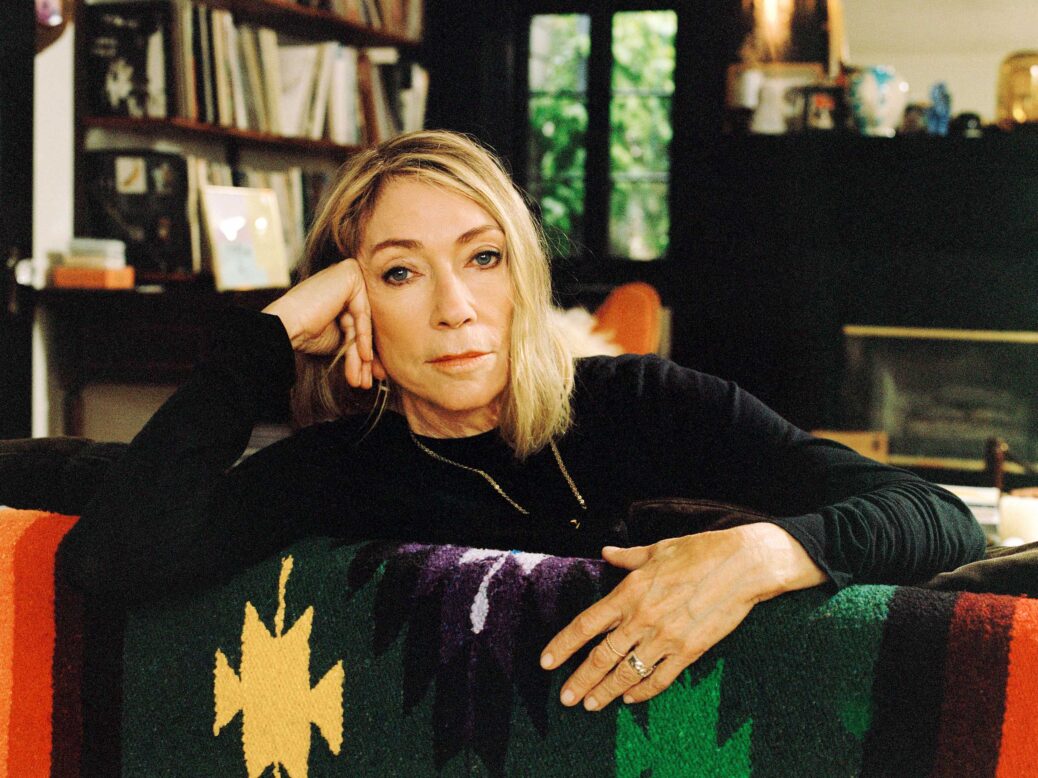
Kim Gordon is a bad sleeper. She is awake by 6.30 or 7am, if not because sleep has once more eluded her, then because her dog, Linus – an Australian sheepdog – has decided for her that the day has begun. When we speak over Zoom, it is nearly noon for Gordon, who is at her house in LA. She recently finished the European leg of her tour, and before she began the West Coast leg of the American one, she managed to hold some exhibitions of her art. But on the day we speak, she’d had a relatively slow morning – a pace that seems at odds with the freneticism often associated with the alt-rock luminary.
There could be, she teases, an astrological explanation for this. It’s a restlessness that she ascribes to her “Uranus, Venus square”, a transit that denotes a tension between the desire for harmony and the impulse for freedom and independence. She isn’t actually that into astrology – believing in it, she maintains, only “to a small extent” – but her friend, a writer and astrology hobbyist, sends her a forecast each year on MP3 and he’s apparently really good at it. “I just like listening to his voice,” she says.
Cosmically bestowed or not, creativity has been one of the driving forces in her career. She is best known as the bass player and a vocalist in Sonic Youth, the band she formed in 1981 with then-boyfriend (now ex-husband) Thurston Moore and Lee Ranaldo. Since then, Gordon’s output has been prolific, slaloming between music, fashion, acting and publishing. Her cult streetwear brand, X-Girl, initially fronted by the perennial it-girl Chloë Sevigny, has been the sartorial representation of her anti-establishment principles since 1993. Her memoir Girl in a Band (2015) was a New York Times bestseller, and her second solo album, The Collective, earned Gordon two Grammy nominations in 2024. A new album, Play Me, was released earlier this year.
“I don’t consider myself a musician,” she tells me. “I consider myself an artist that makes music, or an artist that writes, or makes visual art.” Gordon’s artistic sensibility rejects easy categorisation. Her career has been spent dissolving boundaries: between high art and popular culture; noise and melody. Professionally, she is all of the things we understand her to be: she is punk’s intellectual, fashion’s muse, art’s high priestess of cool. But try to pin her down, and she has no interest in being defined by any of these things. In her day-to-day life she is hosting dinner parties, and even if she’s not that into astrology, she knows she is a Capricorn rising. She recently had to have her high-end Sub-Zero refrigerator fixed, but remains unclear on the logistics, because her accountant pays her bills on her behalf.
Play Me is Gordon’s third solo album. It’s a diatribe against the billionaire class distracting us into oblivion with insipid TikTok videos, and captures the exhaustion that comes from living in a world increasingly governed by AI and the fantasies of tech overlords. Much like her anti-establishment stance with Sonic Youth, her more recent work also reflects an engagement with the affairs of the world – as she puts it, “a country becoming fascist, bringing back the KKK, bringing religion back into the government”.
But rather than simply articulate the demise of American society – “I don’t think political language in songs comes across so well if you’re just so direct with it,” she says – Gordon metabolises it, breaking it down into its constituent sounds. Using trip hop and pitch-shifted vocals, she collages the detritus of life in America as she sees it – a sonic embodiment of the disoriented textures of contemporary life. In the opening track, which gives the album its name, she reels off the names of absurd, algorithmic Spotify playlists. “Make-out jams”, “spring pop, chill vibes”, “villain mode”. It’s an acerbic portrait of a culture that has outsourced the individual’s ability to cultivate their own taste. “I like to make my own choices,” she says, even if it means being inconvenienced. For Gordon, freedom is paramount.
But there’s no doubt about who she’s taking aim at. In “Subcon”, she repeatedly spits: “You wanna go to Mars and then what? Then what?” – a clear indictment of Elon Musk’s desire to colonise an uninhabitable planet with an average temperature of -60°C. “I feel like there’s a sense that [living there] is going to solve our problems with Earth and climate change, and all the things we’ve destroyed here,” she tells me, later adding: “Are there just going to be luxury condos up there?” Yet Play Me also resists literalism. Gordon has always been predisposed to focus more on beat – on feeling – than lyrics. She believes in the importance of what is left unsaid, in “leav[ing] a lot of room for speculation, for other people to bring their own ideas and feelings to a song”.
The American philosopher Denis Dutton argued that a work’s “expressive authenticity” – that is, the degree to which it reflects a genuine personal expression of the artist – is the essential measure of an artist’s value. It is why we become so enraged after learning a piece of art has been forged, or disappointed when we discover a song that we love so much isn’t, in fact, the original. Our appreciation of art is uniquely tethered to individuality and self-creation. Gordon’s work is, in this sense, steeped in authenticity. Play Me’s preternaturally trashy aesthetic – an amalgam of lo-fi dissonance, industrial beats and lyrics delivered in a spoken-word style – directly channels how she sees the world, bleakly atomised and overwhelmed by absurdity.
This has been a running theme in her work, going back to her days making music with Sonic Youth. Emerging from New York’s late-1970s no-wave scene, the band undermined traditional methods of making songs. Their sound was experimental, informed by avant-garde methods, such as tuning instruments with screwdrivers and drumsticks. Their songs, aggressively loud and fast, clashed with the popular artists of that time – Madonna, Sade, Aretha – proving that noise itself, not melodies or lyrics, could be an argument against the strictures of conventional music.
For the 30 years they were together, Sonic Youth helped shape alternative rock. David Bowie named them as one of the two most important bands of the 1980s. (The other was the Pixies.) The echo of their style can be heard across alternative music today, though one of the bands they helped most directly was Nirvana, who toured with Sonic Youth during the summer of 1991, just months before the release of Nevermind, Nirvana’s epochal, career-defining album.
As with Nirvana’s frontman, Kurt Cobain, the myth surrounding Gordon never dissipated, not even after Sonic Youth’s dissolution in 2011 following her discovery of Moore’s infidelity and their subsequent divorce. Gordon was one of few women in a male-dominated genre. Eschewing traditional rock theatrics, she became celebrated for her deadpan, minimalist performance style. In 1997, Rolling Stone branded her “the godmother of grunge”. Girl in a Band, which chronicled the gruelling reality of the music industry’s sexism and the painful breakdown of her marriage, did little to puncture the glorified image projected on to her by fans and critics alike.
She shrugs off such sanctification. Thinking about what people expect of her is, she says, “always a dead end… a paralysing practice”. She adds that the thing she hates most about releasing a record “is just having to do all the promotion”. Conceding that most journalists are “pretty respectful” of the interview process, she still feels “it’s just so much of oneself”.
When Gordon was first performing with Sonic Youth, the language around authenticity barely existed. It wasn’t something anyone talked about. “I think maybe the main difference is that people try to be authentic now,” she says. “The more powerful bands [back then] were just kind of doing what they do, you know. There wasn’t this thing of ‘authenticity’.” She elaborates: “Neil Young said one of my favourite things… He said it’s really vain to think about if you’re a good singer or not. It’s more about how authentic your voice is. It stuck with me because it means your voice is coming from somewhere else, that’s guiding you. It’s not just your vocal cords, it’s deep down, it’s your heart, your gut. That’s why Kurt [Cobain] was such a powerful singer. He was so little and then he just had this huge voice.”
Her expressive authenticity derives from her self-perception as a misfit. “I’ve always felt like an outsider,” she says. Born in 1953 to a sociology professor and a seamstress, she was raised in Los Angeles. After attending art school there, she moved to New York and thought she’d follow a traditional path: join a major gallery and have a career in the highfalutin art world. But this life was left unrealised once she “got involved with music and had this career that suits my personality”.
Her work reflects a natural disposition towards the periphery, preferring to experiment rather than master, which may stem from the “lab school” she attended as a child (“truly a learn-by-doing kind of school”). Gordon grew up with a brother, Keller, who was schizophrenic and who died in 2023, and she experienced a level of turmoil and confusion few of us will ever know. “I looked up to him, but he could be mean,” she says. At the time Sonic Youth was formed, Gordon was 27 and, astonishingly, had never played an instrument.
It’s startling how regularly Gordon resists certainty. There are many things she doesn’t know. She repeats the phrase “I don’t know” 24 times in our 45-minute conversation. As considered as her answers are, they often lack a certain assuredness. (A section of my transcript reads: “I don’t know, like, it’s, you know, unless you’re like, you know, unless you’re, I don’t know, even if, even if you’re a rapper, like, maybe it’s not the most effective, yeah, you know…”) Thoughts are left unfinished, trail off, or turn in on themselves with counter-perspectives. This aloofness could be read as a sort of inscrutability. But it might be more accurate to think of it as a total openness – including to being wrong.
It is also, ultimately, a form of freedom, the purest expression of who Gordon is. For 40 years, she has been an icon; for just as long, presented with ample opportunity to collude in the making of her own myth, she has refrained from doing so. The Gordon I see before me is remarkably relatable, dressed in tracksuit bottoms and a T-shirt, trying to call Linus into frame so she can show me her beloved dog. Even when performing, she’d rather have the lighting “so dark you can’t see the audience”.
This is yet another paradox of Gordon’s personality: the stage is the place where she is most visible, but also where she is most able to “lose myself” completely. Perhaps, too, it is where she is most able to find herself, and why she is still, at 73, touring the world. “It’s a sense of freedom, and that’s basically the most fun thing.”
[Further reading: Ludovico Einaudi repeats himself]