
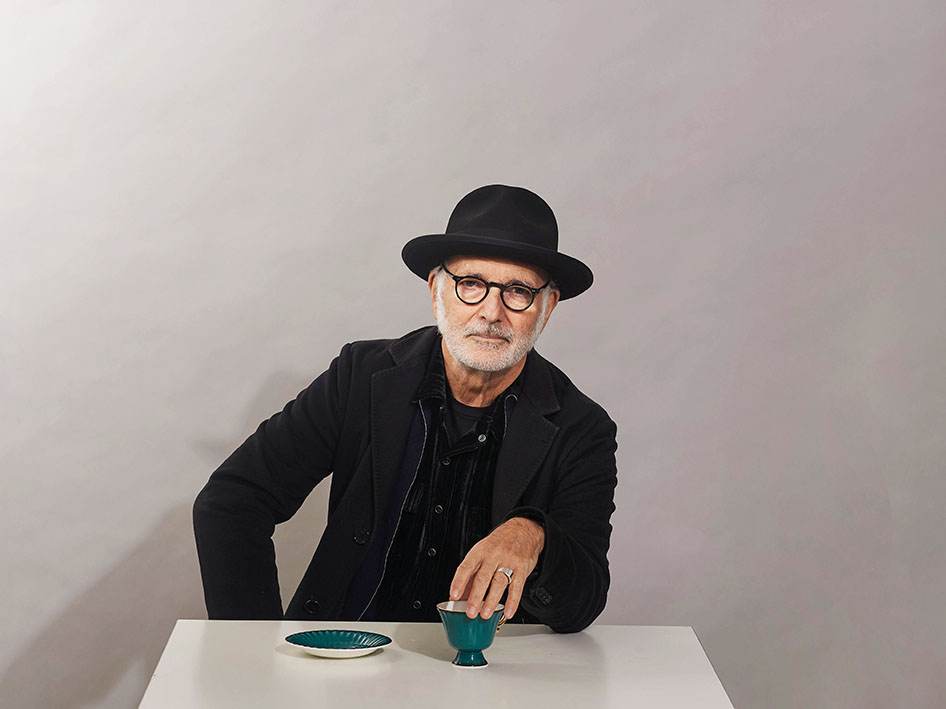
When the tender strings start about a minute in to Ludovico Einaudi’s “Experience”, it seems impossible not to feel something. The body responds despite itself. This has always been what makes classical music remarkable – body and sound in communion, with no intermediary text.
The earnest emotionality in Einaudi’s music allows for its bewitching effect on the audience, subduing them, leaving them in awe. Attending an Einaudi concert is a spiritual experience – his performance framed by brilliant background colours that flow in time with the music. In Rome’s Auditorium Parco della Musica, where Einaudi held four shows at the end of June, a woman swayed her shoulders in rhythm – a reaction that wouldn’t be so strange if you forgot this was a classical performance. You could be forgiven for such a lapse, though – chamber music, this was not.
The 70-year-old, Turin-born Einaudi’s work may not be universally loved in the classical world – it’s fair to say – but his resumé includes a list of statistics which, when rattled off, sound enviable. He is the most streamed classical artist in the world, with almost 7.5 million monthly listeners on Spotify, and the third most streamed Italian artist internationally. But the man himself belies all this with his everyday affability and reserved nature. It’s not that Einaudi seems basic – he has a quiet elegance, his blush polo and olive On trainers juxtaposed with a grey flat cap and tan sunglasses (with grey lenses left on for the entirety of our conversation). He wipes streaks of condensation off the glass carafe of water we have been served at the bar of the Hotel Locarno in Rome, near the Piazza del Popolo. The red velvet curtains and rose-tinted sofa match almost perfectly with Einaudi’s outfit. There is an accessible warmth that radiates from him, but also a sense that he will only show what he is willing to show.
He’s coming off a busy period. He recently wrapped up a portion of the tour for his 2026 album Solo Piano, a collection that uses the piano alone to tell a series of stories in melody. Before resuming the North American leg of that tour this autumn, Einaudi is once again performing his the Summer Portraits tour – a nostalgic look back to the summers of the 1950s and 1960s, which was recently released as a live album, recorded at the Royal Albert Hall. Despite his fame – he could pack in the tours and release albums from the comfort of his favourite places – he chooses to perform relentlessly.
“If you don’t play music live, it’s like a flower that remains beautiful but it never fully blooms,” he says. “It’s as if, playing live, you discover all the nuances that can be created around the music.” The romantic vagueness with which he speaks about his music chimes with the compositions themselves.
This year he’ll be playing more than 100 concerts, but he admits that in 2027 he will try to pare things back and focus on writing. “I’ve come to understand that I need to restrain a bit the impulse that I have to say: ‘OK, I’ll do everything,’” he tells me. “I feel the great desire on behalf of the audience to come to these concerts, so it’s as if I’d feel sorry not to satisfy that.”
The concerts do have something to offer Einaudi’s creative process: they give him the chance to hear the music live and change it, he explains. “Sometimes, things are even added over time… This is something that I like, because it’s like fully exploring a concept that can only be explored through live performance. And there’s the synergy of playing with other people, and each person comes in and refines their own part.”
The same could be said for Einaudi’s approach to composing. Many ideas come from improvisation. “Sometimes, I don’t even know exactly what’s happening,” he says. He often finds it difficult to articulate how his music comes together – while a perennial complaint from music critics has been that there is, in fact, very little to articulate.
In Italy, the name Einaudi – the Torinese family he was born into in 1955 – comes with a certain stature. The composer’s grandfather, Luigi Einaudi, was the second president of the Italian Republic, from 1948 until a few months before his grandson’s birth. Ludovico’s father, Giulio, was an acclaimed editor who founded the eponymous publishing house Einaudi, working with writers like Italo Calvino, Cesare Pavese and Natalia Ginzburg – the best of modern Italian literature. Ludovico Einaudi was born into a world of immense privilege – and pressure. “As a kid, you always feel it,” he says. “You feel like you’re the son or the grandson. It creates this sense of comparison.”
For years, Einaudi felt the weight of this family legacy and a desire to get away from it. “I distanced myself a lot from that world and I followed, with my head down, my own path,” he says. But his musical calling nevertheless came from his bloodline. His maternal grandfather, whom he had never met, was a composer and conducted an orchestra. At home, his mother played piano.
While studying at conservatories in Turin and Milan in the 1980s, Einaudi immersed himself in contemporary music. He eventually trained with some of the greatest names in the avant-garde movement, such as Luciano Berio and Karlheinz Stockhausen. “Among all these people, the one that touched me the most,” he says, “was Luciano Berio, because I found his music more expressive, more emotional, and since he had spent some time in America and was more open minded, he was able to absorb elements from pop and jazz.”
A fruitful collaboration was born. Einaudi worked at Berio’s side for two or three years as assistant and student. But, composing music in Berio’s style – electronic, experimental – Einaudi also realised something: that voice wasn’t his own. “I tried to digest the things I was learning from him and transmit them back,” he says. “And that’s when I realised that, to find myself within the music, that language was something that didn’t fully belong to me.”
The composers of the avant-garde had wanted to “start over”, Einaudi says – to start afresh, carrying the historical burden of having lived through the Second World War. Einaudi was raised in postwar Italy, in a time of great economic prosperity and promise for the country. It was a different era, and Einaudi was a different person.
Eventually, Einaudi found he wanted to start over – which meant making a break from Berio and from composing for theatrical and orchestral projects under his mentor’s influence. Einaudi released his first solo piano album, Le Onde, in 1996. It was named after the 1931 Virginia Woolf novel The Waves, and introduced what would become Einaudi’s signature minimalist style, arguably in keeping with the rhythms of Woolf’s prose.
Little by little, his work attracted a broader audience. Certain moments mark out his growing fame: when, in 1998, the Italian director Nanni Moretti used some of Einaudi’s songs for his film Aprile; when Classic FM began playing his music to an Anglophone audience in the 2000s (one of his pieces, “I Giorni”, even found itself on rotation on BBC Radio 1 in 2011); and when he received more high-profile composition jobs, such as scoring the hit Shane Meadows film This Is England (2006). By the time he composed the score for Chloé Zhao’s Oscar-winning Nomadland (2020), he was already one of the most in-demand composers in the world.
Yet he remains hard-pressed to say what has garnered this extraordinary level of fame. “There’s a sense of clarity and almost simplicity, even in the way the music is conceived,” he offers. “It comes naturally to me – it’s not that it’s a conscious choice, it’s how it comes to me. It’s like a linear, transparent narrative.” He speaks of “some mystery within”.
This simplicity has riled the classical music academy. Critics argue Einaudi’s music lacks complexity. In 2016, the Guardian was searing: “Einaudi casts himself as the antithesis to the stuffy conservatoire – but then plays music that is less adventurous than your average indie band’s… All Einaudi can conjure is the dashed-off poignancy of an Instagrammed sunset or emailed condolence.”
There might be something to this. The imagery associated with Einaudi’s music on platforms like Spotify is a flash of looping visuals from nature. His tracks work in much the same way: extreme repetition. In live performance, it’s easy to be carried away by communal emotion, but listening on repeat in the privacy of your home can give way to an emptiness.
Einaudi seems blissfully unconcerned about such criticisms. “Sometimes I sense a bit of bitterness, maybe because of the success,” he says. “Honestly, I don’t think about it. And I have to say, I’ve always had little patience for the academic world, since these kinds of things usually stem from a very academic way of thinking.”
Though he is usually described as a minimalist, he struggles to place himself in that category – or any category. Citing Philip Glass and Steve Reich as the minimalist composers he has admired the most, he maintains that his music doesn’t quite resemble theirs. “I don’t really understand what minimal means,” he says. Maybe, he suggests tentatively, “it’s like saying, ‘Let’s get rid of all the frills; let’s get rid of everything that’s unnecessary.’”
On 10 and 11 July, Einaudi is performing at the O2 Arena in London. The composer has a fond relationship with the city and the UK in general. There’s a seriousness with which music is taken in Britain that Einaudi doesn’t always find in Italy; he sees the UK as a place where musicians can flourish. But, ten years on from the Brexit referendum, he admits he was “disappointed” with British voters – London seemed happier before, he feels.
His thoughts on Italy’s right-wing government under Giorgia Meloni aren’t positive either. “Culturally, it doesn’t align with what I think and with the kind of people I’d like to deal with,” he says. “At the same time, I think Meloni is someone who knows her stuff – she’s capable – but she’s not surrounded by people I like.”
Ultimately, it’s the crowded theatre that calls Ludovico Einaudi – not the arena of politics. The composer’s mind is always on the next performance, the next project. He’s working on new music – a tentative album that is still in search of a theme and a structure. He’s also writing his first book, an open-ended format that combines memoir with his present life and music; there is a hint of experimentalism here.
But, after a life of experiments, largely successful, where else do you go? Is there much else to achieve? “If one feels at some point completely satisfied,” he says, “it’s probably a sign that something is dying. Instead, the fact that I still have this desire is a sign of vitality.”
Ludovico Einaudi performs at the O2, London SE10, on 10 and 11 July
[Further reading: Daljit Nagra talks to himself]