
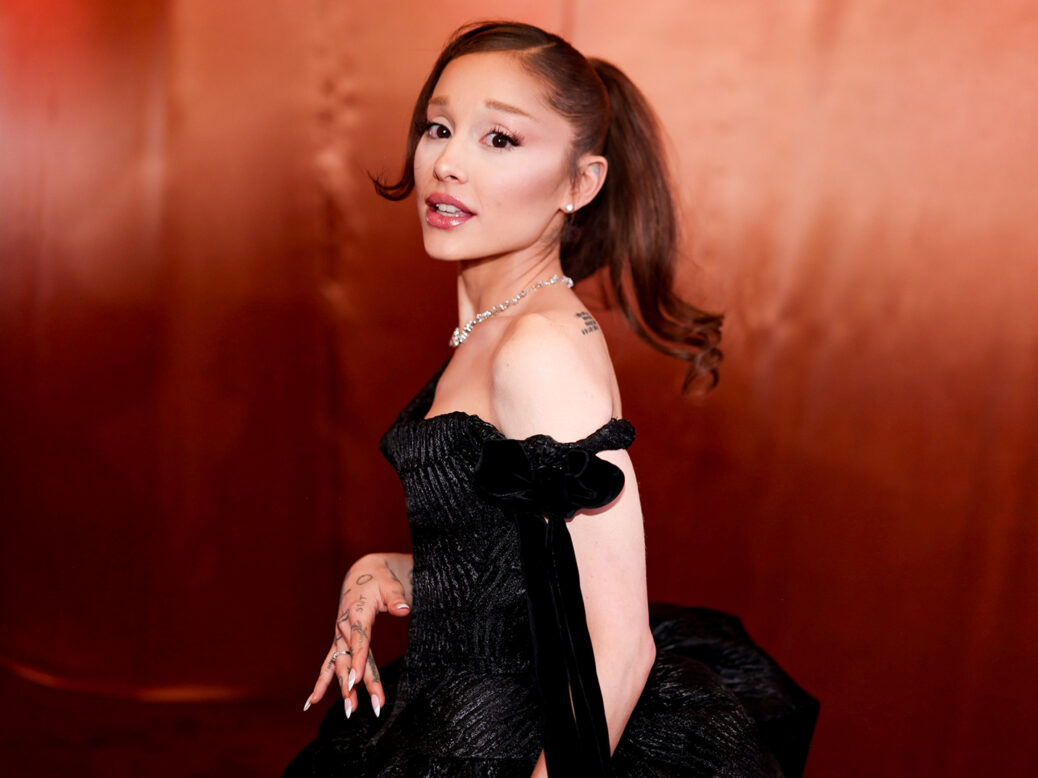
Ariana Grande has had enough. It’s been a hard few years of public attention, and she wants you to know it. In a controversial video for her new song Petal, she plays a midcentury starlet who wreaks bloody revenge on the casting agents who continually reject her. First she appears as a visibly thin Audrey Hepburn type. “Could stand to lose a few pounds,” one writes on his notepad. So she comes back dressed as Sandy from Grease. You can see her sternum, and most of her ribcage.
The video might just about pass as social commentary if anyone else did it. But it is too visceral and disturbing to come across as intended: because Grande’s weight loss is real. She’s been noticeably thin since the start of her bizarre press tour for Wicked, and her weight appears to have dropped further. She’s currently on a world tour of her music, which would be a physically demanding feat for anyone. Onlookers have accused her of choosing costumes and dancers to exaggerate her weight loss and of engaging in “body checking” – posting Instagram images that highlight her visible bones. Her team has said she will end her tour “healthily and happily”, before taking “a much-deserved break from public-facing work and appearances, which has led to endless, ongoing public scrutiny”. She won’t do Stephen Sondheim’s Sunday in the Park with George, which was due to run at the Barbican in London in 2027.
Ariana might be our last tragic star. Her life has been defined by a series of unfortunate events, and questions over her weight are only the latest. She came up as a child actor on the Nickelodeon show Victorious, working with the same producer whose alleged sexual misconduct sparked the investigative documentary Quiet on Set. In 2017, an Islamic State-associated suicide bomber targeted her concert in Manchester, killing 22. A year later, her close friend and some-time boyfriend Mac Miller died of a drug overdose. Unfortunately, it is difficult to imagine an Ariana to whom bad things do not happen.
Grande’s most famous songs, like “Break Free” and “No Tears Left to Cry”, become more resonant when you’re aware of her pain; her acrobatic vocal range might as well be there just to convey it. She has an unusually expressive face, and a voice with melodramatic, breathy affectations. Her best artistic and narrative analogue is Judy Garland, a naturally gifted singer who went through a traumatic childhood, a troubled relationship with her mother, several tumultuous marriages and life-long addiction issues. Garland’s biography Get Happy even describes Garland in her mother’s womb, struck repeatedly as the family car drove over bumps in the road. You will get more out of your viewings of the Wizard of Oz or A Star Is Born if you notice the pain on her face.
Grande’s concerned fans are often chided for being “parasocial”. But this model of stardom couldn’t exist without parasociality. It was the bedrock of the Hollywood studio system, which connected individual stars to universal archetypes, and on-screen narratives to personal lives. Amid public scrutiny, Garland drew a devoted audience of gay men: they could relate to her theatre of tragedy, and to her melodramatic attempts to overcome her trials.
At some point between the fall of the studio system and the rise of Instagram, we learned to think of stardom as solipsistic. But there would be no point in a star who offered nothing to the public discourse. Even the Kardashians offer up-close cautionary tales for failed relationships.
Another recent high-profile star-turned-tragic-figure is Britney Spears, whose story is about as gothic as you can get in 21st-century America. After ascending to Hollywood from rural Louisiana and struggling in an exploitative tabloid culture, her family members plotted to put her under a conservatorship. She became a princess in a tower, sustaining a Clerambault’s-type relationship with fans as her handlers coerced her through more than 200 performances at a blockbuster Las Vegas residency. She wasn’t allowed to drive, or access the money she brought in. Her fans eventually formed an army of gay knights errant, raising public awareness of her conservatorship and campaigning outside her court hearings.
There is a crucial difference here: Britney’s concerned fans were allowed to save her, while Ariana’s must drop their investment in her personal life as they watch her appear to struggle with weight issues. It is pointless to call them out, because it’s an investment they have been asked to sustain for the past decade of her career. They are only holding up the other side of a contract that dates back to the birth of celebrity itself. Without parasocialism, there is nothing left.
[Further reading: Is Kim Gordon still a Kool Thing?]