
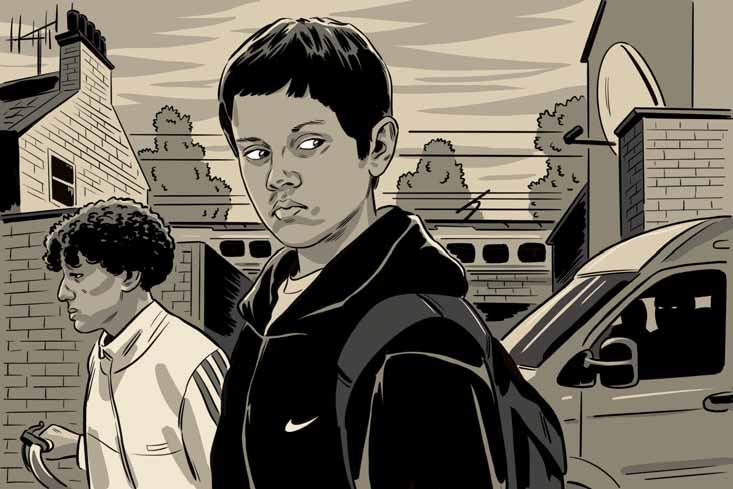
Francois Truffaut’s The 400 Blows (1959), arguably the classic coming-of-age film, opens with eloquent tracking shots of the streets of Paris, loomed over by the Eiffel Tower. Ish, the remarkable debut feature from the artist and composer Imran Perretta, set entirely in the less glamorous locale of Luton, starts more briskly, with a brief scene that only makes sense later. From inside a van, we see a boy’s bike dumped in the road and hear angry voices: “Don’t move!”; “We have a suspect, five eight, IC4, male…” The van door slams shut, abruptly ending the shot.
From there we’re suddenly switched to a leafy idyll, summery woodland filmed in glossy monochrome. Two 12-year-old boys are playing hide and seek, mock-fighting, gathering blackberries. Ish (Farhan Hasnat), a sweet kid, looks up to Maram (Yahya Kitana), taller, more assertive, with the beginnings of a mustache.
These best friends construct a den and watch wheelie clips on a phone (“sick!”), before heading home, perched on a single bike, zig-zagging along to achingly nostalgic, classically inflected music composed by Perretta himself. The pastoral scene shifts to pylons, a looming jet overhead, a tangled overpass, grubby back alleys, suburban houses. We briefly see the streets surveyed from inside a police van again, the radio once more speaking of suspects. Ish and Maram part for the evening, with the awkward mix of tenderness and bravado of boys uncertain of themselves.
Ish is a film with a double edge. It’s a traditional coming-of-age movie, almost archetypal, about that last summer before leaving childhood, when so much changes, so much is lost and gained. But it’s also a sustained polemic about what it is like to grow up as a brown boy in Britain, always under suspicion.
“Post 9/11, my friends and I lived in a heightened state of awareness – hyper-conscious of how we moved through public space, how we were perceived, and how some of us could walk freely while others were constantly questioned,” Perretta says. “That tension, that ever-present sense of being watched, became a defining part of our adolescence. And that’s what Ish captures.”
Ish is already upset by the way Maram seems to prefer socialising with an older gang, when, as they walk through the streets near Kenilworth Road, Maram is roughly detained in a stop-and-search operation. Deserting his pal, Ish runs off. When an enraged Maram is released, Ish is too ashamed to show his face.
Even though Ish continues to join the gang in petty rascality – shoplifting, running riot at the Hitchin lido, letting off fireworks in the woods – his friendship with Maram never recovers. Their paths diverge.
Ish’s Bengali family is close-knit. His airport-worker father (Avin Shah), sparky older sister (Joy Crookes) and traditional grandmother Nanu (Sudha Bhuchar) mourn the recent loss of his mother, praying at her grave. Meanwhile, Maram – “that Palestinian boy” says Nanu, cuttingly – is the son of an angry father and is already politically incensed, scrawling “Free Gaza” on a phone box and calling the local police the IDF.
Ish has great texture throughout. All shot on location, it is fluently photographed by Jermaine Canute Edwards, the choice of stark black and white supplying a formality that lifts the whole film. Luton becomes impressively cinematic, if not exactly Parisian. The eloquent score, eschewing the music the kids themselves might choose, distinguishes it from the more well-worn style of the average TV production. The two boys, cast locally, new to acting, have real rapport. Perretta, co-scripting with Enda Walsh, has made a really affecting drama, successfully melding the political and the personal in a way rarely achieved.
And it’s a love letter to Luton as well (Perretta himself is from south London, but his wife comes from Luton). Or, at least, a love letter to a community within Luton. Though Perretta is half Italian, it’s striking that almost nobody outside the Muslim and South Asian community appears (save a man who buys Ish’s sister’s car). The police, mostly represented by voices and surveillance-camera points of view, are scarcely glimpsed. If Ish takes on the way the system others people, it also performs some pretty systematic othering of its own. Luton, it will be remembered, is the home of Tommy Robinson. Groups like the EDL maintain there is no integration in the city. Ish, admirable as it is, coming from entirely the other side of the argument, could be cited as confirmation of such separation as much as proof otherwise.
Ish is in cinemas now
[Further reading: On the Sea: a romantic delirium]