
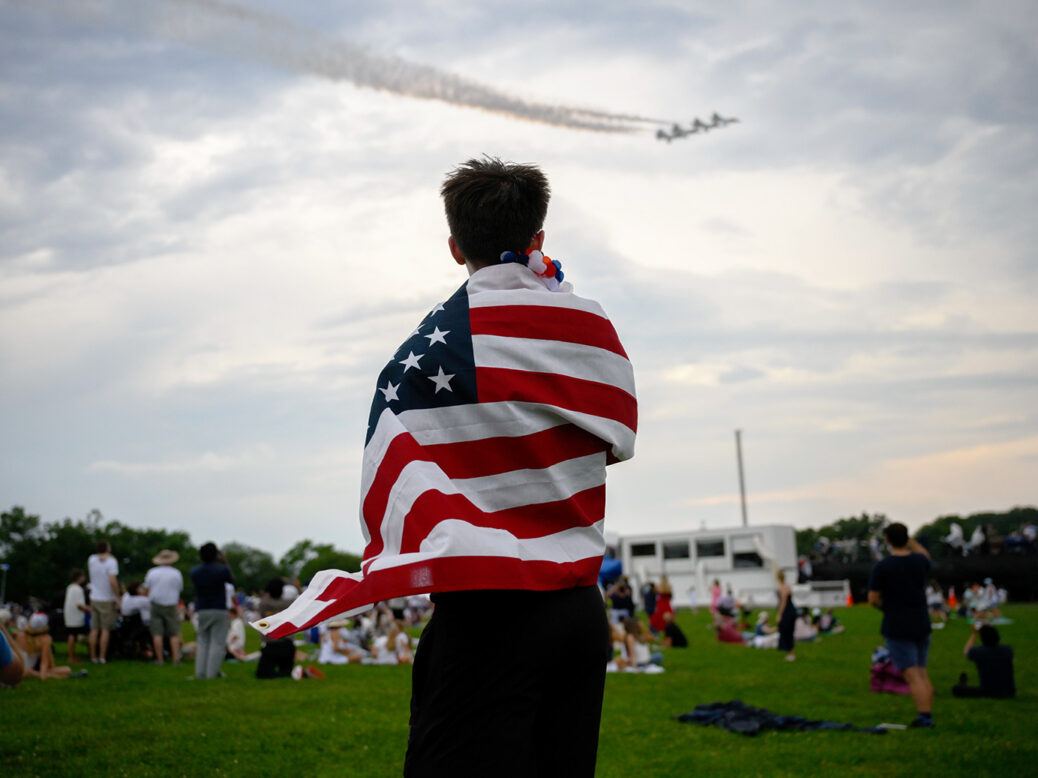
You heard them before you saw them. I was standing at an intersection in Washington DC and the sound of the F-35s flying overhead filled all four of the boulevards around me so that you couldn’t tell where the jets were coming from. They shot past, flipped upside down, pivoted and then seemed to pause in the sky before twisting back down towards Earth. They looked more like spaceships than fighter aircraft, moving in ways that seemed to defy the laws of aerodynamics. The urge to shout “hell yeah” was mixed with the sense you were in some remote Afghan village circa 2010. It was like the assault on DC in Alex Garland’s film Civil War. If what people choose to do on their birthdays points to what they care about, then perhaps an F-35 should be carved into Mount Rushmore. “Fuuuuuuck,” a salivating man with a white goatee said beside me, his mouth agape, head angled towards the heavens.
The military circus taking place above us was the entertainment for thousands of Americans as they queued to get in to the Great American State Fair on the National Mall on 4 July. That, and the leaflets being handed out by a smiling, besuited father and son that read, “Are you ready for your appointment with death and judgement?”
In America’s capital, queues are officiated by soldiers in khaki with pistols strapped to their legs standing in front of a camo-clad Humvee. The lines to get in to the State Fair fanned out through the avenues, crossing over into each other, seemingly endless. And yet, despite the 400C heat, people remained cheery, smiley and patriotic.
Inside, queues spilled out from stalls that represented each state. Tennessee had accumulated a line of people at least 25 feet long. So I waited in Mississippi’s queue for about six feet to learn more about the state the Atlantic recently proclaimed to be Britain’s economic equal. I was met with a jolly “welcome to Mississippi!” by a volunteer who wasn’t aware of her state’s new-found global economic prominence. Instead, she pushed me towards an exhibition about how the teddy bear came about after Teddy Roosevelt spared a bear on a hunting trip in the state and a local shop owner created a toy in his honour.
Mississippi was home to Elvis Presley, William Faulkner and John Grisham – who, if you didn’t know, also served in the Mississippi House of Representatives from 1983 to 1990 – and, as one poster declared, has the largest university-operated high-voltage facility on the continent. You cannot underestimate Americans’ capacity to take pride in themselves.
Back outside, the queue wars were being won by Florida, whose line extended across the National Mall because, as one small wispy man near the front told me, you could get a fluffy toy alligator inside. Next to the National Archives building, which houses a copy of the Declaration of Independence – the very document we were here to celebrate – another line formed. People had congregated beside the Northrop Grumman fighter jet simulator as a squadron of the Blue Angels – the US Navy’s version of the Red Arrows – enveloped us in a boom.
Squadrons of fighter jets kept coming, silencing conversation every ten minutes or so. Women in star-spangled bikinis posed for photos in front of a giant Fox News sign. At this point, I checked my phone to see that the event’s official X account had retweeted – boasted, in other words – about reports that the queue to get in was three hours long. (What’s that? A mile? Two miles? Perhaps this time the better metric is acreage.) The American mantra is the bigger the better – even when it comes to inconvenience.
We can put Americans’ love of queuing down to two aspects of their psyche. The first was handily captured by the motto of the heavy metal band blaring on stage: “Nothing comes without sacrifice.” You’d be shocked at the physical exertion Trump’s fans go through, for instance, to get into a stadium for one of his rallies. Sweaty, determined followers will endure hours of stationary boredom to be in the same room as their leader. Queuing is a demonstration of loyalty and proves that the queuer cares, in this instance, about celebrating their country’s birth.
The second reason for a queue’s appeal is that you can’t have exclusivity without one – and creating the conditions to enable exclusivity, which is then usually purchased, is a pillar of American culture. Go to an empty restaurant anywhere from Boston to Vegas and the maître d’ standing in front of free tables will make you wait a few minutes to check whether they can let you in – just so you feel you’re getting special treatment.
I joined a queue at a large Budweiser truck with two floors, wondering why we were waiting when the bar was empty and there were three different sets of stairs to enter. I asked a man to save my spot and ventured up to the bar to check whether we needed to queue. No, of course not, came the response. When I relayed this good news back to the queuers, I was met with dead eyes. They did not want to hear it.
The clouds turned grey and I walked a few blocks to the International Spy Museum, where the Qatari embassy party was, to watch the fireworks from the roof terrace. Which felt fitting, given that Trump’s new Air Force One 747 – a gift from Doha – had flown over the Mall earlier. Guests were milling around – queuing – in the lobby beside James Bond’s Aston Martin half an hour before the terrace opened. Let no one ever say that it is the British who love queuing. The Americans have long surpassed us at waiting in line.
[Further reading: The truth about America’s new “socialists”]