
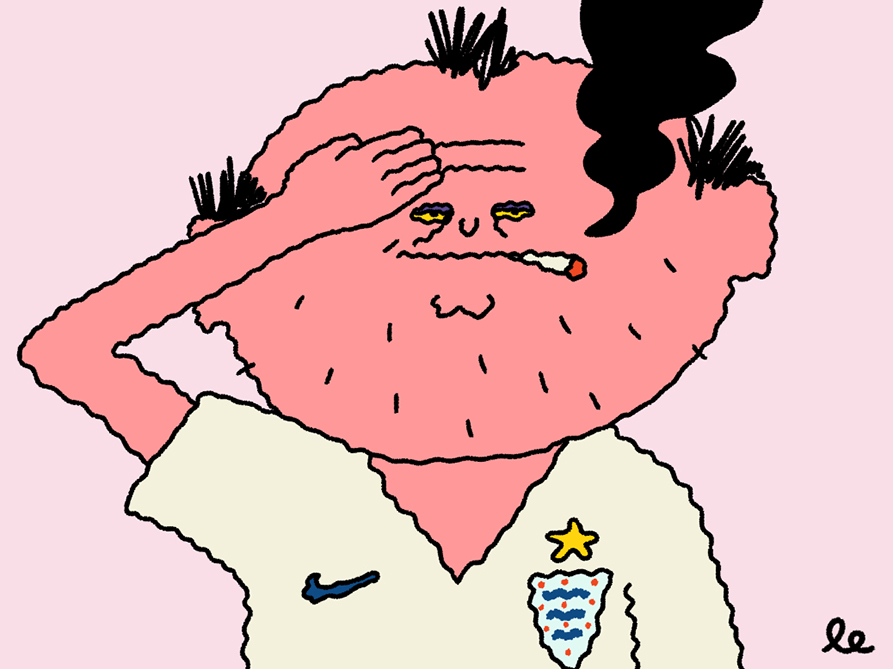
“My country needed me!” That line doesn’t often excuse a working day of near-zero productivity, but there was a special quality to the country on the morning of 6 July. We hailed one another, weary and delirious, asking: “Where did you watch it?” It was the lightness of knowing your day can be totally forgettable because the night before will be remembered forever.
England vs Mexico was our moon landing. And not only because of the Azteca Stadium’s much-referenced altitude, the aerospace engineering of Thomas Tuchel’s defensive shell and the hypersonic velocity at which Anthony Gordon streaked down the left wing. It was a night when a nation stayed up until the dreaming hours and found itself dreaming anyway, all awake and all together. And this miracle of human effort, so far as we can tell, actually happened.
For one night, the infrastructure of bedtime was suspended. Parents roused sleepy kids for the special memory. Others plotted tactical naps and alarms, or media shut-outs so they could watch the recording later. I began watching it in my flat, but at half-time felt compelled to dart out to the pubs, and so did my friends. What was it that felt so precious about the atmosphere, that demanded we run out to experience it, to breathe it in and never let it out?
England faced Mexico in the round of 16 after only shakily besting teams such as Panama and DR Congo. The match would take place in Mexico City at 1am BST and 2,240 metres above sea level. Since the Azteca was built in 1966 – also the year England last won the World Cup – Mexico had only lost there twice.
Electric storms delayed kick-off by an hour; masses of English attempted and failed a micro-sleep. Mexico’s players and fans thrashed out their national anthem with a ferocity that justified its incipit: “Mexicans at the cry of war”. After kick-off, a thunderous “¡Olé!” celebrated every Mexican pass, while England played through a heavy storm of booing. We excised the game’s fury nicely, controlling possession at the back until the shelter of the first hydration break.
In phase two, we adopted a more inquisitive passing game, and suddenly Jude Bellingham had scored, and suddenly suddenly Bellingham had scored again. Lightning struck twice, though you would have needed to pile on all the voltage of the earlier electric storm to approximate our ecstasy. The BBC’s commentator Guy Mowbray called it “the stuff of dreams”.
Mexico scored almost as startlingly and we survived the rest of the half under siege, then ducked for the dressing room and the draught taps. Two-one. From the Azteca’s sound system “Mr Brightside” played presciently: “I just can’t look, it’s killing me…”
The second half ricocheted into its terrible conditions with a red card for the England defender Jarell Quansah, an England penalty that eked out some breathing room, then a Mexican penalty that removed all of it. The terms were set and the match rose to the epic register it will remain in forever: 3-2, England one goal up but one man down, with 38 minutes of Mexican onslaught to be withstood.
Thirty-eight minutes of Mexican onslaught later, Jordan Pickford punched out the last corner cross, and England’s greatest World Cup performance since 1966 was complete. If you were asleep, that was the moment, around 4.15am, when the street erupted in cheers. Every player had willed himself through to a desperate sublimity. With the final whistle came the twinkling chords of “Three Lions” and the mention of “30 years of hurt” that are now double that. But the squad flowed to the fans for a different song. With the rendition of “Wonderwall” came a familiar English moment: all of us had given ourselves up again to the old belief, the hope that kills us, that it might come home. Maybe, this was gonna be the one that saved us.
How do you love a son? That almost infinite question has, in England, one simple answer: you teach him to kick a ball.
My mum and dad’s parental performance looks more and more miraculous to me every day, but I have only ever heard them congratulate themselves for one triumph: that if I ever wanted to kick a football, my dad was outside with me, kicking it back. “We knew we wanted to send you to school able to play football.”
For me and most of the boys I knew, football was the central activity and interest – the sole culture, from childhood to adolescence. Break times were jumpers for goalposts, birthday presents were football kits, entertainment was Fifa 07, and bedroom decorations were Wayne Rooney posters. Our oldest friends, if we are so lucky as to have kept our first schoolfriends, are most likely, in some way, “football friends”.
Mine, when I meet them, still appear to me characterised by football positions and styles they are now much too injured, too old, too busy or too far back in the Ozempic queue to rehearse. For all the diverse passions they now chase, their first dream was to be a footballer. I remember exactly which three boys – Bertie, Harry, Anton – reigned as “best in the year” at different times, and think I always will.
Not that you teach a son football to secure him glory. You do it more to ensure him a proper failure, to introduce him to disappointment. A central experience of footballing youth is encountering the unimaginable, unplayable “next level” player – then discovering how many of those “next levels” exist above them. The apex of the football pyramid rises not just out of reach, but out of sight. It may be that “footballer” is a good first dream because it is a dream so well broken.
In this country, football is the only contest for which all of us are eligible and trialled. Footballing excellence might be the only such merit. There might be several undiscovered Mozarts in Middlesbrough, but a Messi would have been found. The team fielded really is the best we have.
It is tempting to fancy, then, because we all tried out for the England team, that we are all on the England team; that I am the 200,000th reserve centre-mid; that my on-the-ball composure raised the bar, infinitesimally, for Declan Rice; that our preposterously long subs’ bench has a space marked for me. Really, though, the point of football is not that we are included, but that we are excluded. It is a chosen, shared powerlessness. “You say ‘we’ but you’re not on the team.” “They can’t hear you, you know,” the cynic says as you scream at the TV, missing the point entirely as you only scream louder. We sit down to a match already defeated, years ago, at whatever point in childhood we understood we would not play for England.
The first high-five I ever shared with my dad was at the 2021 Euro final at Wembley. I felt free to sing “Sweet Caroline” in front of my parents at the top of my voice – something I would never otherwise do – because my voice was lost even to me among everyone else’s. After the loss, the fans trudged silently out of the stadium, the habitual thoughts about “what if we’d won” lapping our minds, let down again and again. It rained colourful fireworks above the stadium. A man dropped some paper from his pocket. The man behind picked it up, quietly got his attention, and gave it back to him. That sadness felt somehow nourishing. I would have traded it for an England win. But I don’t think I would have traded it for a loss made painless, by my never having hoped that we would win.
Now we’re believing again, of course – it is hard even to think of defeat. Norway are beatable, and there are only two games after that. I’m not sure my country needs me, but I need my country, win or lose. Maybe this really is going to be the one that saves us – maybe we’re already saved. Come on England.
[Further reading: A modern Canterbury tale]