
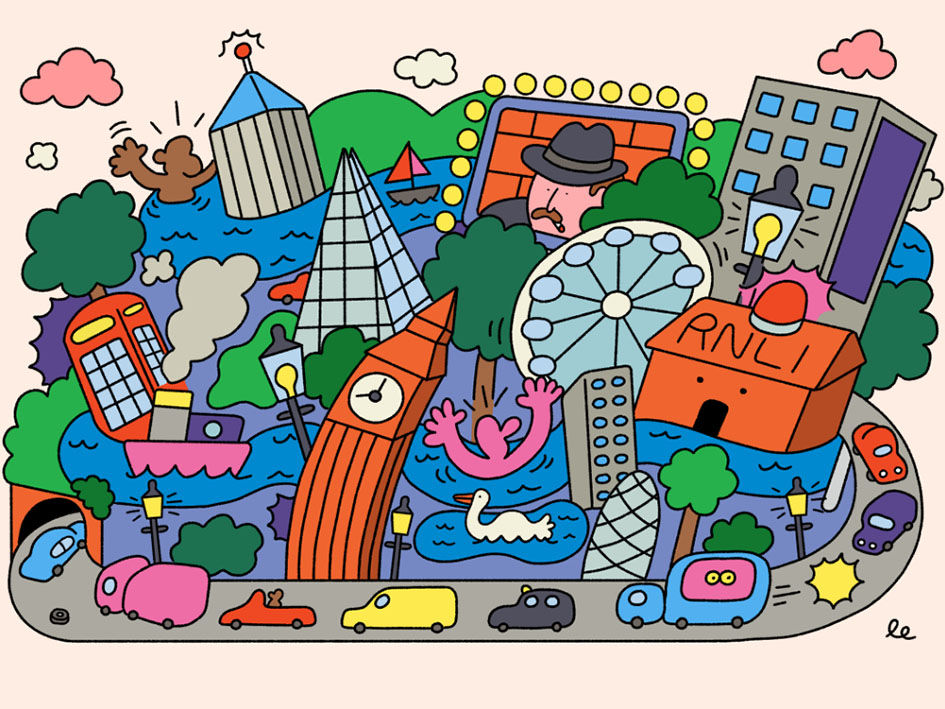
On the night of 20 August 1989, a Thames dredger struck the Marchioness pleasure boat near Southwark Bridge, sinking her almost immediately. In the aftermath of the tragedy, the question repeated: how was it possible that less than half a mile from Westminster 51 people could lose their lives? In the midst of our urban civilisation, how had we stopped noticing the river, this wildness beneath the city lights? And how could we ensure that nothing like that ever happened again?
In January 2001, the response was announced. There was to be a complete revision of emergency procedure on the Thames, involving the police, the Fire Brigade and the Royal National Lifeboat Institution (RNLI). Four new lifeboat stations would be positioned along the length of the river, from Teddington downstream to Chiswick, then to Tower (not under Tower Bridge, but opposite Embankment Tube) and finally out towards Gravesend (“the deep end”).
A little less than a year later, the first volunteers at Tower lifeboat station came on shift. Within a few months, it was clear that the knowledge the RNLI had built up over generations of coastal work (tides, currents, eddies and backwaters, how long to keep searching, how fast to get there, who they would be helping, what could be seen and what could not) needed radical adjustment. When they started, they expected between 100 and 200 call-outs, or “shouts”, a year in London. Tower station alone now gets an average of 560.
Twenty-five years on and it is now the busiest lifeboat station in the UK, with up to ten commanders and around 60 crew. On the coast, volunteers live nearby and are summoned by pager, but in London the crews are on site 24 hours a day, working 12-hour shifts. Some days they might do nothing more than train or watch the matrix noticeboard on the National Theatre opposite; on others there might be six shouts. On the overnight shifts they sleep between call-outs. As crew member Asher Robinson says, “When those bells go off and you’re in a deep sleep, dreaming, literally within 90 seconds to two minutes you’re at Southwark Bridge helping someone. At 40 knots.”
Who’s drawn to this type of work? Often, those who volunteer are from other blue-light services: paramedics, firefighters, coastguard or police. It can be those with a family connection with the river or the sea beyond, but there are just as many who come from unrelated backgrounds: banking, finance, tech, acting. Maybe it’s a love of London that unites them, or adrenaline, or the more practical career benefits of world-class emergency training. Behind the guarded public profile is a genuine zest and energy.
The work is year-round and there’s no particular rhythm to it – a spike around Christmas, more during good weather and school prom season (“inebriated 17-year-olds”). The sun brings people out, both on the shore and the boats. Any 999 call goes through to the UK coastguard, which triages service to situation: if it’s a crime, it’s the river police; if it’s a casualty that the air ambulance can get to first, it goes to them. The RNLI’s job is simply “to stop it getting worse”. “It” could be anything – the lifeboats deal not just with people in the water (however they got there), but also animals (because if the RNLI doesn’t go to them, a bystander probably will), anyone who’s injured or ill on a boat or a boat itself in trouble. Tower station deals with shouts from Battersea to Barking, while at Gravesend, where the river opens out into industry and ocean, the work shades into more familiar coastal matters.
And it gets busier every year. One May evening, as I sit at Tower talking to crew, a mumble of Thames cruisers, working boats, Ribs, waterbuses, lighters and party boats head under Waterloo Bridge. A police boat flashes upstream; a group of kayakers pauses in front of the National Theatre. The Thames is and always was a working river: the big cargo vessels moving spoil from the new London super-sewer are mere inches from the overheated commuters having a beer on the shore steps.
So what’s different about searching on the Thames? Speed, in all senses. The original river was three times wider but half as fast, its ancient shape still traced through the riparian names: Fenchurch Street, Lower Marsh Street, Rotherhithe. London was built from the Thames and on it: construction crews in the 1920s found the remains of hippopotami beneath the once-submerged Trafalgar Square. Gradually, the city walls closed in. The river, once stately and protean, became enclosed and defined. As it did so, it got faster; seven knots or more when the tide is running. Through the central London section the silt roused by passing traffic never gets time to fall and settle, so the water is always murky. It’s a long time since the Thames ran clear.
All of which affects the RNLI’s work. They’ve got only minutes to respond to someone in the water; even the fittest swimmer can’t swim against the Thames’s tide and, because there’s no visibility beneath the surface, it’s almost impossible to conduct dive searches. There is also a melancholic side to the RNLI’s work. An average of 30 bodies are pulled from the Thames every year, the majority of whom are suicides. Because they’re wary of copycat call-outs, the RNLI won’t discuss shouts in which mental health has been a factor. But, as Peter Ackroyd’s great biography of the Thames makes clear, the river has always received those who could take no more of life; at least two spots on the river were once known as the “bridge of sighs”.
Oddly enough, the other thing that makes river searches challenging is light. Until 2002, the RNLI’s night experience was searching unlit coast with, at best, floodlights and the moon for assistance. In central London, it’s the opposite problem. Look upriver and there’s Big Ben, Westminster, the London Eye; downriver is St Paul’s and Canary Wharf. Look opposite, and there’s the Southbank Centre. There’s also the streetlights and traffic of Waterloo Bridge. In this city of eternal light, it becomes even harder to find the one unlit thing you’re looking for. As navigator Ashley Bard points out, it can be disorienting: “If you’re doing a search, you see lots of lights on the water – you don’t know if it’s someone’s life jacket with their light in the water or if it’s just a reflection.”
The BBC Two series Saving Lives at Sea has boosted recruitment, though many had always been interested. Robinson, tells me he grew up downstream, and spent his childhood mucking around in an outdoor-activity centre: “I used to kayak up and down the Thames. We used to stop off at Bankside, have lunch, wait for the tide to come in, and then it was backflipping into the Thames, swimming into our kayaks and paddling back home.” He got into sailing and now runs a powerboat training centre in Shadwell.
He joined a couple of years ago. Was it like he expected it to be? “No. But in a good way, because, I’ve got to be honest with you, the only thing I was terrified with is the CPR. But when you’re in the moment and if it’s a life saved then, yes, you just feel great. Like, ‘OK, this isn’t actually so bad.’ You face what’s in front of you and you get a lot of support from everyone, so it just makes it worthwhile.” He looks through the window at all the splendour of London. Having done this, would he ever want to swap to coastal work? “For the experience, yes,” says Robinson. “But deep down everyone loves things where there’s a bit of uniqueness to it. Obviously, there’s loads of lifeboat stations on the coast, but I just love how unique this is. There’s nothing like it; the ethos is specific to the Thames.”
Bella Bathurst is the author of Field Work (Profile Books)
[Further reading: Who’s normal enough for Makerfield?]
Content from our partners
Related

This article appears in the 10 Jun 2026 issue of the New Statesman, How Britain lost control