It was a rainy morning in Tower Hamlets and a man told me to clone myself. Several people had done it already; one of the clones stared at me from an iPad screen, waving in an infinite loop. He was from Viven, an American start-up specialising in “digital twins,” or chatbot versions of real people. The company was the brainchild of two co-founders of Eightfold.ai, an AI recruitment service currently subject to a major privacy-related class action lawsuit in the US.
The digital twins were supposed to imbibe your knowledge, including even “tacit” knowledge, and spit it back out for anyone who might want to learn from you. You had to spend time training them yourself, uploading your meeting notes and personal documents. The man said you could even tip in the contents of your Gmail inbox, although he stressed to me that this was optional.
You have to have a certain amount of hubris to succeed in business. That hubris is inevitably grating to anyone who isn’t in business, which is why there is something particularly delightful about a moneymaking scheme with an obvious hole in it. I wondered where the financial incentives were. “Why would a professional give away all this information for free?” I asked. “Why forsake their consulting fees?” There was a pause. I thought I had ensnared the man. I thought I had become one of the Dragons from Dragons’ Den, most likely Deborah Meaden. I had not.
He told me about a product designer in India who saw the technology as a natural extension of his 70,000-strong LinkedIn following. The technology held some social value for him, even though he wasn’t doing any of the socialising. I went home and Googled the company, only to find it had already received $85m of investment. “This isn’t just digital transformation,” read one testimonial from an HR consultant. “It’s human amplification.”
The London AI Summit was a balding, besuited republic confined entirely to an industrial-style event space near Shadwell Underground Station. There were more men than women, more over-50s than under-50s, and big money lurking in the background – the kind of money that accumulates in inverse proportion to interesting clothes; the kind that turns managerial employees into CBeebies versions of themselves. (“We both said ‘SharePoint’ at the same time!” squealed an American woman advertising an AI file-scanning company.) Everyone at the summit acted in service of this money, although they rarely mentioned whether their own companies were profitable.
The government had chosen London Tech Week to announce an enormous funding package for AI. The delegates at the conference continued as if this had never happened. A woman advertising “e-residency” told me I could bypass British business bureaucracy by setting my company up in Estonia instead. It would be simple and fast, and cost under €200. I would never have to go to Estonia. She showed me a table on her phone: 5,557 Britons were already “e-residents”, and over a thousand British companies were actually domiciled in Estonia. An employee of an infrastructure firm was sure Britain would never see a spurt of data centres. Our energy prices, he said, were far too high.
This year, the focus was on AI agents. Chatbots are there to comfort the disturbed; agentic AI is there to perform thankless labour for the comfortable. The point is that everyone has a PA, scheduling things in calendars, paying bills, and booking plane tickets. Half the exhibitors appeared to be selling agents of some kind.
A young woman from an AI-generated marketing services company tried to describe her job role by AI-generating herself into a photo of a symphony orchestra. She was the conductor. To use AI agents effectively, she said, we had to “find the right problems to solve.” Most businesses were throwing cash down the drain by setting up useless agents. The issue was so prevalent that her company had come up with an internal acronym for it: “Identify, Recommend, Action”, or “IRA”.
This was what the summit was all about: distilling complex technology into mental models for children, or investors who might as well be children. On the main stage, AI was a “five-layer cake”, with energy, chips, infrastructure and AI models all supporting a real-life implementation. The resemblance to a cake stopped there; the metaphor was invented by Jensen Huang at Nvidia, which has cornered the chip market and has a smaller stake in each of the other layers. A panel discussion about European “AI sovereignty” saw higher-ups from the Ministry of Defence offering Miss World-level non-answers.
A senior vice-president from AstraZeneca told us that you could either be “plus AI” or “AI plus”, the latter of which they were doing at AstraZeneca. She told us to think of two people. There was Patrick, who had already died of lung cancer, and Amara, who would hypothetically beat her diagnosis because she lived in “a world in which AI empowered every element of her care.” She spoke about this unproven bundle of technologies as if it were a sports car or a fancy watch. AstraZeneca would treat Amara, who didn’t exist, with “speed, precision and insight”.
Patrick and Amara flashed up on the screen. They were older people, with AI-generated faces and hospice-like backgrounds. The speech sounded AI-generated too: the flat average of every script for a televised charity campaign, with predictable counter-positions and tonal lilts, planned pauses that could almost be em-dashes, and phrases like “But we can’t do it alone.” The man next to me watched the American version of Dragon’s Den out loud on TikTok. A pheasant’s feather sat in the brim of his fedora.
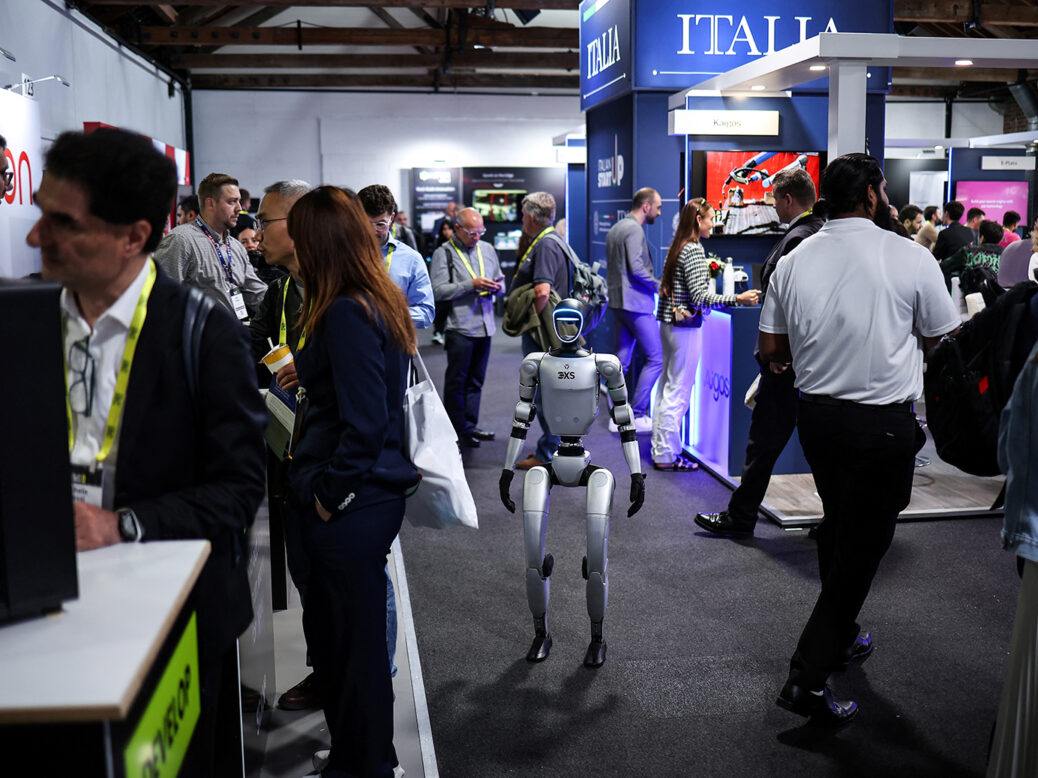
Back in the exhibitors’ area, two companies were attempting to give away a pair of Meta Ray-Ban smart glasses. (“Because the best AI leaders see everything,” said one ad.) The head of a humanoid robot perched on one table. It swivelled to address the crowd, although a blast of corporate EDM in the background drowned out everything it was saying. It was unnerving, not least because the designers had forgotten to add eyelids. A utopian illustration in the background demonstrated several possible use cases for the finished robot, which would eventually have a humanoid body too. The robot, who the designers said was a “she”, would walk about at “points of interest”. She would interview panellists at conferences and expos, not unlike this one. She would play chess with members of the public. A tired-looking team of venue assistants wandered around, wearing T-shirts that said: “Human in the Loop”.
Last year, consumer AI saw a taste revolution. Companies like Anthropic adopted serif fonts and hand-drawn illustrations, threw dinner parties for influencers, and ran adverts about the importance of thinking for yourself. But Tower Hamlets was the land of business-to-business, and the start-ups around me all seemed to take their aesthetic cues from chatbots that had been trained on previous start-ups. They were named in an all-too-familiar start-up language, which felt almost repulsive in its placelessness and weightlessness: Optimizely, Retool, Elsewhen, Unguess, Glean, Jeen. When I Googled the exhibitors, I often found websites that might have been built ten years ago: blue-purple gradients, rounded corners, sans-serif text, and equally placeless, weightless diagrams.
There is one big difference. A few years ago, these websites were plagued by drawings of utopian giants suffering from universal lipedema. They were industry mascots, standing for something larger than a single product: the techno-optimist worldview of the entire sector. AI has consigned this illustration style to the past, which might be the best thing it has ever done. Some of the larger corporations at the event came with mascots who looked like they ought to hang off Japanese keyrings. Folder-scanning service Glean had its own claw machine, stuffed with Labubu-esque, gap-toothed octopuses; the IBM pavilion featured a statue of its new chatbot character, the hard-hatted, totemo kawaii IBM Bob. As a startled-looking employee demoed the company’s new agentic system, IBM Bob gazed at me blankly. He looked as if he was about to turf Hello Kitty and her friends from their managerial office roles. A pair of HTML brackets decorated his round stomach.
“You showed up,” said an email at the end of the conference, directing me to a series of AI-generated podcast summaries. “You engaged. You challenged assumptions. You shared insights and built the connections that turn strategy into action.”
I hadn’t challenged, shared or built anything. I had been marketed to. At any other point in recent history, the sort of people marketing to me would have been forced to go door to door, selling makeup or encyclopaedias. As I walked back to Shadwell Underground Station, past hordes of businessmen and several corner shops, all I could think about was IBM Bob and his big, dumb, plaintive eyes.
[Further reading: The Bank of Canada is quietly running out of room — and Carney knows it]
Content from our partners



Related