
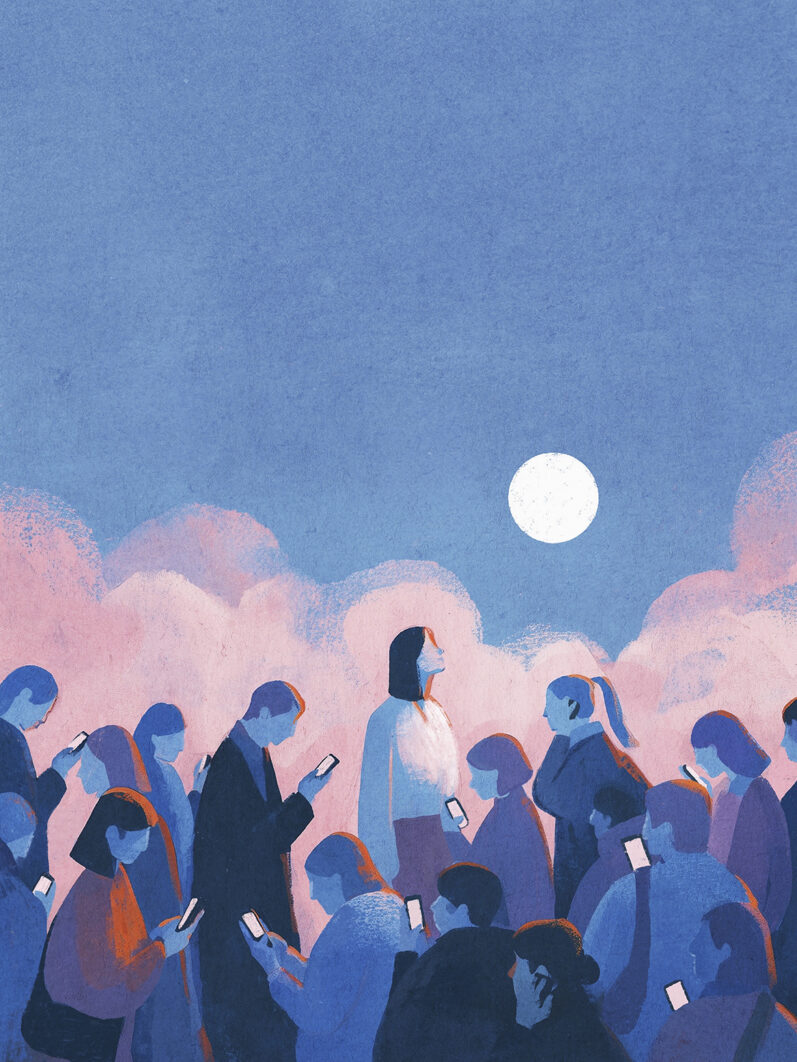
The announcement that the government plans to ban social media for under-16s has been met with opposition. Tech companies are against it, obviously. Meta, which owns Facebook and Instagram, has released a statement in which it claims, hilariously, that a ban risks “driving [children] to unregulated alternatives”, as if its platforms are regulated in any meaningful way. It’s also claimed that a ban risks “isolating teens from online communities and information”, as if capturing children’s attention, monetising their friendships and hosing them with misinformation isn’t the entire basis of their fantastically profitable business. But real people who don’t work for tech companies are also opposed to the idea, for reasons that are worth interrogating.
The first of these is the claim that it won’t work. Australia’s social media ban – on which the UK plan is based – is widely held to have failed because around 60 per cent of teenagers who were using the platforms continued to do so. I don’t have a maths degree, but I believe this also means 40 per cent of the children who were using the platforms stopped doing so. As public health interventions go, that is a huge success. In 2007, as smoking was banned in pubs and other indoor spaces in England, 20.9 per cent of adults smoked cigarettes; five years later, this had fallen to 20.4 per cent. That may not sound like much – as with the social media ban, most of the people affected carried on doing the thing the government was trying to stop them doing – but it was by no means a failure. Research suggests it pushed an extra 300,000 more people to try to quit smoking, and ten years later, there were 1.9 million fewer smokers in the UK.
I doubt the government really expects that everyone will comply with a social media ban if one is imposed, as currently planned, in 2027. It is not unusual for a law to be made in the expectation that most people will break it. The laws that make up our tax system are disobeyed – mostly by small businesses – to the tune of nearly £50bn a year. Speed limits are mostly unenforceable and widely ignored. On an uncongested motorway, 44 per cent of all cars are going more than 70mph (according to government statistics). In the average 20mph zone, 76 per cent of drivers are breaking the law.
This doesn’t make these laws useless, as evidenced by the one place in the British Isles that doesn’t have speed limits: the Isle of Man, where you can drive as fast as you like on out-of-town roads – and where a person’s chances of being seriously injured or killed in a road accident are twice as high as in England. Speed limits tell people how the government expects citizens to act, and this has significant implications for how people drive, even though they can usually break the speed limit and get away with it (and almost everyone does).
Another widely held objection to the social media ban is that it is unfair to young people. The government trusts teenagers with things like marriage, joining the army and democracy (the Representation of the People Act will, if passed, give 16-year-olds the vote), but it won’t trust them with a TikTok account or a cigarette. And surely older people are just as susceptible to misinformation, if not more – why aren’t the nans also being banned from Facebook?
The argument against this is that public health interventions are always more effective earlier in life, for fairly obvious reasons. Young people are more likely to change their behaviour, and the cumulative benefit of a 15-year-old making a positive change is much greater than a 65-year-old doing the same thing. The most important effect of the indoor smoking ban was that it reduced the number of young people who took up smoking, which meant that as older smokers died or gave up, the total was reduced. If the point of the policy is to reduce the extent to which the population is addicted to social media, there is an argument for following successful smoking reduction policies and imposing them on the young.
It’s also argued, persuasively, that the planned ban is a flimsy attempt at a quick fix by a government that has failed to regulate social media. That seems fair: X, for example, was used to generate tens of thousands of sexualised images of children, and it has not been banned. This is just the latest and most egregious example of all the horrifying results of allowing overseas tech companies to move fast and break things. YouTube, Facebook, Reddit and Twitter are all more than 20 years old and for most of their existence, they have been unregulated in the UK. Our government has tried asking them nicely to publish less horrifying content, or to make their platforms less addictive, or to be less aggressive in their collection and exploitation of personal data, and it hasn’t worked. They now operate with what looks like a sense of impunity. Clearly, the government should follow this up with more policies that are more nuanced and directed at the content the platforms publish. But for social media companies to do as they’re told, they have to be persuaded that they have something to lose.
[Further reading: What Trump’s Anthropic AI ban means for Britain]