
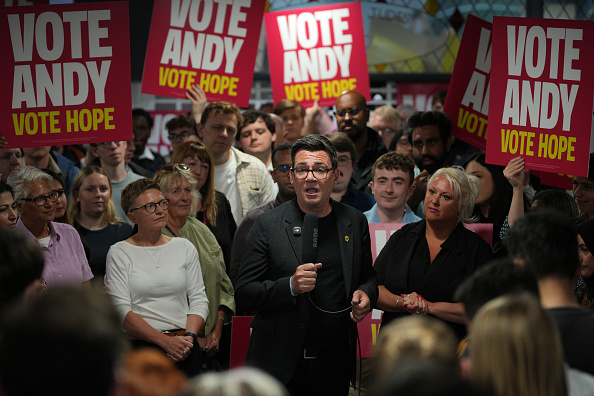
Judging by much of the coverage of the Makerfield by-election, you’d be forgiven for thinking Andy Burnham’s biggest opponent isn’t Reform UK but the bond markets. When he announced his candidacy, a flurry of articles tied his potential leadership challenge to rising bond yields.
Yet, over the course of the campaign, yields (which determine the cost of government borrowing) have fallen. Still, one political editor that “another bout of bond market volatility” is round the corner upon a Burnham triumph. Damned if yields are rising, still damned when they’ve gone down. Even if there is volatility after the Makerfield result, trying to extract a political story out of bond market movements is about as useful as reading tea leaves. And we’re the ones being taken for mugs.
It might be convenient to explain bond market movements through the lens of UK party politics, but other factors tell a more complete story. As the US and Israel’s attack on Iran sent oil prices shooting up, yields followed. Higher oil prices stoke inflation, which markets expect central banks to respond to by hiking interest rates.
The UK’s failure to stabilise inflation since 2022 has compounded this: markets now expect interest rates to remain higher for longer, and expect greater interest on government bonds in return.
Volatility in UK bond markets is a problem, but to understand its drivers we need to look at who is buying bonds. The UK market has moved away from patient defined-benefit pension funds who plan to cover their long-term commitments. Now, the market is dominated by hedge funds and international investors. Such buyers, with their itchy feet, leave the UK prone to sudden swings that spook financial commentators.
Of course, UK politics does play a role: uncertainty over policy causes speculation. Burnham has attempted to calm the markets by committing to fiscal rules. This may somewhat explain falling yields, but market speculation predates the challenges to Starmer’s premiership.
Gita Gopinath, former chief economist of the International Monetary Fund, blamed the UK’s fiscal framework for creating excess policy uncertainty, where tiny fluctuations in the market lead to massive consequences for policy. We saw this in last year’s spring statement: small bond-yield movements suddenly created the need to cut disability payments.
The UK’s bond market troubles, therefore, run far deeper than the potential that Andy Burnham may become prime minister. His comments that we need to get “beyond being in hock to the bond markets” worried some as it could indicate that he will simply ignore bond market movements entirely. But if they indicate an intention to move UK politics away from being overly sensitive to bond market movements, it should be celebrated. The key question is how will he do it?
One answer is sadly familiar: to reduce our dependence on bond markets we must borrow less from them. However it is dressed up, this is a call for austerity – and it’s seemingly the favoured view of bond traders.
One investment officer suggests the UK must cut welfare to prevent a “culture of benefits dependency”. Others worry about a rise in green infrastructure spending. Here, the cost of shucking off bond markets falls on the poor and the victims of climate breakdown. The last decade and a half has shown us that austerity damages the economy and fails to bring down debt – and thus our dependence on bond markets will remain.
Fortunately, there is a less painful way to reduce the amount of government bonds being sold, but this requires looking at the Bank of England. Recently, Daniela Gabor and Adam Tooze have highlighted how the Bank’s actions are making the government’s fiscal situation more difficult. Roughly 20 per cent of government bond sales come from the Bank as part of quantitative tightening (QT). These sales add to the supply of bonds which the market already has to absorb from government borrowing. If the Bank of England were to stop its sales it would align itself with the central banks in the US and Eurozone and ease pressure on market to absorb additional bond supply.
Besides reducing borrowing and bond sales, lowering interest rates would reduce how significant bond market movements feel. The best way to get interest rates down is to lower inflation. Government policies to reduce the price of essentials like energy bills or groceries, either through price controls or public ownership, could be promising but will require the political courage to challenge market power.
The above measures aren’t without their criticisms. Gopinath warned that “heterodox” policies like nationalisation, price controls and getting the central bank to absorb its fiscal costs could be bad for the economy. Yet in her warning, “bad for the economy” means bad for stocks and bond markets.
If the alternative to these heterodox measures is austerity, then shouldn’t we have a debate on where economic costs should land? If we want to live in a democracy that doesn’t just obey the bond markets, these tools must be part of the conversation, even if they are costly.
Regardless of who is prime minister, without serious reform, bond market movements will remain a major news story. None of these reforms will be costless. The real question is who will bear these costs. Currently, bond traders are trying to make sure it is not them.