

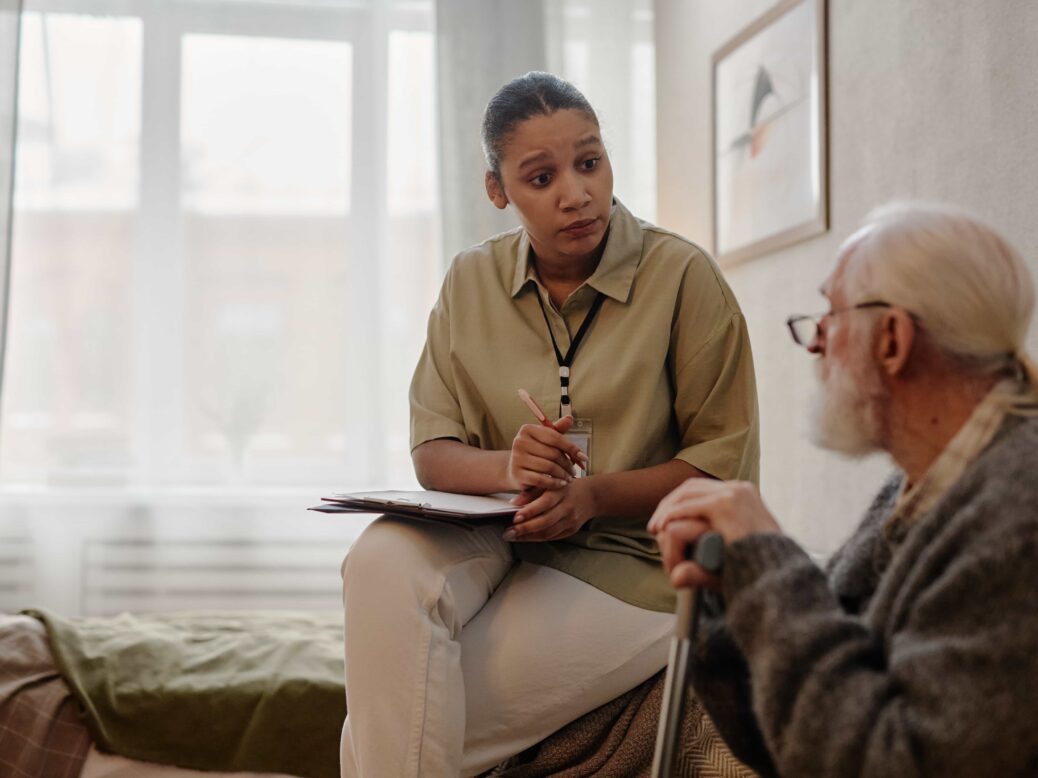
On 20 September 2025, the Labour movement lost one of its most principled and dedicated champions of social justice, Iain Coleman MP. Elected to Parliament in 1997, Iain was renowned in his constituency for introducing free home care as Leader of Hammersmith and Fulham Council. For Iain, that legacy was deeply personal. After leaving school, his first job was as a care worker. Decades later, in a cruel twist of fate, after suffering more than 20 strokes and developing early-onset dementia, he came to rely on the very policy he had fought to introduce.
It was 35 years ago, in 1991, that Iain secured the support of fellow councillors and senior officers to implement universal, non-means-tested home care in Hammersmith and Fulham, removing charges for everyone who required home care, regardless of their personal wealth. This was a deliberate socialist reform: any taxpayer in the borough who needed support because of illness, disability, dementia or frailty could benefit. Everyone contributed, and the protection was available to all, should the throw of life’s dice not be kind to them.
Driven by Labour leadership, the scheme was ambitious and required disciplined financial management: cutting unnecessary costs, striking good commercial deals, and redistributing resources from residential care towards supporting people in their own homes. It worked. Free home care enabled residents to remain at home for longer, often indefinitely, on their own terms. In doing so, it removed what amounted to a local tax on disability, dementia, illness and frailty. While other councils require people with more than £14,250 in savings (excluding the value of their own home) to contribute towards the cost of their home care, and those with more than £23,250 to pay the full cost, Hammersmith and Fulham provides home care on the same basis as healthcare: free at the point of need.
The policy proved so successful that, despite the Conservatives reintroducing means-testing between 2009 and 2014, the borough abolished all home care charges once again in 2015. In the May 2026 local elections, Hammersmith and Fulham bucked the national trend, remaining firmly under Labour control. The popularity of free home care was reflected in the Conservatives’ pledge to retain the policy. Hammersmith and Fulham’s experience shows that, where there is political will, there is a way, and it has served as a model for Tower Hamlets, which followed suit by introducing free home care in April 2025.
The outcomes in Hammersmith and Fulham speak for themselves. By June 2019, 7.5 people per 1,000 were receiving home care, the highest rate of any London borough and nearly double the London average of 3.9. Adult Social Care Outcomes Framework data show that the number of people aged 65 and over in residential care in the borough fell dramatically, from 828.3 per 100,000 in 2014-2015 to 219.5 per 100,000 in 2024-2025. This places Hammersmith and Fulham fourth nationally for the lowest number of older residents in care homes among local authorities. The borough’s discharge outcomes are also strong: in 2023-2024, 95.7 per cent of people in the local authority area remained at home 91 days after discharge, placing the borough
fifth nationally.
The financial case is equally persuasive. An NHS hospital bed costs around £562 per day to staff and maintain in 2025–2026. In contrast, home care, at the 2025–2026 average fee rate of £25.05 per hour, costs just £100.20 to £150.30 for a four- to six-hour support package. Furthermore, in 2026-2027, only 16 per cent of Hammersmith and Fulham’s £123m adult social care budget is allocated to home care, while 33 per cent is allocated to residential care, despite the comparatively low number of people in care homes. Indeed, following its research into the Hammersmith and Fulham model, the Disability Law Service, with the backing of disability rights groups and charities, is now campaigning for the abolition of home care charges.
The arguments for free home care are compelling. First, it is fair and socially just. Disability, dementia, illness and frailty should be treated as shared social risks, not individual financial liabilities. We do not means-test medical care, so why do we means-test support with basic personal care such as washing, dressing, drinking and eating?
Second, it aligns with most people’s preference for maintaining their autonomy and ageing well in their own homes rather than in institutions, surrounded by family, friends, familiarity and community.
Third, it is economically rational. Preventative home care reduces falls, infections, dehydration, malnutrition, and physical and mental decline. It decreases ambulance call-outs, hospital admissions, delayed discharges and readmissions. It is also significantly cheaper than hospital beds and residential care.
Fourth, it supports unpaid carers, who are the invisible backbone of the system and save the public purse billions each year. Free home care reduces the risk of burnout, income loss and ill health among carers, enabling families to sustain informal care arrangements and remain economically active.
Fifth, it strengthens integration between health and social care. When social care is unavailable, unaffordable or rationed, the NHS absorbs the consequences, with hospitals becoming substitutes for community support.
Sixth, it aligns with broader social trends towards home working and care in the community, with advances in assistive technology, telecare and artificial intelligence creating the conditions for a major expansion of home-based support.
Seventh, it complements innovations already being developed across the UK, including meals-on-wheels services, Shared Lives schemes, technology-enabled care, telecare, AI-supported social care tools, Hospital at Home programmes, integrated neighbourhood health teams and age-friendly neighbourhoods.
Eighth, it would help grow the care economy, creating skilled, community-based employment and supporting job creation in domiciliary care and allied professions in every town, city, village, hamlet and homestead across the country.
Baroness Casey recently made the powerful observation that social care, unlike the NHS or the benefits system, has never had its own creation moment – no founding settlement, no defining national mission, and no equivalent of 1948.
At the same time, many people across the country are frustrated by the pace and scale of national change.
We see free home care as a key stepping stone towards a National Care Service: a reform that can begin to take shape this year, with the potential to deliver the transformational change people are seeking, provide a modern Bevan-style legacy, and offer a policy that could help Labour win the next general election.
As Aneurin Bevan drew inspiration for the NHS from a successful local model in his hometown of Tredegar – the Tredegar Medical Aid Society – we draw inspiration from Iain’s legacy in Hammersmith and Fulham. Like Tredegar for Bevan, the Hammersmith and Fulham model demonstrates that change and socialism are not utopian: they are deliverable. Care should not simply be a private act of love carried out by families behind closed doors, nor a patchwork of unequal provision depending on postcode or wealth, held together by workarounds, sticking plasters and glue. It should be a national commitment and a collective responsibility we all share, recognising that care touches us all.