
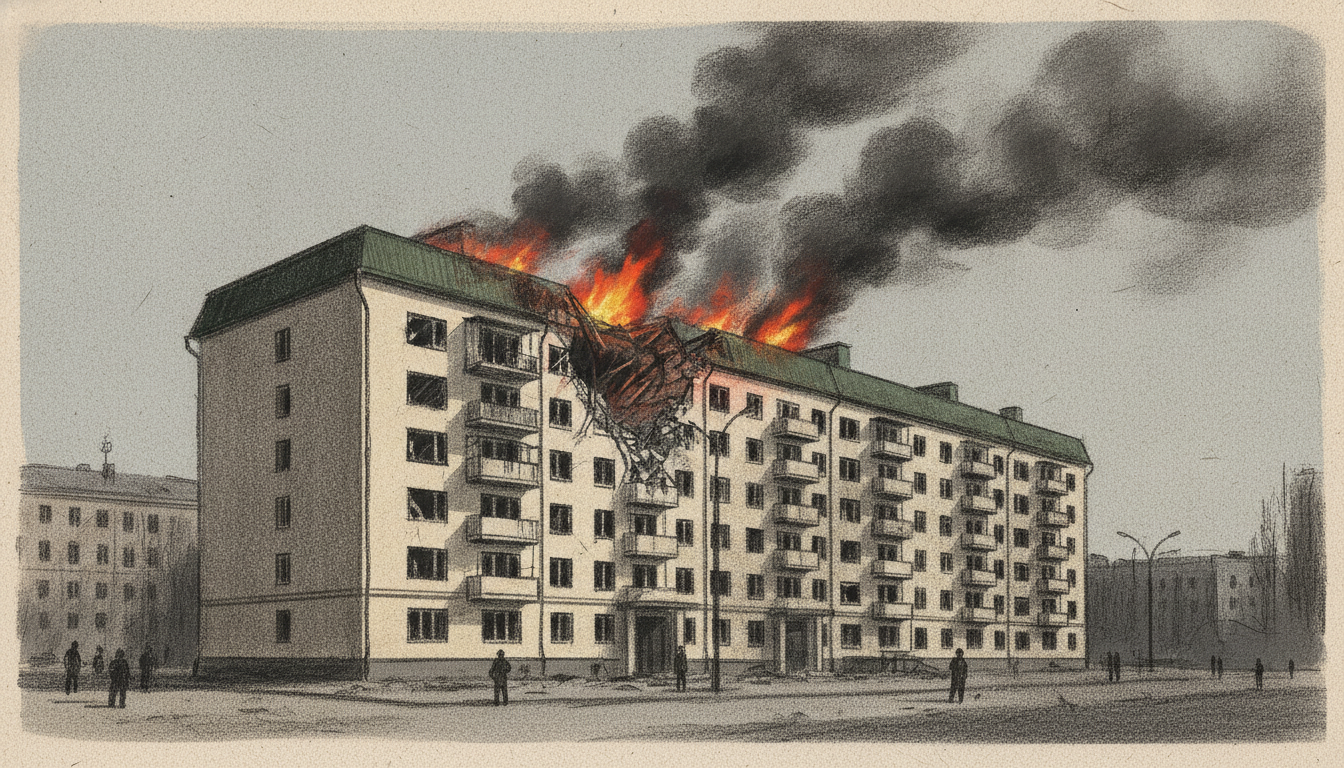
Russian ballistic missiles struck Kyiv on the night of 15 August 2026, igniting fires in two city districts, and Moscow’s air‑defence systems intercepted more than 130 Ukrainian drones over the Moscow region, causing three injuries, according to officials quoted by Handelsblatt.
Missile strike on Kyiv
Kyiv mayor Vitali Klitschko posted on Telegram that Russian ballistic missiles hit the Ukrainian capital, producing explosions throughout the city. He wrote that the attacks caused fires in two districts and that fire‑fighters were on the scene. The mayor’s message, published on the night of 15 August, is the primary source for the claim that the missile strike resulted in localized blazes.
Klitschko’s Telegram post did not give a precise count of missiles or casualties, but it did urge residents to remain in designated shelters. The Ukrainian Air Force also reported, via its own Telegram channel, that the attack was accompanied by rockets, glide‑bombs and drones targeting other Ukrainian cities, though the focus of this article remains on the Kyiv strike.
While the exact extent of material damage is still being assessed, the fire services confirmed that they were actively fighting blazes in the two affected districts. No fatalities were reported in Kyiv at the time of writing, and the mayor’s statement did not mention any injuries.
Moscow’s air‑defence response
In a separate development, Moscow mayor Sergei Sobyanin announced that the capital’s air‑defence forces had shot down “over 130” Ukrainian drones during the same 15‑16 August period. The figure comes from a statement that Sobyanin relayed to Interfax, which Handelsblatt cited in its report.
Interfax, a Russian news agency, confirmed the number of intercepted drones as “more than 130”. The mayor added that three people were injured during the interceptions, though the report does not specify the nature of those injuries or their locations within the Moscow region.
The intercepted drones were described only in aggregate; no details were provided about the types of drones, their launch points, or the specific air‑defence systems employed. The lack of granular data leaves open questions about the scale of the Ukrainian drone operation and the effectiveness of Moscow’s defensive posture.
Chronology of events
- 15 August 2026 – Russian ballistic missiles hit Kyiv; explosions reported across the city.
- 15 August 2026 – Fires broke out in two Kyiv districts; fire‑fighters deployed.
- 15‑16 August 2026 – Moscow’s air‑defence intercepted more than 130 Ukrainian drones; three injuries recorded.
The timeline, as compiled from the Handelsblatt article, shows that the two theatres of conflict unfolded almost simultaneously, underscoring a rapid escalation in both offensive and defensive operations.
Implications and unanswered questions
The twin incidents raise several policy‑relevant issues for Canadian observers of the conflict. First, the use of ballistic missiles against a major urban centre suggests a willingness by Russian forces to employ high‑value, long‑range weapons in a densely populated area, increasing the risk of civilian casualties and infrastructure damage. Canadian defence analysts will likely monitor whether similar tactics appear in other fronts, as they could affect NATO’s strategic calculations.
Second, the large‑scale drone interception over Moscow indicates that Ukrainian forces are capable of projecting unmanned aerial assets deep into Russian territory. While the intercepted count exceeds 130, the absence of a baseline (e.g., how many drones were launched, how many were successfully neutralised in previous weeks) makes it difficult to gauge whether this represents a spike or a continuation of an existing pattern.
Third, the three injuries reported in the Moscow region are the only confirmed civilian impact from the drone interceptions. The nature of those injuries—whether they stemmed from debris, stray fire, or other causes—has not been disclosed. Canadian humanitarian agencies tracking civilian harm in the conflict will need further detail to assess the broader human cost.
Finally, the reports rely heavily on statements from city mayors and a state‑run news agency. Independent verification on the ground, such as satellite imagery or third‑party eyewitness accounts, has not yet emerged. The lack of corroborating evidence means that the full scope of damage, both in Kyiv and Moscow, remains uncertain.
What remains unknown
Several key facts are still missing:
- The exact number of ballistic missiles launched and the specific types used.
- The total area of the fires in Kyiv and the extent of property damage.
- Details on the Ukrainian drone fleet involved: launch sites, payloads, and intended targets.
- The precise location and circumstances of the three injuries in the Moscow region.
- Any civilian casualties in Moscow beyond the reported injuries.
Until further information is released by the respective authorities or verified by independent observers, these gaps will limit a full assessment of the incidents’ strategic impact.
Looking ahead
Both Kyiv and Moscow are likely to adjust their civil‑defence protocols in response to the latest attacks. Kyiv’s mayor has already urged residents to remain in shelters, a directive that may be extended if further missile strikes occur. In Moscow, the high number of intercepted drones could prompt a review of air‑defence readiness and possibly a tightening of air‑space restrictions.
For Canadian policymakers, the events underscore the fluidity of the conflict’s front lines and the importance of real‑time intelligence. Monitoring the frequency of ballistic‑missile use and large‑scale drone operations will be essential for shaping Canada’s diplomatic and defence posture toward the region.
As the situation develops, the next steps will hinge on whether either side provides additional data, and whether independent monitors can corroborate the claims made by Kyiv’s and Moscow’s municipal leaders.