
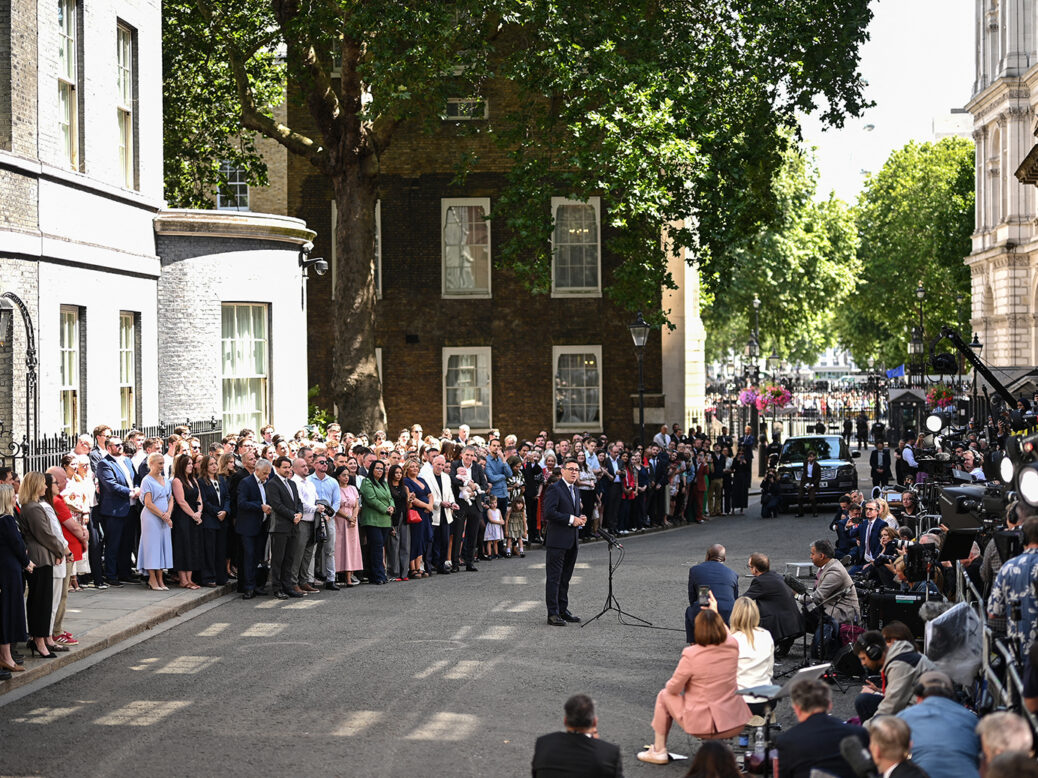
The queues to get into Downing Street for Andy Burnham’s first day in No 10 were hot and long, an atmosphere of genial chaos. The international media was kept to one side to allow in a stream of northern Labour folk; you could tell they were northern because they were dressed more smartly than Londoners – and quite right too. The amplification of music outside Downing Street being temporarily banned (there’s fascism for you, comrades), a baritone simply sung Beethoven’s “Ode to Joy” up the street towards us.
I watched, perched on a scaffolding balcony, as the big cheeses of TV journalism interviewed one another, for want of anyone more interesting to talk to. When Burnham arrived, he spoke well, without notes. But as the hacks left, the predominant sentiment was: “Well, there’s another one…”
It may be my personal weakness (as a journalist it certainly is), but I am a natural optimist and I really want Burnham to succeed. Perhaps Labour’s anthem should be that formidable earworm: “I get knocked down/But I get up again.” Chumbawamba are not, granted, the most obvious choice: Burnley, not Manchester; anarcho-left, not the People’s Party. Famously, they doused the late, great John Prescott with ice-cold water at the 1998 Brit Awards, in protest against New Labour’s treatment of the Liverpool dockers. But as somebody who, post-stroke, does occasionally fall, I’ve always loved the defiant optimism of “Tubthumping”. An old truth: nothing matters more than character. We get knocked down. We get back up again.
And so it begins
Which applies, as well, to all those angry about the new cabinet, including friends who have been disappointed. Cabinet-making is always about balance, power and competence. But it’s also about settling old scores. At one point, late in the evening, there were so many people inside Downing Street waiting to find out their fate that I wondered whether Britain was heading for an impromptu coup. As it is, Burnham has created a formidable Starmerite briefing machine against him. By the following morning, thanks to Darren Jones, it had already begun.
Evading the warpath
Mention of Prescott allows me to trot out an old story about my best interaction with him. Years back, when I was BBC political editor, I was walking late at night, after the ten o’clock news, along a corridor at the back of a Labour conference building. Around the corner, suddenly, followed by a flock of nervous-looking civil servants, came John, furious-looking, arms windmilling like some demented combine harvester. And he came straight for me.
He stabbed me with his forefinger, quite hard, in the chest and said something like: “You fooking bastard, you bastard! I’ll fooking have you…” He then stormed off round the next corner and vanished, leaving me bemused. I had, perhaps, said something slightly rude about the conference on the news, but was it really that bad? Seconds later he reappeared, wryly: “Sorry. Wrong bloke.”
Made of tougher stuff
Watching Burnham accept the Labour leadership with Neil Kinnock, David Blunkett and Margaret Beckett in the audience made me think about how little most of today’s politicians know of really hard times. In the year I was born, 1959, Blunkett’s father, who worked for the East Midlands Gas Board, died after falling into a vat of boiling water. Because he’d worked to 67, beyond the then retirement age, the family received no compensation for two years. It was an act of cruelty.
Beckett also grew up in poverty and lost her father, a disabled carpenter, in childhood. She and her late husband were famously frugal, enjoying modest caravan holidays in later life. As for Neil Kinnock, he once told me that when he stayed with his grandparents in a workers’ cottage between a colliery, gasworks and railway line, the air was so filthy that his gran would call him inside from playing, not to say, “Dinner’s getting cold,” but “Dinner’s getting dirty.” If you ever wondered where the grit comes from, that’s where.
A tribute to excellence
I was late to the party that is the Hurvin Anderson show of paintings at Tate Britain. But what a party it is. Here is a painter so prodigiously talented and ambitious that he overshadows the Whistler exhibition also on there, excellent though it is. It made me ask myself why so many black and Arab artists are at the forefront of contemporary painting – I’m thinking of the glorious Lynette Yiadom-Boakye, Chris Ofili and Zeinab Saleh, all Tate regulars, and of Claudette Johnson. A fine tradition dominated by white men has now accumulated new energy and meaning. But perhaps I shouldn’t be surprised; just the same has happened to the novel.
[Further reading: Larry the cat and “Ode to Joy”: how Andy Burnham’s coronation unfolded]