
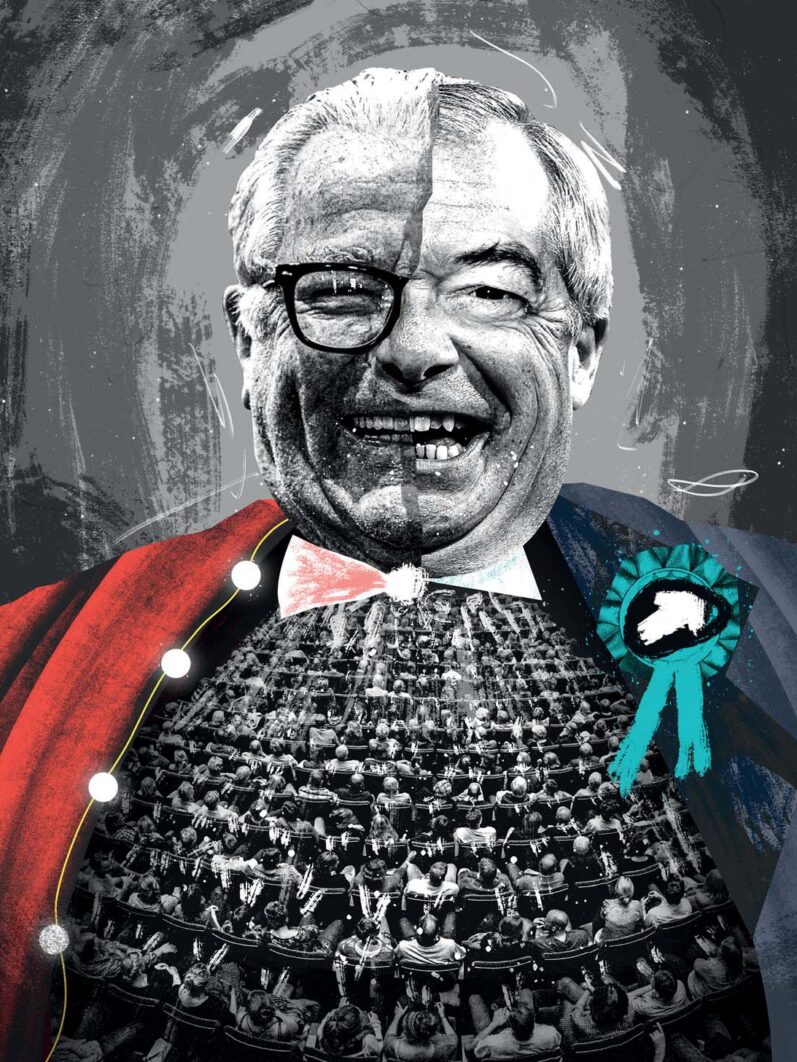
I went because he dared me. “What the f*ck do you want to come and see me fo? [sic] Just write I am sexist and racist not funny and a fossil and save the train fare. Hope you are ok. Jim Davidson OBE.” Those were the exact words of Davidson’s email, a reply to my request for press tickets to one of his gigs. And what the fuck did I want to come and see him for? While Jim Davidson is still a touring comedian, in polite quarters “Jim Davidson” is a punchline, a catch-all for a dying breed, one exiled from Saturday night primetime to provincial theatres, hotels and drive-thrus. Perhaps I wanted to see the pathos of that journey: the ocean of fame, lifting people high upon its crests, before sending them crashing to the depths. But the truth is I had more calculated and politicised reasons for watching Davidson perform.
In the past two years, Davidson has effectively become the house comedian of Reform UK. At the party’s 2024 conference, I saw him lounging in the VIP area – an open-top Reform battle bus – and heralded as “the greatest cultural hero of our time” by Lee Anderson. Reform’s unofficial “chief whip” is now a regular at Davidson’s gigs, and a dinner companion. Davidson has also been photographed with the Reform deputy leader Richard Tice, and is occasionally in touch with Nigel Farage. On his YouTube channel he broadcasts political commentary: “Andy Burnham Is a W*NKER”, 200k views. And his fiancée, Tash, his sixth, is a Reform party member.
Davidson himself is a lifelong Conservative, and was a friend of the late Margaret Thatcher. He will not join Reform, as doing so would involve giving up his Carlton Club membership. But he is undeniably part of the party’s soul. Anderson’s speeches – with their nicknames, pantomime and yollering – are amateurish Davidson efforts. At Reform’s 2025 Conference, Anderson was introduced to the stage as a “famous international comedian”. And this is all part of the attempt to turn Reform into a culture as much as a party, an all-inclusive resort of right-wing politics, with unlimited drinks. They have a TV channel (GB News), a broadsheet (the Daily Telegraph), a tabloid (the Daily Express), a telly don (David Starkey), an Emmanuel Goldstein (Rupert Lowe) and a suite of minor celebrities (GB News presenters, Laila Cunningham; the convicted racist Lucy Connolly). I wanted to see this culture for myself, in its naked form, outside Reform’s institutional bounds. And so, after some email negotiation, I arranged tickets for Jim Davidson’s gig of 5 July, at the West Cliff Theatre in Clacton-on-Sea.
I didn’t know, when I went, that Clacton was going to become the biggest joke of the political summer. Two days after the gig, Nigel Farage resigned, triggering the 2026 Clacton by-election. And SW1 hasn’t stopped laughing since it became clear that Farage would have one main opponent: Jonathan Harvey, who once helped write Victoria Coren Mitchell’s bum-clenchingly bad autocue on Only Connect and now haunts high-profile constituency results as a giant space alien called “Count Binface”. Since then, it’s been one skit after another: Binface on the Today programme, Binface on Newsnight, and an unravelling tapestry of Binface lore (he says he is a 5,900-year-old alien called a Recyclon, and his home planet is Sigma IX). There has been noble talk of Britain’s satirical traditions, and praise for this representative of “Silly Sausage Britain”.
Harvey himself is only giving interviews in character, so it’s impossible to know what he really thinks of the show, or of becoming its biggest clown. But Binface’s appearance as a comedy candidate has come to feel oddly charged. Comedy is something like a surrogate nationalism in Britain, a source of pride and identity. It does a disproportionate amount of political load-bearing via “satirical” television and “radical” comedians. Like some ancient theology, it is riven with schisms and excommunications. And so, while there will be no political struggle in Clacton, this by-election is far from uncontested. If Reform is a culture as much as a party, there is a culture behind Binface and Jonathan Harvey too, one he laboured in the margins of for much of his TV career. It is the culture of Have I Got News for You (which Harvey worked on, and wrote for), Private Eye magazine and BBC 6 Music, Waterstones dads and Amandaland mums. It is arch, metropolitan, wry and retains a battered optimism about British liberalism, one that very easily looks like smugness when it catches the light. It backed Al Murray’s “Pub Landlord” character when he stood as a comedy candidate against Farage in South Thanet in 2015. It backed Eddie Izzard against Farage on Question Time before the Brexit vote. It thinks, all told, that what Farage needs is a good milkshake to the face – if not, as Jo Brand once joked on BBC Radio 4, “some battery acid”.
This culture has been embarrassed before. Ironically, it was via light entertainment that Boris Johnson became liberal England’s favourite Tory. But apparently no defeat can dampen its cheer, or self-confidence. When Binface spoke to Alastair Campbell last summer, they agreed that the true political divide in Britain is between the “sane and mad”. Which raises two questions. Is it “sane” to go looking for political hope in the bottom of a bin? And what, in a society divided in such Swiftian terms, would you do about the “mad”? Because, unfortunately for the sane, mad people don’t know that they’re mad.
There is a rather different national culture behind Nigel Farage. It is just as easy to stereotype. It gets its news from the Daily Mail, its thrills from Minder boxsets and its history from the Churchilliad. It is regional, but highly concentrated where you can find it; headstrong, hoary and hidden from mainstream view. But we will see it at its most fervid in the next few weeks: Farage needs to rally his vote to prove that the people are with him. He needn’t worry. Clacton has some claim to be the most right-wing constituency in Britain, and this culture is very at home there. Because, when I went to the Davidson gig, the people didn’t find Count Binface funny. This is what they found funny.
Fat birds, Pakistanis, Swedish, Australians and the “fucking Irish”. Paupers, ponces and poofs. “The mixed-race little gay man who drives for Ferrari” (Lewis Hamilton). “The little singer off the pink bus” (Will Young). Female sports commentators. Shaun Wright-Phillips. Lesbian footballers. Jaywick (or “the shithole”, or “Gay-wick”). Benefits claimants. People with autism. People with ADHD. Angela Rayner’s pubic hair. Katie Price. George “Keith” Floyd. “Mayor Khan”. Black people in adverts. The Green Party. The NHS. NHS nurses with West Indian accents. “Our once-great country”. Students. Diverticulitis. Zack Polanski’s teeth. “The New Statesman”.
These were just some of the themes, fineries and details of Davidson’s Clacton gig of 5 July (the last may have had something to do with the presence of your correspondent). He spoke for a little under two hours to a 580-strong crowd, in a theatre shaped like a huge Anderson shelter, painted red and blue. The audience was full of bald husbands in short-sleeve shirts and plump wives in summer dresses. They were old – but so is Clacton, with a third of the constituency aged 65 or over. Everyone I saw was white – but so is Clacton, 96 per cent. And they loved it. The woman in the row behind me could barely gather enough breath to voice her ecstasies. Gemma was sitting at the front. She claimed this was her 305th Davidson gig.
I made it through, but I have friends who I think would have been sick on their laps. About the only people to come off well in Davidson’s show were the veterans of the Falklands War, Rudyard Kipling (he quoted “Mandalay”), and the late Cornish comedian Jethro, one of Davidson’s contemporaries and comrades. Davidson is a true pro, working the audience, snapping on necessary improvisations and inhabiting accents and impressions without a second glance. But watching him is like staring down a mortar barrage, and to leave at the interval is to feel authentically bombarded, the obscenity ringing around your head like shellshock. Jokes about dick sizes, jokes about geriatric sex, nasty West Indian accents, jokes about wanking, jokes about black people (“Big bloke – did you know his father was a boxer? His mother was a cocker spaniel”). It wasn’t an end-of-pier show. It was something more grotesque: the troll who lives under the pier.
Politics lurked within every vulgarity – a politics that might be summed up not as “hang the paedos, fund the NHS”, but as “hang the paedos, and fuck the NHS too”. Minutes into the gig, Davidson called for the national anthem. “Keir Starmer’s a wank-uh,” the crowd sang, with no further prompting. And at the end of the first half, after a long gynaecologist routine, complete with slushy sound effects, Davidson declared: “In the second half, I’m going to prove to you, via me, that you’re not alone. We’ll get together and see what we can do to get a bit of change in this country. It’s not about the asylum seekers, it’s not about all the fucking ponces. It’s about a rotten, fucking government.” Loud, inspired applause. During the interval, he came out to greet fans. “He blends in with the crowd, don’t he!” cooed one. He greeted me when he saw me in the bar. It was decorated with pictures of previous guest performers, everyone from Bradley Walsh and Sooty to old forgotten comedians in black and white, fiddling with their bow ties. Davidson nodded at the crowd. “Like a Reform waiting room,” he grinned.
He didn’t used to be like this, not quite like this. Davidson first rose to fame in 1976 by winning New Faces, the main talent show of the decade, which also gave us Les Dennis and Roy Chubby Brown (and Lenny Henry and the Chuckle Brothers too, though they’re obviously a slightly different kettle of fish). Davidson’s act at this time was offensive – he was known for a character called “Chalky White”, played with a thick West Indian accent – but also very popular. He reached his peak in the Nineties when he succeeded Bruce Forsyth on The Generation Game, then counting his viewers in the tens of millions. In 2001, he was awarded the OBE by Prince Charles for his charity work with the British armed forces, flying out to Blair’s warzones to entertain squaddies. And in the same year, he performed a private gig for the Prince at his Highgrove estate, as part of the Beaufort Hunt Ball. Before he went on stage, he later said, Prince Harry told him to “go for it”.
“Still not been paid!” Davidson joked of the Highgrove show when we spoke before the Clacton gig. He had slicked-back silver hair and was wearing a gold watch, a gold chain and a white T-shirt, inside-out. He was friendly but full of nervous energy, switching between reading and distance glasses when he looked at his laptop and then looked back at me. In June, he finished the run of his adult pantomime Big Dick Whittington in Wimborne, and told me that he’d taken “a million quid through the door” so far this year. “All the people from my time are all really struggling to get any work, whereas I’m busy,” he said. “This is sold out. I could have done two [shows] here tonight.” It was, and I believe he could.
At first he was matter-of-fact about who would be coming: “I think the audience that come to me would all vote Reform at the drop of a hat.” But when I asked about Davidson’s relationship with that audience, I met a curious mixture of intelligent reflection and commercial fatalism. “I do a fucking awful thing now about disabled people and mentally ill people, it’s fucking shocking,” he said in one moment. “I nearly get a standing ovation for doing it, and I’m fucking ashamed of doing it, I really am.” In another: “I talk about things and I convince people that that’s what I believe, and I don’t. It’s cheating. It’s showbusiness.”
When I suggested that he was responsible for fuelling political paranoia, he joked: “Yeah, to get laughs, yeah. I’m a fucking whore! No – I do believe that there is some issue worth talking about, but I’m not fuelling it… I just look at what they’re thinking and talk to them about it. Am I fuelling it? I’ll have to deal with that morally.” He also drew a distinction between himself and other “offensive” comedians, saying he didn’t offend “for the sake of it. Not like Ricky does, and Jimmy does: ‘I can say this, I’m Jimmy Carr, I’m Ricky Gervais.’ Not me. I bring it up as something that I see, and I know that they see it.” In other words, he doesn’t see his comedy as a statement of bravery or radicalism; the comedian defying the censor. It’s a more basic ceremony of mutual recognition and rapport – even, perhaps, an exercise in empathy.
In his bones, Davidson is a straightforward Thatcherite. “Don’t reward people who don’t do anything,” he told me. “I don’t like the idea of scroungers and ponces. I really hate that.” But his language became even darker as we moved on to contemporary politics, and more confused. If someone said, he began, “So, Jim, are you racist?” he’d say, “Not yet. Not yet. Seriously getting close to it.” I asked why. “Every time you pick up a paper – I don’t know who’s driving this, whether it’s the papers that only report on the Asian rapists or the Asian murderers. There seems to be some agenda to push black, coloured, minorities to the fore, to try and even it all up, which pisses off all the white ones and just makes better bigots out of them. What it does is fuel the bigot.” Then, in a hushed voice, he took on the character of a conspiracist: “I know what we’ll do. We’ll get Jim Davidson a reputation, and put more black people on the television, and we won’t report any white thugs raping women.”
Davidson clearly knows what he’s doing. He can see himself from the outside: Jim Davidson can look at “Jim Davidson”. Several times during the gig, when he strayed on to more political material, he mockingly quoted the phrase “fanning the flames”, which I’d used during our interview. When I spoke to him a few days later, I asked again about his responsibilities, and dealing with them “morally”. “Not many people with your morals come to see me,” he said. “I normally get people with my morals: ‘Go on, Jimbo, you tell it like it is!’ When someone has a contrary position – and I respected your views – it did make me think a bit.” But, I said, I didn’t get the sense that the set was any different as a result. “I thought about it for a millisecond. I thought, ‘Am I going to sell my soul to the left just so I go to heaven and spoil these people’s night for not being the right-wing nutcase they want me to be?’”
It seemed like he was in a similar position to a politician, I said. “It’s a very interesting question. One susses out one’s audience, and then you take that audience, knowing what they like, feed them what they like and give them a bit more. Giving them the bit more makes them come back.” It’s the dilemma of the salesman, or the pusher, but it’s also the dilemma of any demagogue. If politics is a form of performance – and look at Trump or Johnson – politicians are locked into the same intuitive bargain, exchanging promises and rhetoric for popularity. And it’s the same master-slave relationship, where the spokesman can very easily get chained to his mob.
Davidson’s journey from Saturday night star to Clacton showman is 25 years long. The year after he played Highgrove, he lost The Generation Game. He then moved to the United Arab Emirates, and was declared bankrupt in 2006. In 2007, he made a TV return as a celebrity contestant on Gordon Ramsay’s Hell’s Kitchen, which he was asked to leave, after allegations of homophobic bullying towards a fellow contestant (in particular his use of the word “shirtlifters”). The following years saw occasional daytime appearances (Lorraine, This Morning, Daybreak) as a bullish talking head, before another comeback in 2014, when he won Celebrity Big Brother.
Since then, his mainstream television appearances have been very far between, while remarks from the past, including an apparent admission of domestic violence from his 1993 memoir, accompany every article about him. (“We’re like a couple of boxers. On the first occasion, I poked her in the eye by accident,” he wrote. “The second time I gave her a shiner. I threw a bunch of keys which whacked her in the eye.”) Davidson isn’t interested in negotiating with the mainstream that has rejected him – “I don’t want to ask for forgiveness, and I don’t want to explain myself,” he told me. But he knows a cultural change has occurred, if only in comedy. “It was Ben Elton who decided you can be a comedian without being funny. It was all that, and The Young Ones, and all that stuff that turned up suddenly. It was more important for young people to have their figureheads rather than me, Les Dawson, and all them old farts.”
Davidson’s brief history of British comedy is not a self-delusion. Until the 1980s at the earliest, writes Alwyn Turner in All in It Together: England in the Early 21st Century, comedians “were expected to be working class in their culture and conservative in their politics”. This was the 1970s, the time of Bernard Manning – and the breakthrough decade of a young Jim Davidson. Their dominance is what gave “alternative” comedy its name, a genre vanguarded by comedians who (in Turner’s summary) were “educated, metropolitan, left-leaning, mostly middle class, with a strong distaste for Margaret Thatcher”. This was the generation of Jo Brand, Ben Elton, Stephen Fry, Paul Merton and Sandi Toksvig. All of them are still on television – several appear regularly on Have I Got News For You. All are counted among the prize jewels in the national treasure chest.
The alternative became the mainstream. The old mainstream, with its coarse anachronisms, was thought buried, sealed in a forgotten tomb. But it was buried alive, and kicking. Roy Chubby Brown was the bluest and rudest of the lot. He continued to tour nationwide in this period, as he does today. In 2009, it was estimated that his DVD, Too Fat to Be Gay, was selling more copies than Michael McIntyre’s Hello Wembley!. Even the new mainstream wasn’t free from Davidson’s techniques or language; sketch comedy still habitually featured blackface into the 2010s. Frankie Boyle in 2010: “The Ministry of Defence? At least in the old days we were honest, it was the Ministry of War. ‘Hello Ministry of War, department of n***** bombing, how can I help?’” Jimmy Carr (still a “mate” of Davidson’s) in 2011: “What’s the difference between rape and football? Women don’t like football.” Davidson told me that Gervais once confessed to him, “I’m turning into you!” Through the 2010s, this comic style retreated to the shadows; only in the early 2020s did a comedian with the profile of Gervais re-engage with his rawest material. But it never died out, circulating – as Davidson did – around theatres, pubs and clubs.
Why do we laugh? Only dreams defy the psychoanalysts more obstinately. It would be so much simpler if it were a question of irony or language, wordplay or witticism. And it would be so much easier if you could fake it (even with people you don’t know well, you can always tell when they’re faking it). We laugh to pacify anger, to compress shocks, to lighten misery, to appease betters. We laugh to be in groups, drunk on the company of others (that’s why they have laughter tracks on those Friday night shows, to make you want to fit in). Often, laughter is a place for emotions that don’t know where to go. But the saddest truth about this happiest of natural feelings is that sometimes we laugh to be cruel. There is a special catharsis to be found when, feeling outnumbered in the day, we gather in the evening with like-minded others, and laugh at the people who make us feel alone. As Robert Provine, author of the amusingly titled Laughter: A Scientific Investigation, once wrote: rather than “a simple response to comedy, or a cathartic mood-lifter”, “laughter is primarily a social vocalisation that binds people together”.
Comedy is subjective and, it feels facile to add, so is politics. In his sneery recent history of British comedy, Different Times, the music journalist David Stubbs does not cover Davidson because “since this a book [sic] about comedy, that would be a category error”. (In Andy Medhurst’s A National Joke, by contrast, published in 2007, Davidson is named “heir apparent to Bernard Manning’s ageing monarch” and Chubby Brown is called “the most significant English male comedian of the past quarter-century”.) But minority tastes are powerful ones, in both fields. One minority (45 per cent) thinks the Clacton by-election will damage Farage’s image; another minority (27 per cent) thinks it will aid his reputation. Importantly, that’s the 27 per cent who will already vote Reform.
There were political rewards throughout the 21st century for anyone believed to be sincere or authentic about issues that were unspoken or forbidden. Robert Kilroy-Silk, George Galloway, Nick Griffin, Nigel Farage, Tommy Robinson and Rupert Lowe have all, at different times and to different extremes, benefited from this fact. In the Makerfield by-election, Robert Kenyon achieved a swing for Reform despite – because of? – having written, “He’s only saying what we’re all thinking,” beneath an explicit post about Carol Vorderman. Confessors have a special power over part of the English public, a public that is still governed by codes of manners and ossified class tensions.
Clacton is one of the first places this public burst from the underground. In 2014, during the by-election called by Douglas Carswell following his defection from the Conservatives to Ukip, Carswell and Farage spoke at a rally which local press reported as Clacton’s “biggest public meeting in living memory”. Carswell said the rally was a triumph for “people’s politics”; Farage described Ukip supporters at this time as the “People’s Army”. At the rally, Nigel Farage derided the political establishment, calling them a “career class of politicians”. Speaking to the Financial Times after the event, a woman called Madeline Bray said, “I thought it was absolutely invigorating… It was so nice to hear publicly exactly what we are all thinking.”
Farage’s party won the 2014 by-election. In the 2015 election, his party won 3.8 million votes, on exactly the same platform. In the 2024 election, again on almost exactly the same platform, only without the mobilising advantage of Europhobia, Farage’s party won 4.12 million votes; Farage won the Clacton constituency. Even with recent stumbles in opinion polling, Reform UK looks as if it will double its gross vote at the next general election. A public that could once be written off as diseased or dying – “Let go of Clacton,” wrote Matthew Parris in 2014, a town he called “hopeless” – appears to be growing. There should be nothing funny about this for British liberalism.
When we spoke again after the by-election had been called, I asked Davidson about Binface and whether the two of them were opposites. “Well, we’re not,” he said, “because we set out to make people laugh. And if people laugh at Binface or whatever his name is, that’s fine, he’s doing a good job. If they laugh at me, I’m doing a good job. If we were to swap over audiences, then that would be quite hard work for the pair of us, I would imagine.” Would the crowd from the Clacton gig find Binface funny? “I think they’d probably find him annoying. You know, like little kids playing around or something. They’d find it childish, I think… They will say, ‘Right, this is what the loony left are like. We don’t want them anywhere near us. We better have the loony right.’”
This is a feeling and a reaction that will reproduce across England in the months to come, partly at Davidson’s bidding. The Isle of Wight, Torquay, Great Yarmouth, Hunstanton, Southsea, Eastleigh, Guernsey, Skegness, Ramsgate, Weston-super-Mare, Weymouth, Torquay (again), Southend, Great Yarmouth and Hunstanton (again), Felixstowe and finally, a triumphant return to Clacton-on-Sea. He will also return to Eastleigh, Great Yarmouth, Torquay and Southsea in December as part of the “Christmas Cracker Tour”. The next leg of Davidson’s tour dates plots a little map of a country, one folded within a larger one, not something isolated in Clacton.
“You always come and see me,” Davidson thanked the Clacton crowd at the end of his set. “And I’m kind of working out why, right. I think you come here to hear me say the things that you’re thinking. You come here to feel as if you’re not alone. You come here to feel that you’re not the bad guy because you’re concerned about this rotten fucking government. Well, listen: I’ll always be here for you, like you’re here for me. Now enough of this vomit-making bullshit.” After a huge cheer, that was that. Jim Davidson made them feel less alone. And they’re the reason Nigel Farage is not alone.
[Further reading: Count Binface’s theory of democracy]