
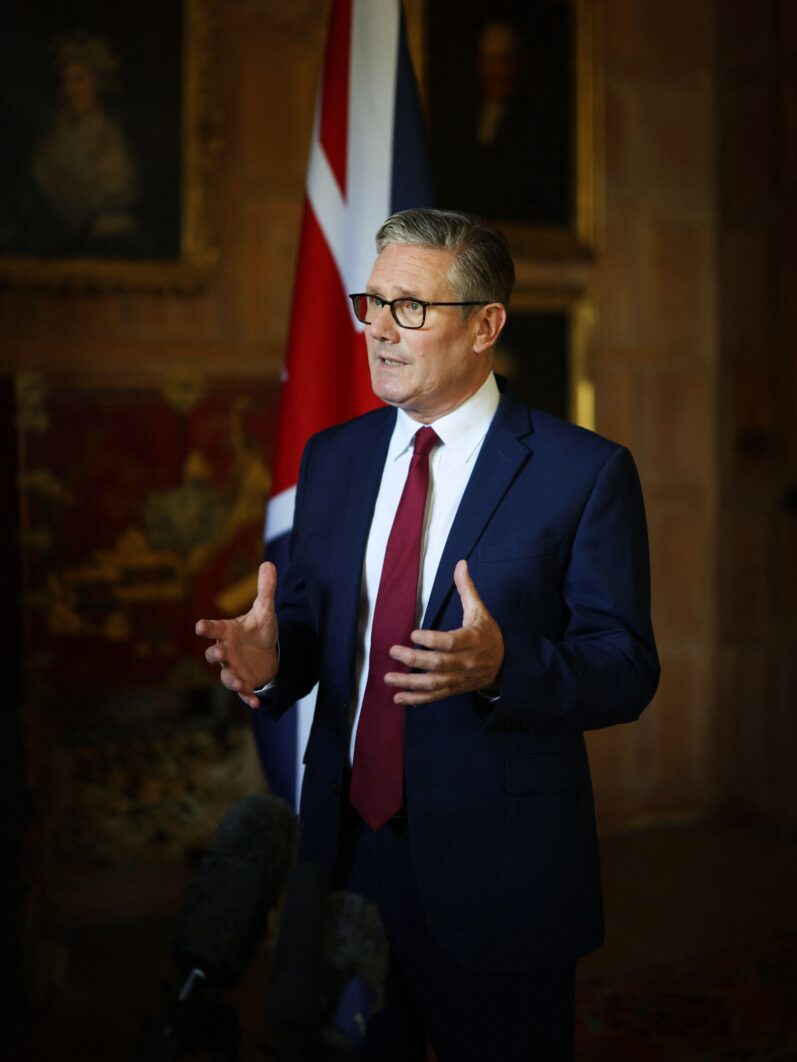
Mercifully, Keir Starmer is no longer prime minister. Though my unadulterated jubilation has been moderated by the shame of Atlanta, I’m glad – glad to see the back of the man it would be harsh to describe as Labour’s worst prime minister, but can fairly be called its most pathetic. Copiously present in national life, but utterly irrelevant to our meaningful existence, like nitrogen. The ambient man.
Starmer’s great skill was a lawyerly awareness of what to say and when, how to avoid verbal ensnarement and diplomatic complication, and – crucially, when it came to facing Boris Johnson – the application of those same mechanisms to his enemies while in opposition. So what intrigued me about Starmer was that, despite this clear grasp of the power of language, he said so little, and meant less of it still.
Consider his election to the leadership of the Labour Party on, as far as the membership was concerned, a weapons-grade platform of policy positions. Some of his promises: increase income tax for the top 5 per cent of earners, abolish Universal Credit, support the abolition of tuition fees, no more illegal wars, abolish the House of Lords, lower energy bills by £300. We now know that Starmer was less the architect of these ideas than their vessel, identified by Morgan McSweeney as the prime candidate to implement his own vision. We also now know the true nature of Labour’s general election campaign, organised by the scandal-ridden Labour Together, thanks to the exhaustive reporting of Patrick Maguire and Gabriel Pogrund, and others.
The observant will have noticed the continued presence of ermine on the parliamentary estate. I could mention, too, that my energy bills are yet to be £300 cheaper. Maybe they will be in 2030. That’s because those pledges were lies, ankle-flashing to the Labour left.
We should pause here, briefly, to consider this dishonesty in its context. Starmer became party leader opposite Johnson, a man who could lie in 1,000 different ways: by obfuscation and bloviation, by exaggeration, omission and comic digression, by promising different things to different people. Starmer’s dishonesty was different: colder, more ruthless and specific. His were not the lies of a man with a pathological indifference to the distinction between truth and fiction, but of a man who knows precisely what he is doing.
Starmer was acutely aware of what the Labour membership wanted, and he told them they’d get it. But for his next election he faced a very different electorate, which required a different message. And so, he shifted his rhetoric to the right. He spoke more about fiscal discipline or welfare cuts than significant increases to infrastructure spending, or the revolutionary decreases in childcare costs for young parents. He promised not to increase taxes, before adding the qualifier “on working people”. Since securing power his government has increased taxes by £62bn.
It is not miraculous that this strategy, this disjunct between word and deed, alienated the broader electorate, just as it did the Labour Party’s left. It was too clever by half, and the ultimate cause of the collapse of Starmer’s political authority.
The irony is that Starmer’s great miscalculation was that he wasn’t cynical enough. He understood politics as a contest of messages, opponents and moments; he underestimated the extent to which politics is also a contest of meaning. Voters will forgive almost anything from a politician who is authentically taking them somewhere. They will forgive difficult choices, broken promises, even failure. But if they suspect you of dishonesty, of inauthenticity, they will not follow you.
Starmer’s verbal precision discredited and condemned him morally. He was the prime minister who would sooner say that “Israel has that right” to cut off power and water to Gaza, a war crime, in an LBC interview a few days after 7 October, than condemn the slaughter of Palestinian civilians. Later, he said he had misspoken. I think the moment was more revealing: history will remember him for Britain’s complicity in the massacre of Gaza, perhaps alongside his more authoritarian indulgences: social media bans for teenagers, the thousands arrested for social media posts and the attempted imposition of digital ID.
I wish people would stop calling Starmer a decent man. It is not decent to lie. It is not decent to indulge warmongers. It is not decent to, as happened to Faiza Shaheen, abandon a mother who has devoted her life to beating former Tory leaders in safe seats because she is too left-wing. It is not decent to humiliate a predecessor because it’s expedient to do so. It is not decent to refuse to lift hundreds of thousands of children out of poverty, then scrap the two-child benefit cap after caving to internal pressure and to try to take the credit in a resignation speech.
That Starmer declines to name his children in public is not a moral absolution for these horrors. In fact, what kind of father would, when Russian-linked assets are firebombing your home? No, Keir Starmer is gone and I am glad. Here’s hoping Andy Burnham can do better. The bar is low.
Listen to Tom McTague in conversation with Oli Dugmore about Starmer’s departure on our interview podcast The Exchange
[Further reading: Finally, a Prime Minister who prioritises homelessness]