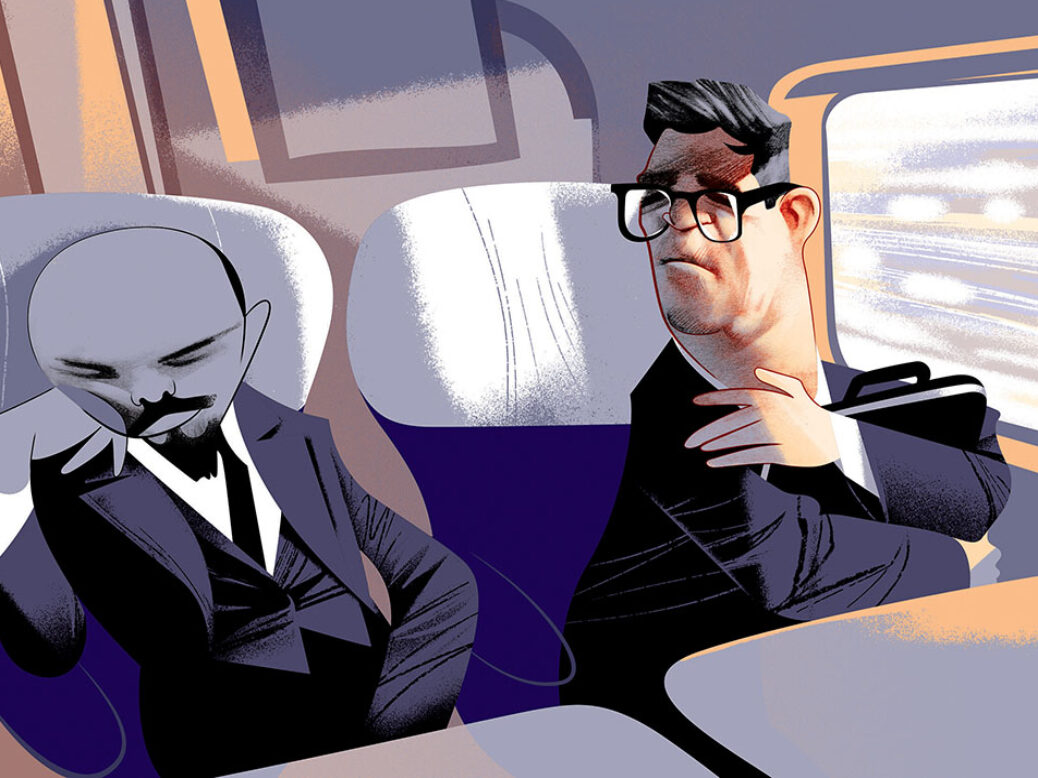
Everybody was saying Andy Burnham’s trip down to the capital on the 10.43am Avanti West Coast service from Manchester Piccadilly to London Euston was just like the secret “sealed train” Vladimir Ilyich Ulyanov – or Lenin, as history calls him – took from Germany, through Sweden and the Grand Duchy of Finland, to St Petersburg’s Finland Station in April 1917. Lenin’s 2,000-mile journey took just over a week. I suppose that’s still faster than the average train from Manchester to London these days.
Comrade Burnham was hurtling south for the same reasons that Comrade Lenin went north 109 years ago. Peace. Land. Bread. Oasis. Manchesterism. Barms. Seize the factories and Post Offices. Storm the palaces. Organise the oppressed proletariat into a formidable hard core. Crush and wreck and purge. Delirium and release. Farewell Rachel Reeves. Goodbye being “in hock” to the bond markets. Let the fresh blood of the bourgeois parasites and/or Starmerites flow through Nevsky Prospekt and/or Whitehall. Revolution at last.
Reflecting on the world-altering nature of Lenin’s journey, Winston Churchill later described his train as a “plague bacillus”. A disease, in other words, injected into a body at the worst possible moment, with catastrophic consequences. Keir Starmer, you imagine, would use stronger language to describe Burnham’s train. The former mayor of Manchester was less a total bacillus than a total bastard, from the outgoing prime minister’s perspective. What Lenin’s train did to Russia, the Avanti West Coast service did to Starmer’s premiership.
When Lenin arrived in St Petersburg on 16 April 1917 he was met at the station by Lev Kamenev and Vyacheslav Molotov. When I looked around Euston Station at 1pm on 22 June 2026, there were no masses waving red flags, hymning Bolshevism. There was no armoured car for Burnham to clamber atop and there demand redress for the people. Just me, those dumb buggies ferrying around the elderly, and a gathering, fretting crowd of press photographers, autograph-hunters and bemused civilians who wanted a straightforward journey to Crewe. Nobody looked like Kamenev. Euston smelled as it always smelled, of hot urine. A pub TV I had passed a few minutes before was tuned to the BBC’s somewhat hysterical coverage, showing the route of Burnham’s journey: Wigan, Hindley, Crewe, Stoke-on-Trent, Rugby, Euston. News choppers buzzed above the train. A northern conquest was progressing south.
“He should have been on the platform 15 minutes ago,” muttered the photographer. A short man in a flat cap, given to the dark thoughts all press photographers are haunted by, he looked down the concourse of inauspicious platform 13 and sighed. It was a good day for Andy Burnham, a bad day for whatever incredibly stressed flack was in charge of the Avanti West Coast public relations department, and a horrible day for this snapper. He had been here early as well, ahead of the game, but now the game was here. Dozens of photographers were around us. Reporters with foam microphones from those YouTube channels that have become the mainstream media were here, too. The longer the train was delayed the more photographers appeared, the more muttering there was.
I spoke to a guy who just wanted an autograph or a picture with Burnham. He was blind in his right eye and I promised that once the next prime minister arrived I would help him get a selfie. He then launched into a detailed analysis of Britain, its economy and its political class that wouldn’t have been out of place gracing the pages of the New Left Review. He said he liked meeting politicians. He had met Reeves a few years ago, before she became Britain’s first female chancellor. What did he say to her? “Don’t balls it up, Rachel.” Did she balls it up? His face rearranged itself into a dubious expression.
Burnham’s train was now 20 minutes late. The new MP for Makerfield was entitled to Delay Repay compensation. Some of the photographers, properly tweaking, were beginning to develop ticks. One of them scratched his arse with his Canon. The security laid on by Euston began to get nervous. First a tiny man in a high-vis jacket came out and squeaked at us to get back. Then a slightly taller woman wearing a lanyard came out and shouted at us to “get back, get back, get back”. Then – this was the final boss – a seven-foot tall, fridge-wide British Transport Police officer with a tasteful Maori sleeve tattoo and a hard face like the flat of a meat cleaver started screaming until he was hoarse: “GUYS I NEED AN EXIT ROUTE HERE”. The crowd barely moved an inch. Lenin, I thought, would have simply had us all shot. “Just run ’em over mate,” shouted the copper to the driver of one of the dumb little buggies. It would have made a wonderful photo.
Burnham was coming, but not yet. One of the glamorous women clutching a foam microphone explained her tactic for the moment the future leader of the Labour Party arrived. She called the process “chase and chat”. She would tail Burnham and strafe him with pointed questions, like a fighter plane closing in on its target. How would she get a reaction out of him? “I’ll just address him as prime minister.” Burnham would probably quite enjoy that, I thought to myself.
There was, by half past one, a violent feeling in the station. (Being in Euston for any length of time tends to have that effect on people, regardless of whether or not they are waiting to pap the next prime minister.) Just as I was considering sacking it all off and going to the Nandos a 45-second walk away, something happened.
The photographers, as if they had heard a dog whistle, began to move as a pack. They began to sprint as a pack. There was a hidden VIP exit underneath the station, on Eversholt Street. Burnham was beneath us now, getting in a black cab. Nobody was going to get a decent photo unless they moved fast.
I followed the pack. There was more shouting. More ludicrous shuffling. More terrible heat from the sun. The copper with the hard face did everything short of picking people up and lobbing them in the direction of Bloomsbury to rearrange the crowd. It did, after all that waiting, feel like a revolution. Not long after he came back to Russia, Lenin, a diehard atheist, wrote that “there are no miracles in nature or in history”. Yet something strange happened that night at Finland Station, strange enough that he was moved to admit the “peculiar co-ordinations” that allowed for his return “must appear miraculous to the burgher’s mind”.
Burnham was nobody’s idea of a premier a year or two ago. There are no miracles in history, yet Burnham has tried twice to lead the Labour Party and this time, third time lucky, miraculously, he will become an overnight prime minister. Why else was this sweaty, dishevelled, shouting, pushing, desperately expectant crowd baying for him? Power has its own exhilarating choreography, its own peculiar coordinations. Power makes people stand outside Euston Station and shove cameras into the windows of black cabs in the hope of a half-shot of the former mayor of Greater Manchester’s eyelashes. Power sends helicopters into the sky and bog-standard train journeys into the annals of history. Power is Andy Burnham’s to throw away now. There is one thing power can’t do, though: make the Avanti West Coast service between Manchester Piccadilly and London Euston run on time.
[Further reading: The twilight of our European dream]
Content from our partners
Related