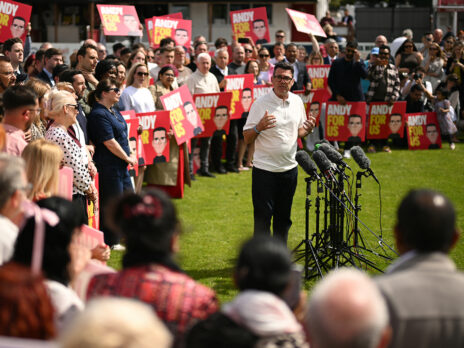
Is it all going to be OK? That is the question Labourites dared to ask in Makerfield on 18 June. There was positivity in the party for the first time in a long time, and that wasn’t just thanks to the £3.95 pints of Guinness in the Stubshaw Cross Club, Andy Burnham’s by-election campaign headquarters. Burnham had managed to make them believe again.
But even in the hours before polls closed, when it seemed the result was certain, some turned their attention to what was coming next. One particular obsession was the “first 100 days”. This, another US import into our politics, has become a measure of the initial success or failure of a new government.
Keir Starmer failed this test. His honeymoon with the British public lasted four weeks, before his net approval rating turned negative following the decision to cut the winter fuel allowance. Within six months of the 2024 general election, Labour had lost its polling lead. After 15 months, Starmer had become the most unpopular prime minister on record.
With a bit of careful planning, Burnham may succeed where his predecessor failed. But how much careful planning can there now be? Starmer has expedited the question with his swift timetable for departure. Wes Streeting, by stepping aside and allowing a coronation rather than a contest, has shortened that timetable to a matter of weeks.
It is worth stating the scale of the challenges Burnham faces. He may be left to resolve the open-ended defence row that helped end Starmer’s premiership. His first Budget will have to take account of the effects of the Iran war. He is likely to face a public backlash when Rachel Reeves’s deferred fiscal-tightening measures, such as the tax threshold freeze, come into effect. He will face tough local elections. He has been raising the alarm for years about the need to reform social care, but will now have to step up and deliver it (the last serious attempt, by Theresa May, nearly destroyed her premiership).
Even Starmer’s critics within his party accept he faced unprecedented attacks from media, some of which were based on malicious fantasy. Burnham could delude himself into thinking he will get an easier ride because he is “normal” and “likeable”. Yet his opponents will do their best to ensure the public think he is neither within a few months of him taking office.
While he has a large and perhaps overwhelming proportion of Labour MPs behind him, party unity could fracture in the face of challenges. Note his commitment to electoral reform: it is not something he will give up easily, but neither is it a settled question in the Labour Party. There will be more internal rows over energy, as MPs point to the most successful progressive leaders in the world – Mark Carney in Canada and Claudia Sheinbaum in Mexico – and ask why Britain cannot follow a similar version of “fossil-fuel socialism”.
For some of Burnham’s original backers – left-wing activists, think tankers and MPs aligned with the “Mainstream” group in parliament – there is already a whiff of betrayal. Some feel overlooked in favour of the more conventional parliamentary power brokers who flocked to Burnham during the by-election campaign. There was unease when some of his longest-standing parliamentary supporters were not invited to the overnight count in Makerfield, where places were highly limited.
For the Burnhamites who wanted a radical break with the past, there is some apprehension about the appointment of the former Bank of England official Andy Haldane as one of Burnham’s key economic advisers. Until recently, Haldane had been associated with Prosper UK, the group of Tory moderates led by Ruth Davidson and Andy Street. One left-wing backer compares Burnham’s return to Westminster to a recovering alcoholic going to a bar with his old drinking buddies: the risk of a political relapse to his Blairite past.
Burnham might have to be all things to all people. The last prime minister who managed that was Boris Johnson. While it is not a comparison the Makerfield MP would welcome, the case is compelling. Both were popular outsiders about whom most MPs were deeply sceptical, until it became clear that their only alternative was electoral oblivion.
Johnson was viewed as the most right-wing prime minister since Margaret Thatcher, but he also ended up dividing the UK with a hard border in the Irish Sea, increasing immigration to record levels, expanding the welfare bill and approaching most questions with the instincts of an erratic centrist. The challenge for Burnham may be to do something similar from the left: uniting the progressive side of politics behind a Labour government while governing with the non-ideological pragmatism he has described as “business-friendly socialism”. The question is how he can achieve that unity – perhaps as Johnson did, through a headline-making dose of Leninism that signals he is willing to antagonise vested interests and get things done? Let’s see what the left-wing equivalent of proroguing parliament and threatening a no-deal Brexit might be.
As Burnham returned triumphantly to parliament, I spoke to an old hand who still remembered him as the conventional New Labour politician of the pre-mayoralty days. Could Andy Burnham really become the most left-wing prime minister since Harold Wilson? Which Wilson, I asked, remembering the infamous shapeshifting of Britain’s last northern-accented leader. No, they said, the more pressing question is: which Burnham?
[Further reading: The Burnham revolution]
Content from our partners


Related