
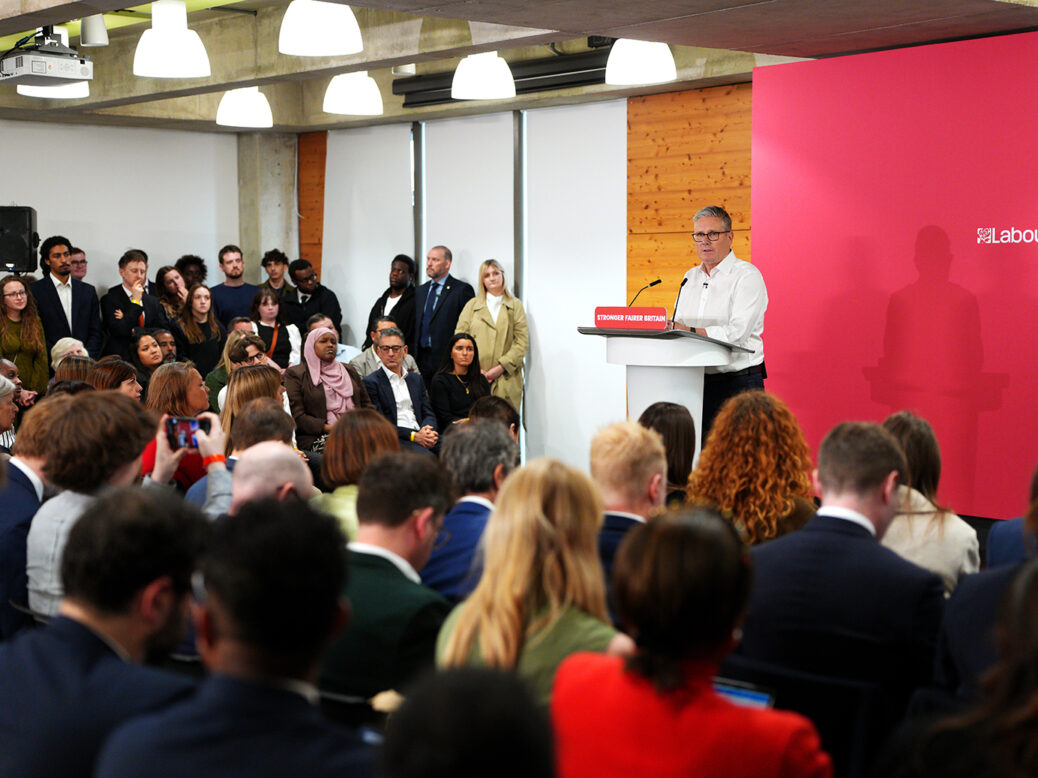
To be fair to Keir Starmer, he has always been clear that the thing to do is to reset. In his first speech on the steps of Downing Street, after the landslide victory of July 2024, he told the nation: “Our country needs a bigger reset.” By December of the same year the main thing that had been reset was Starmer’s approval rating, which was lower than any other prime minister (five months in) since polling began. Despite having been elected on a Manifesto for Change, little had changed, and therefore a Plan for Change – a reset, the biggest reset in a generation – was needed. By September 2025 it was clear that the Plan for Change had been more of a Plan and less of a Change, and so a reset of that reset – “phase two”, Starmer called it – was needed. This was followed by a more specific “Brexit reset” in January of this year. Then, in May, Labour lost 1,496 council seats, half their London councils, and Wales. Clearly, it was time for a reset.
The reset speech Starmer gave on 11 May was billed in headlines as “the speech of his life”. The 25,000 people watching the BBC’s feed of the speech were told that “the stakes couldn’t be higher”, although obviously they could have been, and will be next time. Starmer has given one truly memorable speech so far, at the 2024 party conference, when having presumably skipped breakfast, he called for “the return of the sausages… the hostages”. Would a similar rhetorical flourish be enough to turn things around and secure his political legacy?
No, obviously not, this never happens. The only time a monologue changes everything is in a film, when the writers need a quick plot swerve. Even Starmer, as he sat in the front row waiting to speak, didn’t look particularly convinced. Someone had told him to remove his jacket and tie, to roll up his sleeves, but this gave him the look of a leader enjoying success – Obama in the early 2010s – rather than a man interviewing desperately for his own job. As he was introduced, he glanced nervously at a crouching photographer. His top lip was drawn back over his teeth in a manner that said: look, I’m smiling, this certainly is what a smile looks like.
“The election results last week were tough,” he told the audience. The party lost control of 38 councils: “That hurts,” he said, “and it should hurt. I get it. I feel it.” What a relief for his party it must have been to be informed that the Prime Minister had not only noticed their disastrous results, had not only understood that they were bad, but was sad about them too. He was sad not only because his party had taken an absolute kicking at the hands of Reform and the Greens, but because these are “dangerous times”. The world today, he said, is “more dangerous than at any time in my life”, which is quite the statement from someone who was born just before the Cuban Missile Crisis. A man who has seen 27 per cent inflation, Chernobyl, 9/11, the global financial crisis and the Covid pandemic thinks this is a uniquely dangerous moment, because it’s one in which some people want to vote for Nigel Farage.
Even so, Starmer allowed himself some light boasting about his tenure so far. “We stabilised the economy,“ he declared, as the yields on UK government bonds hovered at levels not seen since the late 1990s. “We got the big political choices right,” he said, although the only big political choice he mentioned was the choice to not do something. The Tories and Reform wanted to get stuck in to the Iran war, but under Starmer we took the British way: we participated enough that the Iranians think we’re culpable, but dragged our feet enough that the Americans think we’re useless, and it made bugger-all difference, because the global oil market doesn’t offer a discount for being on the right side of history.
So what was Starmer, in this latest reset, planning to do to combat this most dangerous of moments? “Some people are frustrated with me,” he conceded. “I know I have my doubters… I’ve spent too much time talking about what I’m doing, and not enough time talking about why.” Actually, he’s spent too much time talking about what he might do. What was he going to do? “Incremental change won’t cut it,” he cautioned. But what was going to happen? “We will make the big arguments,” he said. Oh, yes! If there’s one thing Britain lacks, it’s definitely arguments. There’s a national shortage of opinion! We must start importing takes from other countries! “Evidence matters, but so does emotion,” he said. “Stories beat spreadsheets.” Somewhere in the Treasury, Rachel Reeves lowered her forehead to her desk and closed her eyes.
But wait! He was going to do something! “Full national ownership of British Steel,” he declared, to whoops and applause. “Steel is the ultimate sovereign capability,” he declared, which hasn’t been true for at least a century, but it didn’t matter. Across Britain, grateful people ran into the streets and threw their hats into the air: the government was going to do something! To an extent! In that it was going to introduce legislation that would, if passed, give it the option to do something, subject to a public interest test!
He was going to “place Britain at the heart of Europe”, too, although, it was less clear whether this would involve anything being done. Brexit, he was clear, was an absolute shambles, but as to whether he wanted to actually rejoin the common market or the customs union, he refused to say. So much for making the big arguments.
He didn’t even want to say whether he planned to prevent Andy Burnham challenging him for his own job: “That’s a matter for the NEC,” he said. Keir Starmer is on the National Executive Committee! He’s also the Prime Minister! If you’re serious about preventing a coup you say: “Yes, I’m going to use my position to defend my position, because I’m the best person to lead the government”. You don’t say: “Andy’s doing a great job… we work very well together.”
He was similarly coquettish about Angela Rayner. Had she reassured him that she wasn’t going to support a coup? Oh, well, sort of. Her new habit of staring him in the face and drawing her finger slowly across her throat is just her way of saying that Labour needs a full-throated response to its critics! “I know exactly what her thinking is on this,” he said. So do we, the audience thought.
This was not the speech that saved Starmer’s premiership; no speech could. Like John Major, Starmer has a voice, strangled and petulant, that sounds like he’s impersonating himself. The lack of real things to announce was only made more obvious by the generic KeirGPT slop – “nothing less than a battle for the soul of our nation”, as if politics is ever anything else – that had been hastily padded in around it. Starmer is a very intelligent man who has grasped the dissatisfaction, decades deep, that afflicts the British people. But he seems not to have realised that what is really pissing them off right now is Keir Starmer.
[Further reading: It’s happening]