
Westminster has spent much of the past two weeks analysing Andy Burnham’s cabinet appointments and what they say about the kind of Prime Minister he will be. Is this a move to the left because some of the Blairites are out, or a move to the right because the Socialist Campaign Group remains minister-less? Is this a victory for the soft left, whom we were told were driving Burnham’s campaign? If so, why has he appointed a thoroughly un-soft Chancellor and Home Secretary?
These are the wrong questions to ask. A better one is: do you think the Labour’s founding principles are eternal – to represent the organised working class by winning parliamentary power and establishing democratic socialism – or not? When it comes to the Labour Party, are you Old or New? This is the real divide in the party, if not always the most visible.
Now that the dust has settled, it’s clear that Old Labour is back. From his cabinet, rhetoric and policy choices, there has been zero attempt to update Labour values for a new setting. Instead, he has delved back confidently into the party’s back catalogue. The old classics are on repeat, and the early signs are that the country rather. Take his ministers: Healey, a man best described in Ailbhe Rea’s prescient profile, as “Just Labour”, someone who came to politics through the trade union movement. Those in the cabinet that, like Burnham, served Blair and Brown, were almost always on the side of the latter in that civil war, very much Old Labour in the fight with the New.
Or the rhetoric. At the Trade Union Congress – note the venue – Burnham delivered the most unashamedly nostalgic speech I can remember hearing from a Labour leader. He painted in sepia-tinged hues, talking about how Labour “… was forged in the steel works and iron works of Sheffield, Scunthorpe, Port Talbot and Teesside”. Of course, Labour leaders often pay tribute to the party’s industrial past. But they have always hedged: while the past might have been great, things have to change. I have heard no such caveats from Burnham. Not long ago Al Carns was making similar noises. He was widely, and unfairly, mocked. Now, we are all Old Labourites.
Nor was there any modernising, no tortured triangulations reminiscent of Blair in last week’s policy blitz. Instead, we got “bread and butter” announcements: cheaper bills, cheaper pints and cheaper buses. This is giving the punters what they want – after being told for a very long time they can’t have it. This transcends left and right, for now. Because Labour’s eternal battle between the Old and New is not a battle between left and right, even if it became that under Blair. Instead, it is a battle between those that believe the party’s founding doctrine as being sacred, and those – on the party’s left and right – who disagree.
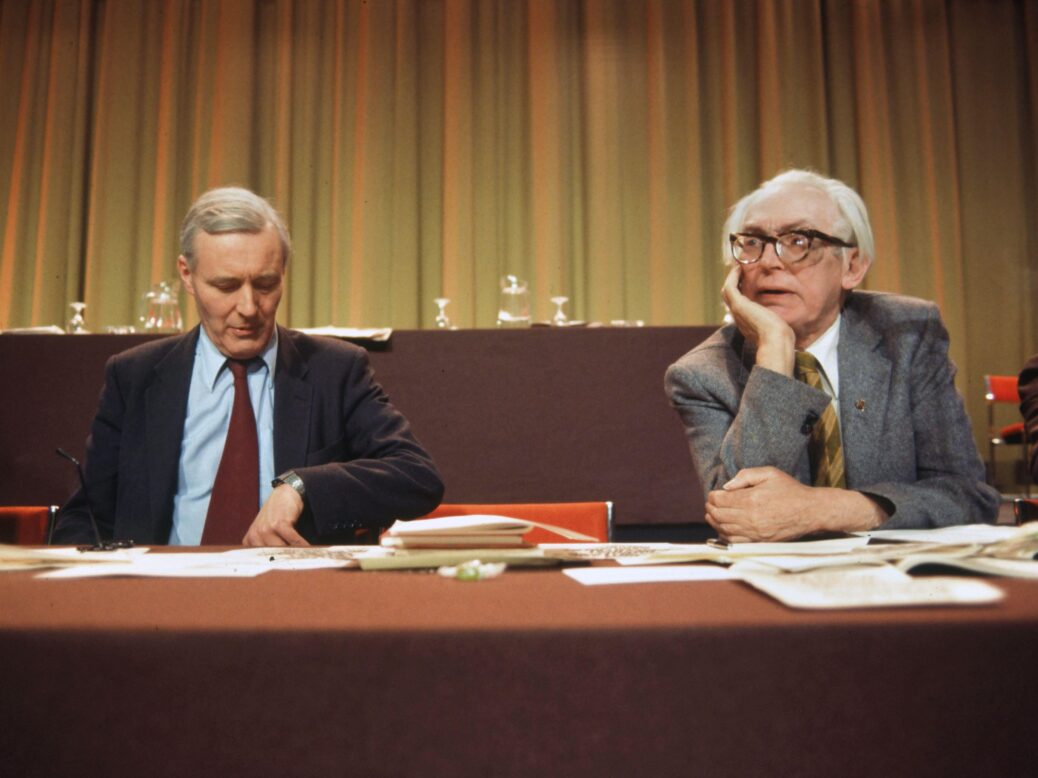
Because it was the left that sealed the tomb marked “Old Labour”, whatever mythologising New Labour might engage in. As the trade union movement moved in a more militant direction in the late 1970s and early 1980s, Labour was dragged with it. Under Michael Foot’s leadership, the party became more interested in new social issues, particularly nuclear disarmament amid the peak of the CND’s membership in the 1980s, as opposed to the materialism of Old Labour. Blair built on the new left’s embrace of the future and modernity. It kept the social liberalism of the 1980s and gutted any attachment to leftist economics. Utilities remained in the hands of asset managers, monetary policy was handed to unelected technocrats, markets were introduced to public services. In a sense, the founder of New Labour wasn’t Kinnock or Smith but Foot, under whose leadership Old Labour was finally defeated.
So Old Labour has had a bad 40 years, to use Burnham’s favourite yardstick. Yet some in the party have kept the flame alive. The “old right” has survived under the mantle of Labour First, led by Luke Akehurst. This grouping is defined by a deep commitment to the trade union link, a relentless focus on the economic sphere – jobs and conditions – rather than social policy, and the primacy of defence and security over all else. This remains philosophically distinct from the “new” right of the party, which, through organisations like Progress, forged New Labour. It is notable how many of Progress’ leading lights have been chucked from the cabinet, including Kendall, Kyle and Lammy, under-examined victims of Burnham’s bloody reshuffle.
On the soft left, there are differences between the older left Tribune group and the newer left-wing group Mainstream. The differences are subtle, but Tribune has concerned itself with a long essay collection on economic policy, while Mainstream is campaigning hard for electoral and constitutional change, among other areas. Again, if there is a big winner from the reshuffle it is the Tribune group – not least its co-chair Louise Haigh – with key Mainstream figures like Clive Lewis still on the backbenches.
But spreading the Old Labour gospel won’t be easy. In Constituency Labour Parties, two characters loom large. First, those who long for the grown-up days of New Labour, often living in places like inner London that were genuinely transformed by Blair and Brown. Second, those who would almost certainly be in the Greens or Liberal Democrats if we had a proportional voting system, for whom environmental concerns and issues of individual liberty are more important than class struggle. Of course, there is often overlap between these two camps. Both represent the “new liberalism” Labour inherited, sharing the late David Marquand’s longing for a more liberal, human-faced Labourism.
They have always been important parts of Labour’s sometimes enormously broad church and will require careful consideration from any Old Labour project. Both share a deep concern about Brexit. Both are strongly committed to electoral reform; Roy Jenkins’ incomplete mission to reform the electoral system in the late 1990s haunts a surprising number in Labour’s rank and file. Both hate anything approaching militarism, because of a latent CND-ism or a longing for the glory days of David Miliband, DfID and global leadership under New Labour.
All of these stances present challenges for Burnham. Reversing Brexit remains the most explosive. The Prime Minister might be on easier terrain on electoral reform, given his clear support for the issue, but doing so without a general election will be tricky. Finally, it seems impossible that Healey cannot now deliver the funds for higher defence spending. But what area of public services will be cut to pay for this? This will require a new phase of leadership from Burnham, assuming the role of “leader as teacher” to borrow Steve Richards’s phrase. This is because, while hindsight is a wonderful thing, we can now see that Labour’s divergence from the “old” has been a disaster. Some hard truths have to be told.
The new left shifted the party’s focus too far from the economic realm, at a time when Thatcher was radically remaking it. This paved the way for New Labour’s embrace of that order. In office, Labour oversaw a period of deindustrialisation to which it did far too little to reverse. This led to a decay in our nation’s periphery and the systematic degradation of our public utilities. That Labour in office oversaw the development of these problems at least partly explains why much of the public loathes it. Betrayal is always the wickedest sin, and many assume the centre-left has been engaging in such an act for decades.
Burnham must bury not just neoliberalism but 40 years of Labour history. Whether he is able to do so remains to be seen. But after a strong first fortnight, with the party united behind him, there has never been a better time to try.
[Further reading: What will Labour’s newly dispossessed do next?]