
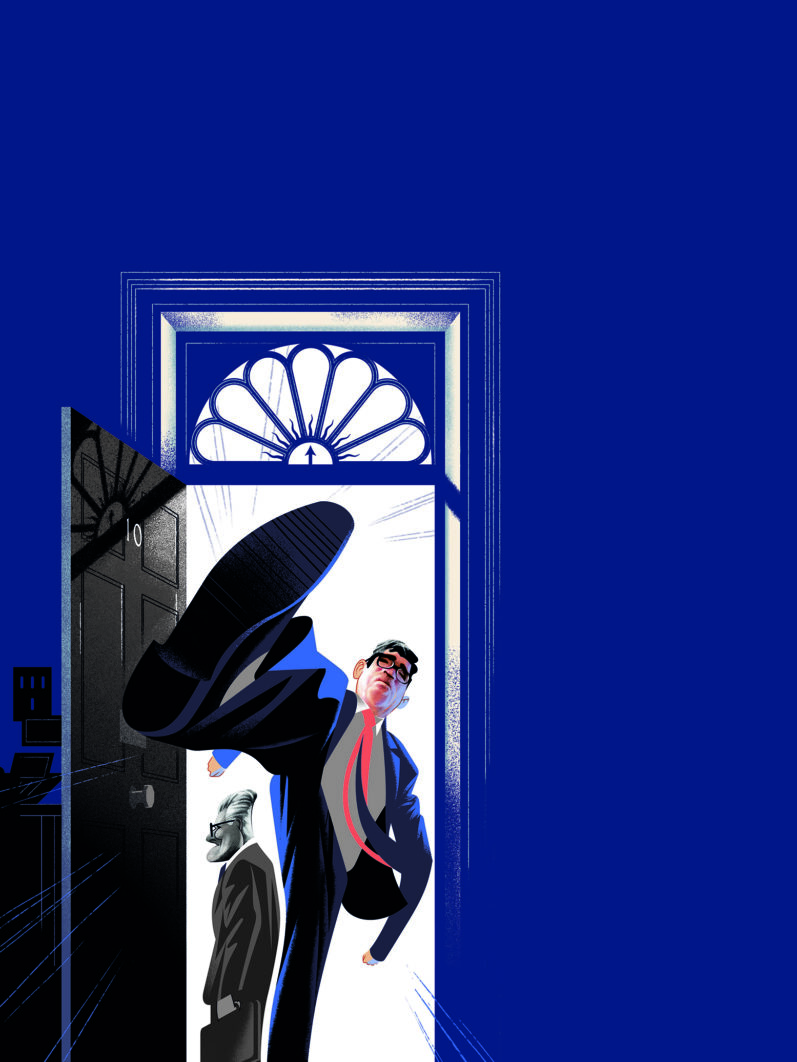
Andy Burnham, the UK’s 59th prime minister, began his premiership as he means to go on: as in touch with everyday life and its hardships as he can possibly manage. At 7am on 20 July, he was chopping vegetables with staff at The Passage in central London, an organisation that helps people sleeping rough or recovering from recent homelessness. He went on a walkabout, meeting people who had slept rough that night, reflecting that it felt like “the right way” to start such a life-changing day. Hours later, he was in Buckingham Palace, “kissing hands” and accepting King Charles’s invitation to form a government. Then he stood on the steps of Downing Street – no notes, no lectern – and announced that when he got through that famous door his first instructions would be to end rough sleeping.
This is who Burnham wants to be as Prime Minister: in touch with the people he represents, and demonstrating to them, to us, that he can really deliver change. He has spent a long time thinking about what he would do with power, and now he intends to act. He has heard the conventional wisdom about tackling rough sleeping, for example – a knotty policy challenge that could take decades, or even prove impossible. Yet “he’s responded simply by saying, ‘I’m not having that,’” as one insider puts it. He wanted to signal with his first announcement that, after years of failed governments and mounting distrust, politics “can actually do things to help you, and can move quickly”, a close ally told me.
Burnham also wanted to say something about his values and the kind of Britain he wants to live in. He believes he doesn’t have a moment to lose. Rough sleeping on day one, energy VAT cuts on day two, capping bus fares on day three – he has begun with a policy blitz aimed squarely at people’s day-to-day lives; “getting stuff done, sorting it out”, delivering hope fast. If this sounds a little different to Keir Starmer’s carefully caveated warnings, and Rachel Reeves’s fiscally responsible but politically disastrous cut to the winter fuel allowance, that’s because it is.
When Burnham shared a video of his newly appointed cabinet on his Instagram at the end of his first day in office, he accompanied it with the rock anthem “How You Like Me Now?” by the Heavy. The video showed Burnham hugging and shaking hands with his new top team, John Healey, Shabana Mahmood, Louise Haigh, Ed Miliband – all figures involved in the ousting of Starmer – to a soundtrack about being bad and getting away with it. “It’s almost like you’re just being cocky with it, because you know that you can do it,” the band’s singer Kelvin Swaby once said of the song’s meaning. It wasn’t a deliberate message, Burnham’s team insists, but for those Labour’s newly dispossessed, it was rather on the nose.
If “how’d you like me now” is the question, the answer is that some of Burnham’s Labour colleagues like him rather less than they did when they still thought they were in with a chance of staying in government. At the Grafton pub in Kentish Town on the evening of 20 July, Starmer, Reeves and their former colleagues drank late into the evening, “a mixture of furious and sad” at Starmer’s treatment and the sheer, unexpected extent of the clear-out of perceived Starmer loyalists. Sacked cabinet members arrived one by one, to applause, with resentments towards Burnham and his team building as the night wore on and word of new appointments trickled through.
Burnham’s team, for their part, were delighted both by their cabinet appointments and that they had managed to keep them so tightly held, while much of the lobby incorrectly guessed that Mahmood was to enter No 11. Haigh – the right-hand woman who, along with Burnham’s chief of staff, James Purnell, oversaw the appointments planning with the incoming premier – received the most important job: Chancellor of the Duchy of Lancaster and First Secretary of State, the de facto deputy position formerly held by George Osborne, Peter Mandelson and John Prescott. (The first secretary of state has not been a woman since the late 1960s, when the position was held by Barbara Castle, one of Haigh’s political heroes.) In her new role, running a beefed-up Office of the Prime Minister, there is little Haigh won’t be across, driving Burnham’s agenda from the centre, while also overseeing the redistribution of power around the country.
After initially favouring Miliband for the role of Chancellor, in the end Burnham delivered the great surprise of the day by appointing Healey, chosen because he has “the same outlook” as Burnham, one No 10 insider says. He is being described as a “split the difference” candidate between Mahmood and Miliband, sharing Burnham’s radical priorities but with the serious, “safe pair of hands” demeanour of a former defence secretary. Miliband now takes on yet another role once coveted by his elder brother, David, as Foreign Secretary. Mahmood, meanwhile, happily retains her Home Office brief with a vote of confidence from the incoming Prime Minister for her approach on immigration, despite concerns on the back benches.
Burnham’s team felt there were enough Starmer allies in the mix – Yvette Cooper and Emma Reynolds, for example – to ensure Labour unity. Burnham’s No 10 team, too, retains many Starmer advisers, alongside well-liked newcomers including Alison Phillips, the former Mirror editor, and Hayden Munro, Jacinda Ardern’s former campaign director. Yet Burnham’s cabinet appointments, favouring a wide range of people from across the Labour ideological spectrum, but mostly united by their shared efforts to get rid of Starmer, have been perceived as nothing short of a declaration of war. “They started a factional war on day one,” a newly fired senior adviser says, describing it as “absolutely nuts”.
Burnham’s good news blitz was undermined on day two of the job by a newly sacked cabinet minister. Darren Jones, fresh from the pub the night before, pointed out on X that the incoming prime minister’s VAT cuts to energy bills were unfunded, because the digital ID scheme that was being scrapped to pay for it never actually had any money behind it. Jones had planned to remain quiet until September, but decided that Burnham starting with an unfunded tax cut, as he saw it, was too much. “It will be a red line to many of us in the Parliamentary Labour Party, given how hard we worked to regain the public’s trust on the economy,” one former senior figure warns.
Even some behind-the-scenes appointments are causing division. Kate Groucott, who stood prominently behind Burnham in his speech on Downing Street, has a role in No 10 ensuring connectivity between No 10 and No 10 North. This is despite Groucott publicly supporting her husband, Conor McGinn (a former Labour MP who was suspended from the party in 2022), after he was charged with sexually assaulting a woman in January. (He has “vehemently denied” the allegation.) Nevertheless, the appointment is a cause of upset for Labour figures who have taken it as a sign that Burnham and his team don’t believe or care about McGinn’s accuser. As one Labour insider expresses it, “50 per cent of cabinet members being women is purely tokenism if Andy Burnham’s team can’t take seriously sexual assault charges” against a friend. “Surely memories are not so short about what happens when prime ministers ignore warning signs about people who align themselves with alleged abusers?” (Burnham’s team did not respond to a request for comment.)
If you want a visual metaphor for the position Burnham now finds himself in, it is him standing on the steps of Downing Street, declaring his intention to do politics differently, moving bystanders to tears, while behind him stands a figure whose presence at the heart of his team hurts some in his party and nods to a factionalism they believe hasn’t gone away.
Burnham hates briefings, infighting, and the divides that so often tear Labour apart. But he is already finding out that while he focuses on delivering for people and communicating to the nation, the problems that dogged Starmer have not yet gone away.
[Further reading: Why did Andy Burnham pick John Healey?]