
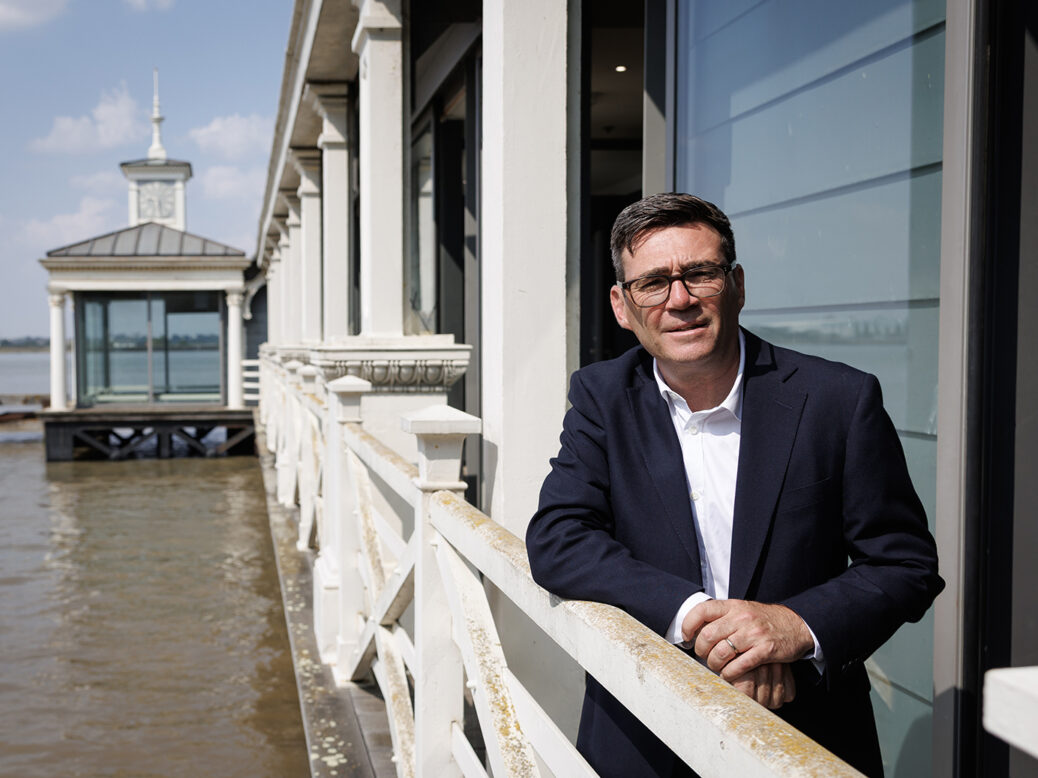
Despite the hostility from some quarters, Andy Burnham’s premiership always felt desirable and, despite his tricky path into parliament, always looked feasible, even inevitable. Even before the 2024 general election, it was obvious that Keir Starmer’s leadership of the Labour Party, and then the country, was doomed to fail. He was propelled into government by powerful forces: contempt for the Tories and hunger for change. But he offered only a clunky and managerial style. Bereft of deep ideas, and riven by a bitter and brittle factional culture, Starmer’s government was never going to last.
Meanwhile, 160 miles north in Greater Manchester, something different and better was stirring. Andy Burnham was testing the limits of the new powers of metro mayors and building a reputation for a contrasting sunny radicalism. As his star rose and Starmer’s fell it did indeed become inevitable – after the defeats in Gorton and Denton, Wales, Scotland and across local government – that the party would turn to Burnham as its saviour, just as it turned to Tony Blair over 30 years before. Like Blair, Burnham now wears the crown because of his personality, popularity and his intimations that he has a semblance of a plan.
But in the relief-tinged excitement of yet another new dawn, this is a moment, perhaps like no other in the history of the Labour Party, for what Antonio Gramsci called “pessimism of the intellect, optimism of the will”. Because the harsh reality is that Burnham’s only achievement so far is giving Labour another chance to prove that social democracy has a role in the middle decades of the 21st century, that democracy itself can be saved and national populism defeated. But it is just a chance and slim one at that.
Thanks to Burnham’s efforts, Labour has merely reached base camp, and now faces a daunting mountainous climb which will take tremendous energy and nerves of steel. Does he have the sherpas, supplies, oxygen tanks and route map for what must be a ten to 15-year journey? Because that is the scale and timetable for reversing 40 years of neoliberalism. Burnham is the best person for the job, but is he good enough? Given the rapid failure of Starmer, and with less than three years to go before a critical general election, it cannot be too soon to ask whether and how a Burnham premiership will actually succeed.
There are obvious grounds for optimism. Burnham combines a charismatic personality with the beginning of a political plan, the combination that gave rise to his popularity not just in Greater Manchester and Makerfield but nationally. He learns fast, not by theory but by practice. And his involvement in the Hillsborough campaign has forced him to question the establishment. He is right not to want to be in hock to the bond markets, to embrace both control and, crucially, ownership of the privatised industries. And his support for proportional representation demonstrates both a recognition of our fragmented party landscape and the need to build, as he did in Manchester, long-term, cross-party support for real change.
He comes into office in a moment where people are hungry for exactly that change, but politically short-tempered. Every election since the 2016 Brexit referendum has represented a vote for change, and polling by More in Common and the UCL Policy Lab shows the appetite for radicalism is growing. More than anything, Burnham was the right move, not just because of his popularity but because he understands the fundamental need to reform our democracy and rewire the state so that we can change the economy and society.
Burnham has demonstrated he has many of the necessary political skills, and an awareness of the gravity of the moment. But that is not sufficient if the task truly is to reverse four decades of free market fundamentalism. Thatcherism wasn’t defined by the single issue of the privatisation of essential utilities that Burnham focuses on. Rather it led a much deeper cultural and economic revolution which championed individualism, consumerism, financialisation and globalisation at the expense of the community, the producer, the citizen, the local and the national. It attacked the institutions hostile to its project, like the unions, local authorities and the BBC. And it built electoral, economic, social and cultural platoons which would entrench its reforms, like the City and the property-owner and the shareholder. As Thatcher herself put it, economics was the means, but the object was to change the heart and soul.
And not least, Thatcherism changed the climate of the nation because it was built on an intellectual and ideological ecosystem of public intellectuals, think tanks and committed campaigners. Its specific policies were based on precise and meticulous planning, through documents like John Hoskyns’s Stepping Stones strategy paper to defeat the unions, and the Nicholas Ridley Plan to beat the miners into submission. Books, pamphlets, speeches and articles gave her governments the momentum to sweep away almost all traces of the postwar settlement. As a project, Thatcherism was hegemonic.
If this really is what Burnham wants to replace then he needs an intellectual, cultural and organisational army to achieve it. As such the challenge is closer to what Labour achieved in 1945 than 1964 or 1997. That revolution was based on what David Marquand called a “100-year conversation” which melded Marxism, Methodism and Fabianism with the interventionist liberalism of Keynes and Beveridge. But, just as vital, those ideas chimed with popular movements, not least trade unions like the mighty South Wales Area National Union of Mineworkers, whose pure political might ensured the NHS was free at the point of need and not insurance based. Where is Burnham’s vanguard, or his movement?
Even Labour in 1964 and 1997 had a sense of the culture and technological zeitgeist which so far Burnham seems to be missing. Already, with its talk of the 1970s, his project sounds like a rather nostalgic politics of “returnism”. But social democracy is only ever transformative when it grasps how to shape the culture of the moment in a way that is egalitarian and democratic. New Labour’s formation between 1992 and 1997 was based on an intellectual renewal of social democracy with sources as diverse as Anthony Giddens, Will Hutton, Julian Le Grand, Charlie Leadbeater, Marxism Today and various think tanks. These were the roots of New Labour’s intellectual experimentation with public management theory, the Third Way and beyond.
This took place in a context of international collaboration – a network that stretched from the US to Germany, Singapore and Australia – in times that were relatively benign in terms of a growing economy and global stability. Today nothing is stable and social democracy is on the retreat across the globe. In Anton Jäger’s world of hyperpolitics, in which everything feels permissible but nothing is actually possible, “Manchesterism” has the power of potential, but is so far undercooked.
The golden question in all politics is never really the “what” but the “how”. Burnham has many of the necessary instincts in terms of devolving power and building long-term cross-party consensus for change. But he is communicating this with a presumptive, presidential style. “I have a plan”, Burnham tells us – as if all that is required is for Andy to be “for us”, as his campaign slogan in Makerfield suggested. But that is not enough to command a zeitgeist as contested as ours, especially when competing political movements all have their own forms of digital agency. The new world can’t be forged for us, only by us.
This is why the early signs on social care are concerning if it is to be modelled, as he has suggested, on the NHS, a product of the world of 1948. Much better would be to look at the kind of participatory neighbourhood social care model being developed in Sheffield by the Citizen Network. And in all this Burnham’s project needs a guiding central thesis. It was said that civil servants always knew the answer to any question posed by Thatcher: to create a market. For social democracy to succeed in the 21st century Burnham must have an equivalent: to deepen democracy and push for more citizen participation, devolving power to the local state and to communities.
This is clearly a Herculean task. So, when commentators exclaim that Burnham will never be more powerful than he is now, it should make us wince. If this project is to be as bold and sustainable as it obviously needs to be, then he, his government and the movements around it are going to need to become more powerful over time. This requires ideas, culture and alliances.
Returning to Gramsci, hegemony is the ability to turn one’s political beliefs into a new common sense. Back in 1966 Stuart Hall, Britain’s leading exponent and interpreter of Gramsci, argued that to take office in the name of structural change and reform without any accompanying consciousness and a popular mandate is to become the prisoner of the system. The power of countervailing forces, both ideas and organisation, is essential if this is to be an expansive project rather than one that simply diminishes over time. Burnham rightly talks about being guided by his instincts, but it is the capacity to act on his instincts that will determine the success or the failure of his government.
Forty years of neoliberalism will not be rolled back by one person, whether they reside in No 10 South or North. It will be rolled back by a new common sense that emerges only because it is commonly created for a more innovative, equal and sustainable way of living. Burnhamism bubbles with possibility but that’s all it is: possibility. Just as Farage and Trump are symptoms of the long-term failure of Blair and Clinton, if this project fails then the backlash that comes will be fast, furious and quite possibly fascist. Reform UK might well falter, but anger behind Reform will only burn brighter. The danger here is one of complacency. Given his popularity, Burnham could be seen by some in Labour as cover to maintain their existing strategies, only with better vibes. This will not be enough. The last roll of the dice must be meaningful and radical. Every decision and every appointment must be measured against the goal – does this help us roll back neoliberalism and roll forward a new settlement?
This is a project that cannot be allowed to go wrong. Yes, it’s down to Andy Burnham, but it is down to all of us to be constructively critical, to define answers, pose solutions and build alternatives. As Burnham’s mountaineers survey the scene from the base camp that’s been established, it might be useful if they reflect on the words of Sir Edmund Hillary, who led the first successful ascent of Everest: “It is not the mountain we conquer, but ourselves.”
[Further reading: The truth about “the Burnham Bounce”]