Not long after I left university, a dazzlingly accomplished debut novelist told me that his book took the form of a mystery story because he might only get to write one novel – “so there had to be a detective”. When, some time later, I embarked on my own first piece of fiction, or the first I had a realistic chance of completing, I discovered that I had a pair of sine qua non.
The book, eventually called The Boys, would need to portray large communal gatherings of the sort I had enjoyed in fiction and movies. On this score, I went a little overboard, at least at first. One marginal comment on an early draft read: “Are we really about to embark on a third party scene?” And though I felt a sense of vindication when I saw that seven minutes later, my friend had added, “This party is actually more fun than the last one,” I eventually made do with just the two. My other, even stronger desire was to find some role for a party of another kind – New Labour, an unignorable presence during the second decade of my life, and an inescapable legacy in the period since. In a strange way, the two subjects were linked: one of the few parties I remember my parents having was on the event of the 1997 landslide election.
Certain components of the book’s make-up didn’t feel elective. A dearth of experience, imagination, and time for research necessitated that the book would be set in London in the modern day and contain material on public transport, romantic failure, Chinese food, Jewish stuff, family life, cinemagoing, and football – including the famous Gerrard-Lampard midfield dilemma faced by England managers. These were simply my horizons. It would have been possible to write a novel that didn’t touch on New Labour, let alone its central figures. Many writers of my generation, including the author of the brilliant detective-story debut, had managed it. But I found that I didn’t want to.
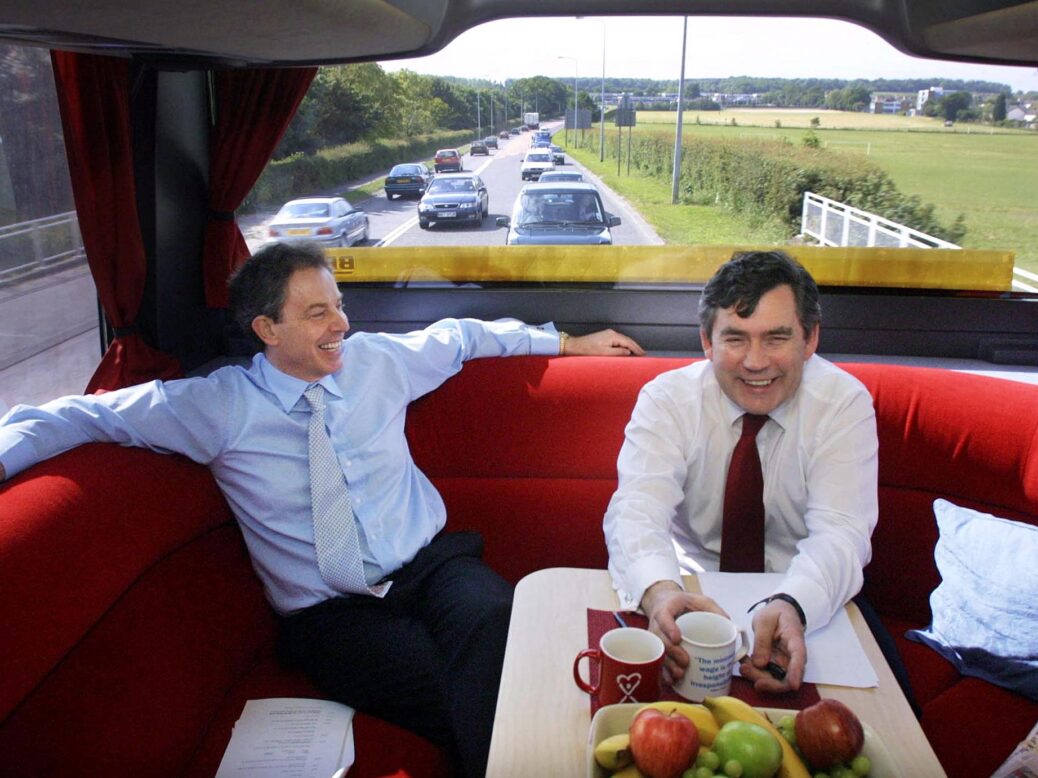
For reasons I cannot remember, I decided to set the book in the summer of 2012. No doubt I shouldn’t float such an unrigorous theory in a political magazine, but I had come to think of the Olympics as New Labour’s last hurrah. My central characters, all in their twenties and thirties, were heirs to that legacy, and trapped in a landscape Tony Blair, Gordon Brown, and Peter Mandelson had created (a sensation that might be even stronger if the novel were set today). So the New Labour story formed part of a modest effort at social portraiture. In a book that hops around a bit in time, it was also a useful way of dating things: “not long after Tony Blair’s landslide victory”. But the main import of New Labour proved to be symbolic.
I wanted to explore certain ideas about paradoxes of timing and chronology, and the elusiveness of a present moment. My narrator, Johnny, becomes an orphan and then a great-uncle before he feels he has settled into adulthood. He recalls the exciting period when he first got to know his older half-brother, Lawrence, and realises that none of the things he thought would happen in their lives had come to pass. Part of the appeal of the Olympics as a backdrop was that it was promoted even in advance in terms of its “legacy” – nebulous social benefits, its power to “inspire” the next generation of British athletes. At one point, Johnny and a younger pair he has befriended discuss their unease at the idea that the cost and hassle of the Games had all been for other people, some of them not yet born. In the past, my characters felt they had been invited to think about the future, and then when that point seems to have arrived, another future had taken its place.
As I was writing a novel – or so my thinking went – I was not trying to develop an airtight or even coherent philosophical argument, merely rummage around a cluster of related concepts. Looking at my notes document, I see that it contains the word “future” exactly 100 times, and mainly in quotations. There was Hayek, at King’s College, Cambridge, in 1944, announcing that “the future of England is tied up with the future of Europe”, though we didn’t need Hayek to tell us that – at least not at the time I was writing. The art critic Roger Fry, recalling his early encounters with post-impressionism, described the recognition – elated or wistful? – that “what I had hoped for as a possible event of some future century had already occurred”. There were psychological reflections from Freud and Adam Phillips, and a wonderful line on parenthood from the Guardian writer Anne Perkins: “The listened-to baby whose needs are lovingly met and whose limitless appetite for exploration and experimentation is nurtured is the future happy citizen.”
But much of the talk of hope, “fresh opportunities”, and so on came from my reading about the Labour Party – in the 1945 manifesto, “Let Us Face the Future”, or Harold Wilson’s excitable statements, but most of all, the early days of Blair and Brown, talking first about what came next for their party and then the country. The New Labour story is now largely, though not exclusively, told as one of failed promise and unkept promises, and progressiveness sacrificed in the name of progress. Blair’s message was that we must not be shackled by the past, or by fidelity to traditions and existing ties, institutional, collective, or personal. Change for him was the opposite not of a foolish consistency, or even stasis and complacency, but death.
One of the salient things about New Labour – especially perhaps for a fledgling fiction writer – was its intimate relationship with narrative and mythology, self-generated or otherwise. Blair is the only Prime Minister to have been depicted in an Oscar-winning film while still in office – The Queen, released in 2006, which concerned the fallout from the death of Diana. At the time and in the period since, I was more drawn to its made-for-TV predecessor, The Deal, also written by Peter Morgan, directed by Stephen Frears, and starring Michael Sheen as Blair, which appeared three years earlier and concerned the fallout from a less storied but far more consequential death, which had occurred three years earlier – that of the Labour leader John Smith on May 12 1994 (I remember where I was).
The Deal begins in May 1983, with Thatcher’s re-election and Blair and Brown winning their seats and being required to share a dim, windowless office – a remote rabbit warren, in Peter Mandelson’s description. It ends in the summer of 1994, after Brown agrees not to challenge Blair for the Labour leadership, in exchange for certain assurances. The Deal, unlike The Queen, portrays a range of other figures from that time: Brown, his PR man Charlie Whelan, and Mandelson; delightfully played by David Morrissey, Dexter Fletcher, and Paul Rhys. Brown’s brother John and his aide Ed Balls and – the crowd favourite – Blair’s friend and aide Anji Hunter appear fleetingly while Alastair Campbell is present in news footage. (It also features the novelist and screenwriter David Nicholls in a tiny role as a TV producer, giving Mandelson five minutes’ notice before a grilling by Andrew Rawnsley.) In the scene where Blair is heading to meet Brown, to hash out their truce or “deal”, at the restaurant Granita, in Blair’s heartland, Islington, on the evening of Tuesday 30 May 1994, Mandelson says, “You’re going to have to offer him something – even if it’s just hope.”
One day, writing on my phone, I found myself portraying the Granita summit. Ed Balls has argued that we cannot know “exactly what was said” because “nobody was there other than the two of them”. But in the version of events in my novel, the narrator’s older half-brother Lawrence is sitting at a nearby table. “There wasn’t any politics,” he recalls. “I’d have switched off.” (To find out what actually occurred, you have to buy the book.) In the margin next to the Granita passage, my otherwise picky friend had written, “Love this.” So it stayed. A sequence involving a neo-punk band called Clause IV (In Memoriam) didn’t make the cut.
The evening at Granita gave me an opportunity to mess with an overplayed moment of Labour lore – the “New” was added a few months later – and to revisit an early instance of the blinkered pseudo-Darwinism, that unshakeable sense of what the future looks like, which proved to be such a central part of Blair’s character. But I also wanted to revisit something comparatively unspoilt.
I remember my fascination as a student – around the time of Blair’s third victory – going through the old issues of the London Review of Books in the rolling stacks of my campus library and coming across Blair’s diary piece “Thatcherism” from October 1987. (I also found a book review by Brown, which, fittingly, was shorter, came later, and appeared under the same title – to this day, the only pieces in the LRB that have.)
By the time Blair became Shadow Home Secretary, his willingness to borrow or outdo Tory policy was in ample evidence. Nick Cohen’s Pretty Straight Guys, published the same month The Deal aired, had left me in doubt of this. When Thatcher died, Blair said, “I always thought that my job was to build on some of the things she had done, rather than reverse them.” But the LRB article seemed to take you back to a time before “always” – when Blair was critiquing the idea that Thatcherism has “established a new consensus and that all the rest of us can do is debate alternatives within its framework”.
What I liked about revisiting these early years was partly the mild counterfactual potential: the idea that, as Thomas Jones has written on the LRB blog, the Blair who wrote that 1987 essay might have been the one who became prime minister; that despite Blair’s recent comment on the Granita deal – “well, there’s no altering it” – people are still free to wonder what might have been if Brown had taken the reins, or if Blair had simply beaten his old friend in a contest. But I was mostly interested in the dynamics of the moment itself – the future-minded as a present state. Or to put it another way: can a moment of hope exist in its own right? I had been struck by a moment in a documentary that appeared six months before The Deal when the pop critic and cultural historian Jon Savage recalled the sense of euphoria he felt one night in May 1995. The day after the Tories were roundly beaten in the local elections, he had caught a performance of Oasis’s “Some Might Say” on Top of the Pops and started crying. “I thought, ‘something is really changing here.’”
What I found it intriguing was that Savage recaptured that moment without alluding to subsequent events or seeming affected by them. And sure enough, in a 2024 essay, he directly asserted that “the decadence and demise of Oasis” and “the failure of Labour to capitalise on the 1997 election landslide” didn’t change the fact that for a time, politics and pop seemed to be moving “towards a more hopeful and inclusive Britain”. That illusion hadn’t even lasted long. Savage’s essay questioning the use of the Union Jack as a marketing tool appeared in the October 1995 issue of Artforum. But then this is an established way of reinhabiting the past. When Wordsworth wrote “bliss was it in that dawn to be alive”, he was referring to an event, the French Revolution, about which, two decades later, he felt loathing and contempt.
Johnny, the narrator of my novel, takes an indulgent view of the early days of New Labour. He recalls shutting out his older half-brother’s comments about “the limits of charm” and “the imperilling” of English socialism so that he could enjoy the “brightness” – not blissful ignorance, of the Savage-Wordsworth sort, but active denialism. When, roughly 18 years later, he tells a younger friend how amazed he was when he saw Peter Mandelson in the street (“like bumping into God or God’s sidekick”), he is chastised for ruminating on something he knows would turn rotten. I wanted the feeling he describes to seem genuine and possibly understandable, and also for the riposte to seem correct, even unanswerable – in its logic, whether or not you agree with the specifics. I wasn’t aiming for balance or impartiality. I was trying to mine what I considered one of the advantages fiction has over journalism – one’s ability to explore feelings that are less ambivalent than irreconcilable, in this case about a historical phenomenon whose defining note and greatest moments will remain forever prospective.
[Further reading: The dictatorship of the elderly]
Content from our partners

Related