
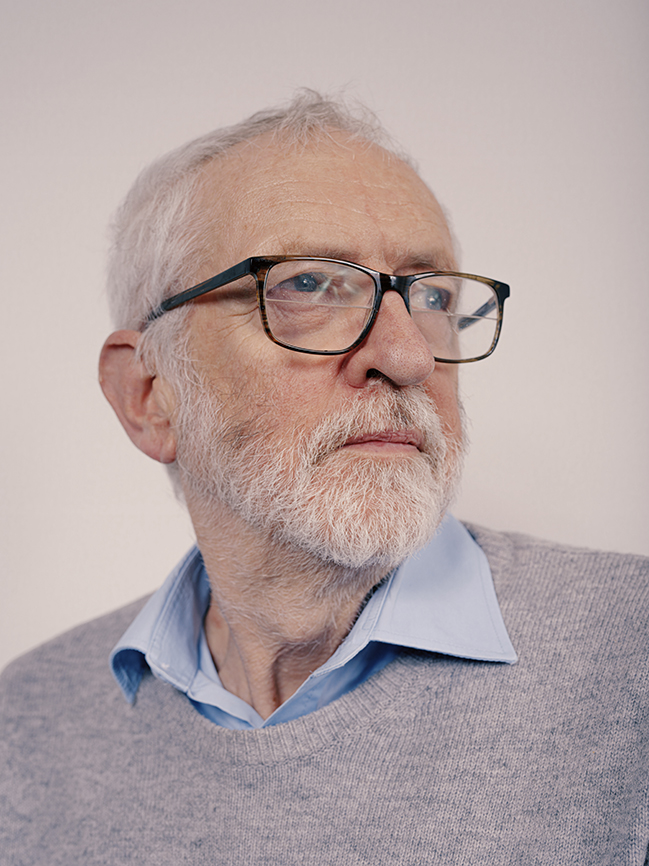
In the middle of the 2015 Labour leadership election, Andy Burnham travelled to Sheffield to meet party members. It was his second tilt at the job, and, as the race began, he was the frontrunner. In Sheffield, he gave a speech at a local church before opening the floor up to questions. As the Q&A started, the first speaker piped up. “Andy, I like what you’re saying,” he said, “but you do realise you’ve been speaking under a sign that says, ‘Repent: JC is coming’.”
Jeremy Corbyn spluttered with delight as he retold this story. We were in Portcullis House, the greenhouse-style atrium in the Parliamentary estate and as usual, Corbyn had been late — 40 minutes late — having just returned from taking his wife, Laura Alvarez, to the airport. When he arrived, apologetically, he took off his beige baseball cap and laid it on the table, a tiny pin in the shape of a watermelon – a symbol of Palestinian resistance – was attached to its front.
The sign on the wall back in 2015 might have proved inauspicious for Burnham, but more than a decade on the tables have decisively turned. While Burnham finally achieved what he couldn’t back then, Corbyn has found himself back on the sidelines of British politics, expelled from the Labour party after a prolonged and painful row over the handling of anti-Semitism under his leadership. Elected as an Independent MP in 2024, over the past year he has been involved in the creation of a new left-wing party – Your Party – and since 26 February has assumed the role, once again, of a party leader. (Though it took him a while to change his affiliation on the parliament website from Independent to Your Party MP. He only did so when nudged by the Speaker, Lindsay Hoyle).
Corbyn spoke warmly of Burnham when we met. “During the leadership campaign, we got to know each other quite well, because we debated all over the country,” he said. “Sometimes it could be quite funny.” Burnham, Corbyn felt, did not make the competition personal despite their “profound disagreements”. Corbyn is also clearly grateful for the fact Burnham accepted a place in his shadow cabinet and “didn’t take part in the coup” against him, as he put it.
Beyond this, however, Corbyn remains sceptical of Burnham’s approach, particularly his push for devolution. “There is a danger of overestimating the thirst for devolution,” Corbyn muses, “in favour of the thirst for equality within our society”.
Unsurprisingly, Corbyn shows no such warmth towards Starmer. In both of Starmer’s resignation speeches – once on Downing Street and again during his final session of PMQs – the outgoing Prime Minister made tacit reference to Corbyn’s leadership, declaring that he had picked the party up and turned it around after it was found to be “institutionally anti-Semitic”. (The Equality and Human Rights Commission found the party guilty of three serious breaches of the Equalities Act regarding its handling of anti-Semitism). On both occasions, Corbyn was furious. During Starmer’s final PMQs he kept bobbing for a question, standing up so that the speaker might select him, but Hoyle did not call Corbyn’s name.
When I asked Corbyn for his response to Starmer’s comments, I could immediately sense his anger. “The EHRC report was critical, yes..,” he admitted. However, he defended his own conduct: “[The report] also acknowledged that I had brought in an independent process for examining complaints that the leader was not involved in.” Corbyn told me he should even be “thanked” for this.
But does Corbyn not feel sorry for his successor at all? “On one level, any human going through trauma and stress, I do know what that trauma and stress is like,” he said. “I know what that sense of isolation is like.” But the niceties stop there. Corbyn described Starmer’s behaviour over Gaza as “shocking” and added: “History is going to look sharply on Keir Starmer.”
What is Corbyn up to now? He is still involved in Your Party and has been travelling around the country to help establish the party’s first branches, meeting some of the party’s 56,000 members. His squabbles with Zarah Sultana over the party’s future have now come to an end. He has also begun writing his memoirs, which are due to be released next year. But he has mostly returned to the work he loves best – being a backbench MP, campaigning on foreign policy issues.
When we met, he had just released his latest book, The Gaza Tribunal, which he has co-authored with academics Neve Gordon and Shahd Hammouri. The book puts together the full findings of an independent inquiry held by Corbyn last year into the UK’s involvement in the war, after his attempt to force Starmer’s government to hold its own was knocked down in parliament. The afterword is written by Sally Rooney. The pair met at a meeting of the Hague Group – which is convened by his former aide James Schneider’s Progressive International – earlier this year. Rooney introduced herself to Corbyn as “Sally from Ireland”. He later invited her to come on board with the book.
He doesn’t deny his intentions to run again at the next election (currently set for 2029, by which point Corbyn will be 80). “I’m available, I’m young,” he joked when I asked. “I’ve got years on my side.” I asked him if he would ever take a peerage. “No. No,” Corbyn said, vigorously shaking his head, “let’s clear that one up.”
As I was writing this piece, Diane Abbott, one of Corbyn’s long-time parliamentary allies, was re-admitted to the Labour Party following a long suspension over an anti-Semitism row. (A statement released by the Labour Party on 30 July said Abbott has apologised and been issued with a formal warning.) The same will probably never happen for Corbyn. McDonnell has already called on Burnham to consider it, but there is certainly no sign of that happening. Corbyn has said publicly that he has “no wish to”. He revealed on Newsnight on 22 July that though he and Burnham have already had a “pleasant chat”, there has not been “the slightest indication” that the party wants him back.
But in some ways, spiritually he has never left. His closest friends in parliament remain McDonnell and other Socialist Campaign Group MPs such as Richard Burgon, as well as the Independent Alliance MPs. Whenever I have interviewed him, he is always keen to spend the final ten minutes talking about the Labour grandees he has known in his 40 years in parliament. I have heard Corbyn’s stories about his close ally Tony Benn and even the Labour right bruiser and former deputy leader, Dennis Healey. But as leader of Your Party, to give up so publicly and jump ship would be politically humiliating.
Even so, Corbyn still haunts the Labour benches. His leadership has shaped the party we see today. Burnham’s programme for government has hints of Corbynism written into it. And the party remains scarred from the darkest days of the anti-Semitism crisis in 2019. When Burnham steps up for his first PMQs in September, Corbyn will be in the top right-hand corner of the opposition benches, watching his old comrade in the role he never played.
[Further reading: What will Labour’s newly dispossessed eat next?]