
It’s been an awful decade for the Muslim Brotherhood. Mohamed Soudan, one of the most senior members of the Egyptian political movement alive in the UK today, doesn’t try to argue otherwise. The exile from Alexandria, who is 69 when we meet in the basement of a Costa Coffee in Cricklewood, north-west London, can no longer stand for prolonged periods. A failing heart has reduced his pace of life. His tiling shop in east London is gone. So, at home, he compensates by reading scripture and dreaming of one day returning to his homeland. “I really miss my country.”
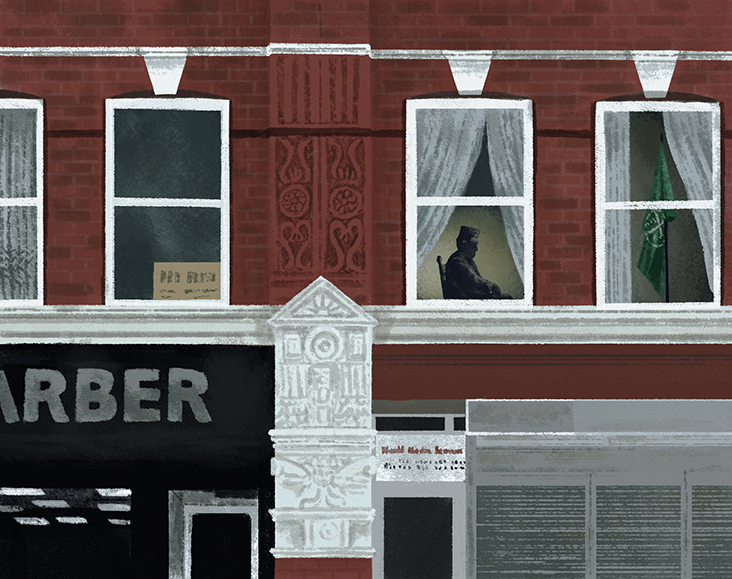
It took me weeks to find him. The official Muslim Brotherhood leaves virtually no trace of its existence in Britain. Its members have no obvious headquarters, no functioning website. Not even a spokesperson. Most people wouldn’t recognise the Brotherhood’s flag: two crossing kilij swords below a Koran against a green canvas.
But you can detect the group’s presence. When voices on the British right invoke the name of the Muslim Brotherhood they describe a fearsome conspirator. Its influence on university campuses is now so grave that the United Arab Emirates, one of the Brotherhood’s arch-enemies, has slashed funding for Emirati students wanting to study in the UK. It is a covert force organising worldwide pro-Palestinian marches; it’s the inspiration for Islamist gangs in prisons; it’s a pressure group that helped secure the ban on supporters of the Israeli football club Maccabi Tel Aviv from Birmingham last season. In January, President Donald Trump designated the Egyptian, Jordanian and Lebanese chapters of the movement terror organisations. Two months later the Henry Jackson Society (HJS), a national security think tank, launched its own campaign: “Ban the Brotherhood”. Reform has made this policy one of its top electoral pledges. “All across the Middle East, countries have banned the Muslim Brotherhood,” Nigel Farage announced at the party conference last September. “We will do the same.”
To Soudan, the rhetoric is bemusing. “What is the power of the Muslim Brotherhood to organise all this? We don’t even have a political party here.”
In 2012 the situation was different. The Brotherhood was in government in Egypt, with the country’s first democratically elected president. Soudan was a senior official within the movement’s newly founded political front: the Freedom and Justice Party (FJP). But a year later the army had seized power, reclassified the Brotherhood as a terror group and imprisoned tens of thousands of its members. Soon after, Cairo’s Arab allies began outlawing their own domestic iterations of the transnational Sunni movement. First, the UAE and Saudi Arabia, and most recently, Jordan. Those that could, fled: to Turkey or Qatar – governments known for their Muslim Brotherhood sympathies – but also to the UK.
Just three minutes’ walk from Costa is an office on Cricklewood Broadway. It sits above an empty kebab shop, between a Turkish barber’s and second-hand electronics dealer. It was there that the movement’s former acting leader Ibrahim Munir once supervised the online newsletter Risalat al-Ikhwan, which celebrated the group’s history and teachings.
Munir came to the UK in the 1980s. He fled Egypt having spent more than a decade in prison after President Gamal Abdel Nasser’s brutal purge of the Brotherhood. He was granted political asylum here and made London his home. In public, Munir purportedly served as a board member for a number of Muslim charities throughout the 1990s. But by the mid-2010s he was the Brotherhood’s most senior official in the UK. In 2020 Munir, then 83, was chosen as acting leader of the Egyptian chapter – but only because all the more senior members had been locked up. By then he “was an old man, and having problems with his memory”, one former member recalled. When Munir died in 2022 the movement was beset by factional divisions.
Munir was the last Egyptian Brotherhood figure of stature to call Britain home. Soudan estimates there are roughly 300 Brotherhood members here, scattered across various cities and towns. “I’m talking about Egyptians,” he qualified. “I have no idea about the others.” Offshoots of the movement have spawned across the Muslim world, from Tunisia to Iraq. Each group is independent and structurally distinct in its own country. But abroad, senior officials from the various memberships coordinate and are known commonly as Tanzim al-Dawli: the International Organisation of the Muslim Brotherhood. Munir, who always denied the existence of a secret global outpost in the UK, was widely believed to have been its secretary general.
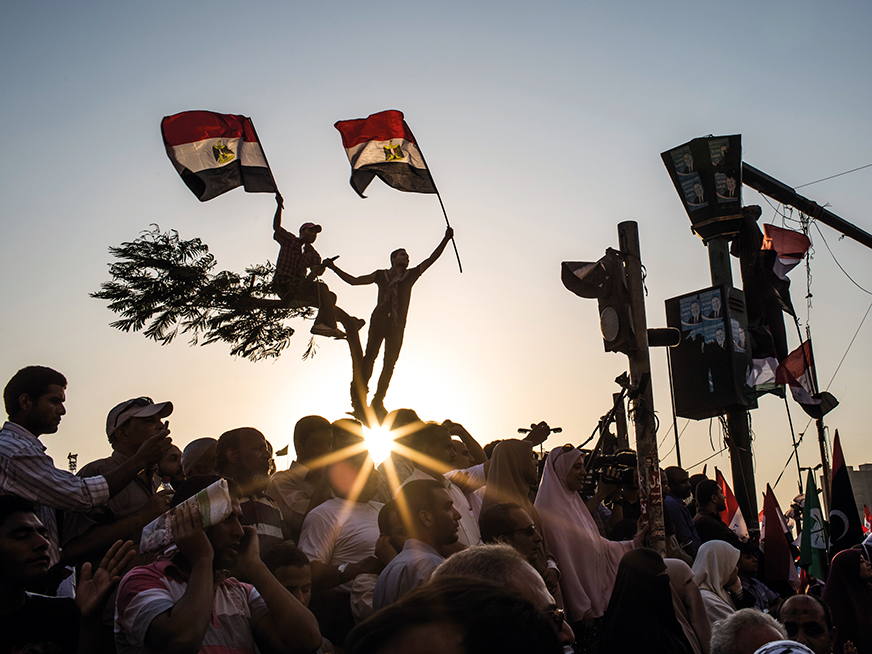
Muslim Brotherhood supporters celebrate the 2012 Egyptian election victory. Photo by Daniel Berehulak /Getty Images
Soudan doesn’t engage with my question about Tanzim al-Dawli. All exiled Egyptian members, he insists, rarely meet up en masse because they have little Brotherhood business to discuss. What occasionally brings some of them together, he says, are the demonstrations that mark key dates in the Brotherhood’s calendar. One of those is 14 August. On that summer’s day in 2013 the Egyptian army opened fire on thousands of Brotherhood supporters who were part of a sit-in demonstration outside the Rabaa al-Adawiya Mosque, Cairo. The FJP had just been ousted from power by the current president, Abdel Fatah el-Sisi. Hundreds were killed. Soudan knew the authorities would come for him next.
On 20 August, he sent his family to another part of Egypt, left his Cairo home and drove straight to the airport. Soudan says London was the first ticket he could find, but also confesses that he had a five-year British visa stamped in his passport. Because of his government work he also had a visa for South Africa, one for Turkey, and another for Europe’s Schengen Area. “I was the foreign relations secretary.” At this year’s anniversary, dozens gathered outside the Egyptian embassy and released yellow balloons bearing the four-finger sign of Rabaa. Soudan’s poor health meant he wasn’t able to attend. But over the past 13 years these types of demonstrations have diminished in size. “After a while people give up.”
Soudan was sentenced in absentia by an Egyptian court. His various bank accounts were all frozen. It took almost three years for his British asylum claim to be approved, he said. Once settled, Soudan founded a civil engineering company, Interfield, and opened a double-fronted tile shop under the same name in Wanstead, east London. That was before open heart surgery forced him to step back. Retirement is a painful topic. “I’m an engineer and I don’t want to forget that.” Prior to 2013, Soudan says, he ran a much larger firm that employed 12 engineers. Mustafa Tolba, a Liverpool-based senior Egyptian member I track down, is a retired surgeon, a white-collar professional like so many members of the Brotherhood.
Risalat al-Ikhwan is still online. This relic of early 2000s web design is run by a “media team”, Soudan explains, without expanding. Printed above the door to the Cricklewood office are the words “World Media Services”, the company behind the newsletter. A second non-trading firm called the “Nile Valley Trust” is also registered there. When I enquire about its purpose Soudan grows suspicious: “Why are you asking such questions?” I ask because at least three of its directors have been senior Egyptian Brotherhood members: Munir, Tolba and a man named Mahmoud al-Ibiary.
A common accusation levelled by critics of the Brotherhood is that, in the UK, it conceals itself within other organisations. The Islamic Relief Worldwide (IRW), a Birmingham-based humanitarian aid group with a yearly intake of nearly £300m, has been repeatedly cited as having ties to the Egyptian Brotherhood. One of the former’s founders, Essam al-Haddad, was a presidential adviser in the FJP; he has languished behind bars in Egypt for the past 13 years. The multinational aid group was outlawed by the UAE and Israel in 2014, accused by the latter of funding Hamas. The IRW has refuted that claim and Israel is yet to produce credible proof of a link between IRW and Hamas. The IRW also denies it has any links to the Brotherhood. The only scandal came in 2020 when it was uncovered that a director and two trustees had posted deeply antisemitic and pro-Hamas content on social media. The scandal led to the resignation of the charity’s entire board and two independent reviews of IRW, one of which was undertaken by the British Charity Commission. But neither produced evidence that the Muslim Brotherhood, or Hamas, were operating within the IRW. They found a humanitarian organisation that needed a better social media vetting process.
[Further reading: Islam is part of European history]
The Brotherhood is highly secretive. Its members are cautious about disclosing their rank or precise duties to outsiders. The group’s finances are equally opaque. Qatar is often named as the movement’s great patron. What details Brotherhood members do give away are cryptic, even when addressing the simplest of queries. How do the exiled members communicate with each other? “Could [Brotherhood] people talk to each other? The answer is yes,” Tolba replies. “I would say there are exchanges of views depending on the circumstances.”
Some things are clearer. Membership of the Brotherhood runs in “families”. The Egyptian mother branch has five stages with “working brothers” being the final of these. Traditionally, these fully fledged members are obliged to donate 7-8 per cent of their salary to the group’s operations. Hierarchy in the highest chamber of this fraternity has everything to do with one’s age and personal sacrifices made for the movement. There is no retirement from the Brotherhood, only death or abdication. That is why elderly men like Munir find themselves at the helm of the organisation’s pyramidal structure. “It is why I left,” one ex-member says. Given his age and role in the FJP party, two former Brotherhood members believe Soudan is almost certainly ranked somewhere at the top of the reported 300 Egyptian members residing in the UK.
Defining the Brotherhood’s ideology is harder still. “No member would describe the Brotherhood as a mere political party, a social movement, or a religious sect,” explains Abdelrahman Ayyash, an Egyptian author and former member. “It is none of the above. It is all of the above.”
It was founded in 1928 by Hassan al-Banna, an Egyptian schoolteacher. In his pursuit of an Islamic state, he established schools, restored dilapidated mosques and led charity work. An Islamisation from below. The movement’s radical legacy was defined by one of Al-Banna’s disciples, the writer and ideologue Sayyid Qutb. His writings in the 1960s depict a world struggle between believers and non-believers, real Muslims and fake Muslims. His ideas were an inspiration for al-Qaeda’s godfather, Ayman al-Zawahiri. A torn-up copy of Qutb’s seminal book, Milestones (1964), was found by a former colleague of mine in Baghouz, eastern Syria, the remote river town where Islamic State fighters made a final defence of their imploding caliphate in 2019.
History is an awkward topic for the modern, democracy-championing Brotherhood. Even for men like Soudan and Munir. It’s as if they refuse to reconcile with the dark tangents of their 100-year journey, or more worryingly, can’t see any of the darkness. “The Muslim Brotherhood are a moderate group, they never turn to the violence,” Soudan argues. A historical half-truth. The Lebanese branch has an active armed wing. Munir gave similarly confused remarks during a parliamentary committee on political Islam ten years ago. When asked to explain his concept of an Islamic caliphate, he drew a strange comparison with the United Nations. To a yes-or-no question on whether he believed individuals had a right to freedom of sexuality he gave a 71-word reply (in translation) that included neither the words “yes” nor “no”.
Israel-Palestine is another complex issue – which is one of the reasons we now hear the Brotherhood’s name mentioned so often. Hamas was founded in the late 1980s as the Palestinian branch of the Muslim Brotherhood movement but has morphed into an independent organisation. Nonetheless, the Egyptian Brotherhood has continued to back Hamas, praising its past suicide bombing campaigns and voiced a number of nakedly antisemitic tropes. The 7 October attack on Israel was hailed as an act of resistance. So, while the Brotherhood may have reneged on exercising violence itself, it supports disciples’ use of it.
The last time the Brotherhood came under sustained scrutiny in Britain was in 2015. The coalition government dispatched several civil servants to investigate the Muslim Brotherhood worldwide, to determine whether the organisation should be outlawed. After months of deliberating, the then prime minister, David Cameron, concluded that the “Brotherhood is a possible indicator of extremism” but fell short of enacting a ban. John Jenkins, the civil servant who led the review, says this wasn’t because he and his colleagues concluded the Muslim Brotherhood was a benign, non-violent movement. The issue was, he explains, more one of legality. “What is it you’re banning? There isn’t an organisation in this country called the Muslim Brotherhood.”
But in March 2024, six months into the war in Gaza, the Brotherhood’s name was again invoked by a senior British politician. Michael Gove, then a minister, announced an update to the government’s definition of extremism, reconfiguring the term to mean “a promotion or advancement of an ideology” rather than an “active opposition”. Against this new term a number of far-right and Muslim organisations would be reviewed. On the list was the Muslim Association of Britain (MAB). “The British affiliate of the Muslim Brotherhood,” Gove declared – though just like the IRW, the MAB vehemently denies any affiliation to the Muslim Brotherhood.
At 7.30pm in a mosque in Balsall Heath, south Birmingham, Ahmed Helmy and Abdullah Saif start their discussion session on Islamophobia. Around a dozen people participate, all local residents from this Muslim neighbourhood. Helmy is an Egyptian-born MAB representative and a senior NHS doctor. Saif is a Birmingham native and a natural orator who regularly collaborates with the MAB for talks like this.
After discussing a number of attacks on Muslims the attendees conclude that the main perpetrators of Islamophobia are far-right extremists. But defining the deeper causes of these attacks proves more difficult, a search for answers that exposes a vulnerability. Saif and Helmy then open the floor to the possible solutions. There is a long silence. One man, who didn’t know what Islamophobia meant before the session began, simply concludes that it’s on them: “Muslims should be better Muslims to show the media.”
The MAB is one of the largest Muslim grassroots organisations in Britain. Its stated aim is to improve Muslims’ participation in society but it is better understood through the range of events it leads, from Eid picnics to first-aid classes. Some activities are interfaith, others aren’t. Nearly all are free and regularly take place in impoverished communities, operating much like a charity.
At Muffin Break in Harrow on the Hill, north-west London, the MAB’s former CEO and co-founder Anas Altikriti walks me through the organisation’s history. The part-time hostage negotiator doesn’t pretend the Brotherhood has had no influence on the MAB, or him. Altikriti’s father was a leading member of the Iraqi Islamic Party, Baghdad’s branch of the Muslim Brotherhood. One of the men he co-founded the MAB with in 1997 was Kamal Helbawy, a senior Egyptian Brotherhood member who later abandoned the movement. Another was Azzam Tamimi, an ex-member of Islamic Action Front, the Jordanian branch. A third was Mohamed Sawalha, a former Hamas official. Helbawy died in 2023. Tamimi gave up his MAB membership in 2015. Sawalha, according to Tamimi, no longer lives in the UK. In their absence, Altikriti insists the MAB has clear boundaries: anyone who wants to be a member has to cut ties with the Muslim Brotherhood first.
The MAB is a political organisation. It’s a dominant voice in the campaign commonly known as the Muslim Vote, with its members running for local councils and lobbying politicians. The names of its 1,000 members are not publicly disclosed, for safety reasons the MAB says, so Altikriti’s boundary with the Brotherhood is difficult to verify. The association is also one faction of the coalition that organises monthly pro-Palestinian marches across the UK. Inflammatory remarks by prominent members have been damaging. Altikriti made headlines in the press for comments he made on a YouTube podcast weeks after the 7 October Hamas attack. “Hostage-taking,” he said, “was an important part of any sort of strategic military action, or act of resistance as such, because for every hostage you can then negotiate.” Far more difficult was when Tamimi, referring to a suicide bomb attack against Israelis, told a BBC journalist in 2004: “I would do it if I had the opportunity.”
Almost 22 years on, Tamimi tells the New Statesman his words were taken out of context and what he really meant was that he was prepared to sacrifice himself for his country as any British soldier would. “I probably shouldn’t have been provoked,” he concedes. When it comes to Palestine, the MAB asserts that its members are firmly bound by a “similarity in principles”; the organisation’s stated campaign is to end “Israel’s flouting of international law, continued military occupation of Palestine, and systematic apartheid”. Violent action to these ends is never encouraged.
The MAB argues it has a proven history of countering Islamist extremism. To make the point, Altikriti takes me back to 2005, a period when the MAB communicated with the government and when a number of Muslim clerics espoused hate speech, including the tabloid favourite Abu Hamza. Transcriptions of his sermons at Finsbury Park Mosque are frightening. He openly justified the killing of non-Muslims. He was a violent manifestation of Sayyid Qutb’s ideas.
According to Altikriti the police informed the MAB they were planning to raid Finsbury Park Mosque. Abu Hamza had been arrested the year before, but his sons and supporters retained considerable influence among the congregants. Altikriti said he and others at the MAB, including Tamimi, managed to talk the police out of it. “You would have desecrated a holy place,” he recalls saying to an officer. “All of a sudden, at least 50 per cent will turn and say ‘this is a mosque’. And they’ll start sympathising with Hamza.” Instead of the planned raid, Altikrit and some 20 others occupied the mosque themselves, blocking Hamza’s followers from entering the prayer room. Down the road the police waited, in case back-up was needed. After several hours, Hamza’s followers gave up. Most never came back.
In Cricklewood, I ask Soudan what he thinks about the MAB and the Brotherhood. “A lot of organisations in all of Europe and America have the ideology,” he responds. But the MAB, he stresses, is not the Muslim Brotherhood. “There is no MB in the UK.” I was given this obtuse answer several times in the course of my reporting. In June 2016, six months after the movement had narrowly escaped proscription, Altikriti was asked an inversion of the same question by the then Tory MP Nadhim Zahawi at the parliamentary committee on political Islam: “Why aren’t you members of the Brotherhood?” The MAB co-founder responded: “If there was, if there came to be, an organisation registered and operating under British laws and tax, I probably might.”
What would banning the Brotherhood even mean? Reform UK did not respond to several requests for comment so it can’t tell us. If there is scant evidence that an organisation in Britain called the Muslim Brotherhood exists, then what could be the target if such a policy were enacted? Would it result in a raid of a semi-defunct media office on Cricklewood Broadway or on Soudan’s family home, and the arrest of attendees at demonstrations outside the Egyptian embassy? Would the ban target all remnants of the entire transnational movement or just certain branches? Would it lead to the abolition of the MAB, and other grassroots Muslim groups and charities, because of beliefs they have cherry-picked from a century-old movement? How do you ban a religious school of thought?
The Henry Jackson Society, the conservative global affairs think tank leading the national campaign to proscribe the Muslim Brotherhood as a terror organisation, gave some hard answers. When asked how its proposed ban would impact the MAB and other Muslim groups, a HJS researcher responded: “Any organisation that meets the proscription criteria – namely that it is demonstrably ‘concerned in terrorism’ – would be affected by a ban.” On whether the HJS-desired ban would affect former members of the Muslim Brotherhood who have since sought asylum in the UK, they replied: “A full proscription under the Terrorism Act 2000 of the Muslim Brotherhood would likely affect individuals who were once members and have sought asylum here.” However, the researcher added, it would depend on the individual’s case, timing and recent behaviour.
Austria tried to ban the Brotherhood. On 9 November 2020 the Austrian government launched Operation Luxor, raiding dozens of properties belonging to Muslim organisations. The country’s politicians described the police operation as a crackdown on political Islam and the Muslim Brotherhood. The previous year, symbols of the movement were outlawed. But of the 30 people arrested that day, no one has been convicted of a crime. The Graz Higher Regional Court later ruled that the raids were unlawful and justified on insufficient evidence. But it went further: “The court does not consider the Muslim Brotherhood a terrorist organisation… It is a mass movement consisting of millions… The conclusion that every person associated with this movement is a terrorist is simply wrong and therefore inadmissible.”
Either way, Reform’s pledge to ban the Brotherhood is moving the UK in the same direction as its allies. Across the Channel, a report by French civil servants found that “Islamist” organisations were undermining France’s secular institutions, including the country’s education system. They pinned the blame on the ideology of the Muslim Brotherhood. Fifteen months ago, the Emirati government added eight British-based companies to its terror list, firms it said were affiliated with the movement. Days later, one of Reform’s MPs, Richard Tice, asked in parliament what responsive actions the Labour government would be taking. Tice has been a vocal advocate of Dubai’s low-crime society and economy. He visits the sheikhdom frequently. His fiancée, a prominent Talk TV journalist, lives there. In November, Farage announced that his party had appointed a chief adviser on global affairs. His name is Alan Mendoza, the executive director of the HJS.
Soudan isn’t panicking. He is confident the Brotherhood will survive in some shape, somewhere. It always has. “This is our history.” From Cricklewood to South Birmingham, I find the fragments of its teachings and a tale of exile: a tangible presence but nothing that bears the hard form of a dangerous reality, at least not yet. Soudan likes the UK, for its democracy and the refuge it gave him. But he never wanted to be here in the first place. In Egypt he lived through the transformation of Islam’s most consequential political movement, his movement, from prohibition to governance to ruin. An outcast again, he shuffles along Cricklewood Broadway, anonymous for now.
[Further reading: How to solve the Neet crisis]