
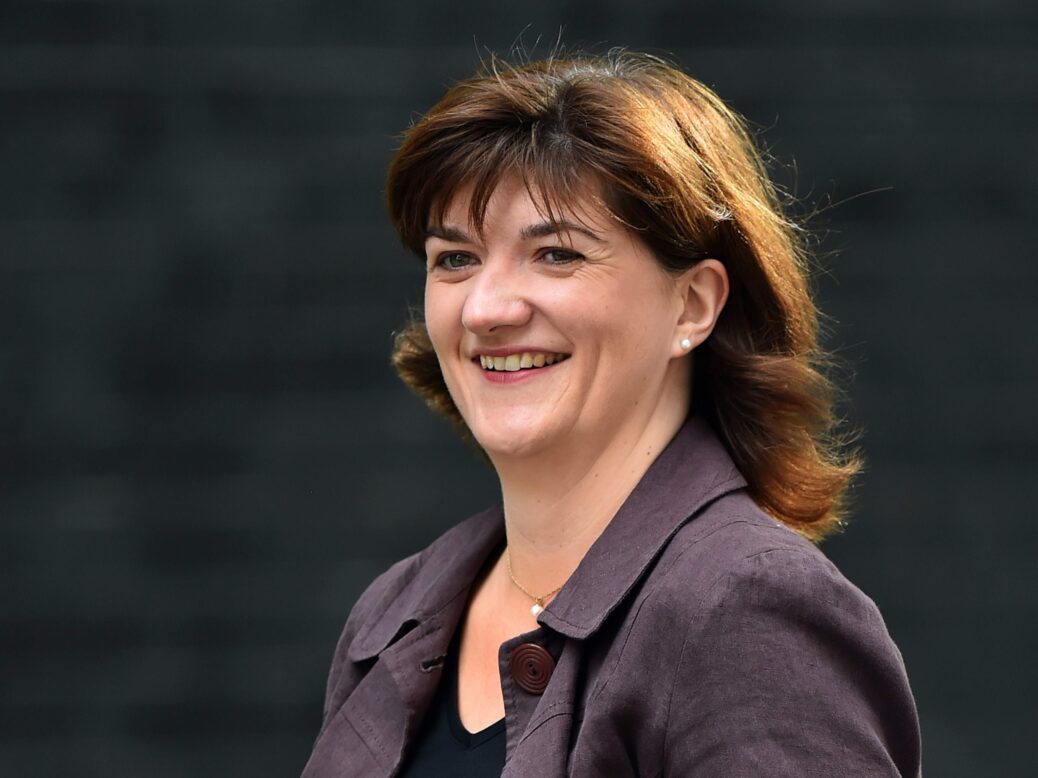
David Cameron’s final reshuffle before the general election was more sweeping than expected, bringing the demotion of Michael Gove and William Hague, as well as several big promotions. Here are some of the ministers you’ll be seeing much more of.
Nicky Morgan
The new Education Secretary may have risen quickly (she became an MP in 2010 and was number five at the Treasury until April) but she hasn’t sacrificed her willingness to speak her mind. At a meeting of the Bright Blue think tank in January, she attacked the oppositional approach of some of her party colleagues: “We’re against this, we’re anti-that, we don’t like them . . .” A move away from that kind of antagonism will be a relief to the teaching unions, which clashed repeatedly with her predecessor at the Department for Education, Michael Gove.
Morgan’s first taste of cabinet responsibility came in April when she inherited the position of minister for women from Maria Miller. At the time, the linked role of equalities minister was given to the Culture Secretary, Sajid Javid, perhaps because of Morgan’s religious opposition to gay marriage, one of Cameron’s flagship reforms. She now holds the equalities brief as well as the one for education, but responsibility for same-sex unions has gone to the junior minister Nick Boles.
Morgan, a former corporate lawyer, takes an approach to moral questions that is informed by her Christian faith. She is regarded as a safe pair of hands by parliamentary colleagues, and the leadership will be hoping she will prove a calming influence on a policy area dogged by tussles with the union, anonymous briefings and lack of transparency.
Caroline Crampton
Lord Hill of Oareford
“Lord who?” was the response of many at the news that Lord Hill was the UK’s new European Commissioner. Even David Cameron has seemed shaky about his identity: Hill tried to resign in the 2012 reshuffle but the Prime Minister distractedly told him to “carry on the good work”. He stayed in his education post.
Though many had expected a woman to get the job, Hill is a natural choice for Cameron. His background mimics the Prime Minister’s: public school and Oxbridge, followed by a stint at the Conservative Research Department and years in the private sector during the 1990s. He is a low-key choice: other countries send former leaders or senior ministers to the EU. “You can be damn sure that nobody anywhere else in Europe will have heard of him,” says Charles Grant, the director of the Centre for European Reform.
Lord Hill’s appointment suggests that Cameron wants someone who can cut a deal out of the spotlight. As a bonus, by appointing a peer the Tories have dodged a potentially tricky by-election.
Harry Lambert
Liz Truss
The “Trussette”, as she is known by admiring male Tory MPs, has never made a secret of her political ambition. Behind the scenes, she has long been happy to confess her
desire to reach the cabinet table, and after a stint as an education minister she has done just that.
Truss is now Environment Secretary, replacing Owen Paterson, a climate-change sceptic who was culled rather more successfully than Britain’s badgers. She is known as a right-wing ideologue and is one of several 2010-intake Tories who co-authored a neo-Thatcherite treatise called Britannia Unchained in 2012.
Although Truss’s reformist, right-wing credentials put her in tune with the new mood in the Tory party, her rise has been bumpy. Before 2010, “Turnip Taliban” activists in her South-West Norfolk constituency revolted against her on the grounds that she was an “A-lister” – on Cameron’s list of preferred candidates – and that she had failed to disclose an affair with the MP Mark Field.
A forthright personality, Truss was nicknamed the “human hand grenade” while in her education brief. Once a left-winger who went on a CND march at the age of eight, she became president of the Oxford University Liberal Democrats before joining the Conservatives. She will now have to adapt to the discretion and self-censorship required of a cabinet minister.
Anoosh Chakelian
Michael Fallon
In an age when all party leaders place a premium on youth, Michael Fallon is a rare example of a political slow burner. Thirty-one years after he first entered parliament and at the age of 62, the MP for Sevenoaks has finally been elevated to the cabinet as Defence Secretary.
It’s a promotion many Tories regard as long overdue. Fallon, who previously served as business and energy minister, is widely admired in the party for his firefighting and troubleshooting abilities. In the dark days of 2012, when the government seemed to lurch from shambles to shambles, it was the redoubtable Thatcherite who served as “minister for the Today programme”. The only blot on his record is his botched handling of the Royal Mail privatisation, which he oversaw in 2013.
After years of cuts to defence budgets, the Tory right hopes that the arrival of Fallon, one of its own (he voted against equal marriage, established a grammar school in his constituency and wore a black tie in the House of Commons on the tenth anniversary of Margaret Thatcher’s resignation), will offer the department greater protection in future spending reviews.
George Eaton