
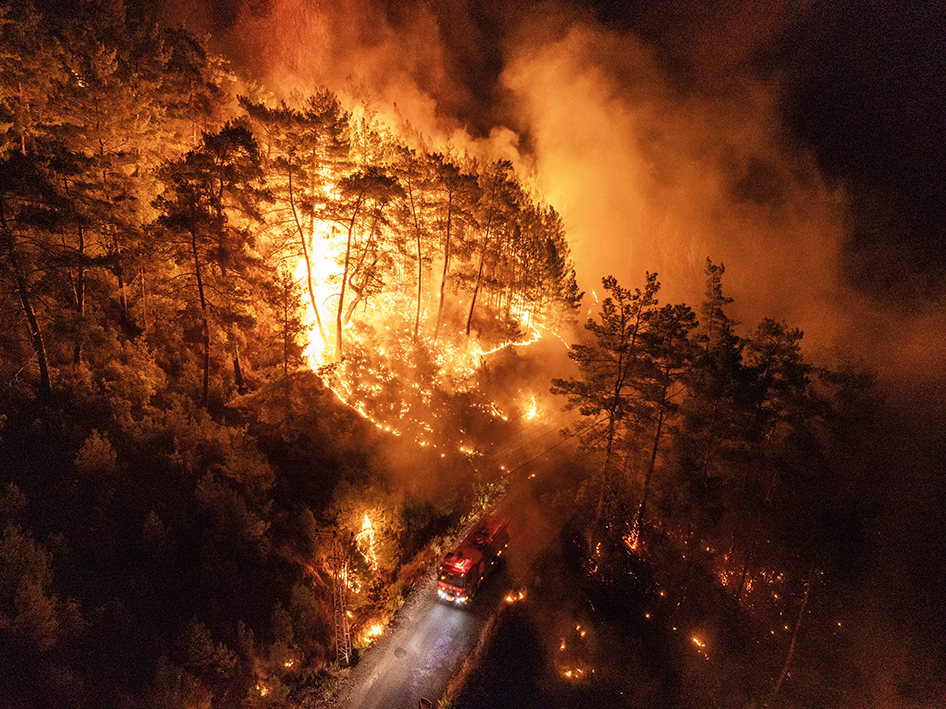
In Saumos, in southern France near Bordeaux, a wildfire erupted on 22 July and within two days had generated the country’s first ever pyrocumulonimbus, a thundercloud formed by smoke and ash. In the ferocious heat generated by the blaze, a smoky, sooty convective column punched into the upper troposphere and condensed into a thundercloud, generating downdrafts, erratic high winds and dry lightning that struck the dried-out biomass on the ground, creating more fires. This is typical of the logic of climate change: the fossil-fuelled industrial activities of capitalism convert the biophysical feedback loops of the Earth system into destructive spirals.
Last year’s European wildfires were the worst on record, and in recent years European fires were 273 per cent above the 2006-21 norm. This year, in France and Spain, the area burned is breaking records. Across Europe 250,000 hectares of land have burned so far, an area equivalent to Luxembourg, with more than 300,000 people displaced. While “sceptics” claim that the continent is having its “quietest” year of wildfires, records show that in terms of area burned it is one of the worst years. The fire frontier is moving north, as new pyroregions arise in Germany, Romania and even the UK. In the “firewave” blighting the UK this summer, even the Cairngorms in Scotland – historically not a zone of uncontrollable fires – burned with alacrity. Meanwhile, in Suffolk – whose Reform-led council opposes net zero and recently voted to rescind the Climate Emergency Declaration – a major incident was declared as wildfires burned just miles from the Sizewell B nuclear plant.
The planet is made to burn, with plenty of organic fuel, flammable carbon-based organisms, heat and lightning to produce recurring wildfires, to which ecosystems have adapted. Each ecological system has its own native fire regime, some of which – like the Taiga forests circling the Arctic – have been burning regularly since the ice age. Whole ecological niches have become adapted to fire, and some organisms even seem to have evolved to burn. Certain Banksia and Eucalyptus species of tree, for example, exhibit serotiny, where seeds are retained inside a cone or fruit and only released during a wildfire. This is why fire suppression efforts are often counterproductive.
For example, while the grasslands, shrublands and chaparral and woodland habitats of California burn more intensely and dangerously because of climate change, efforts to prevent fires rather than manage them tend to leave fuel to accumulate while also changing the biochemical composition and moisture retention of the soil, thus making the fires more extreme. Australia, likewise, has evolved to burn since it broke off from ancient Gondwana, with ecosystems packed with pyrophytic and pyrophilic trees and plants, across large, low-nutrient, parched landscapes. About 5 per cent of its land surface is burned by wildfires each year, destroying a tenth of the country’s “net primary productivity”: the ability of tropical forests, woodlands and savannah to photosynthesise solar energy. This is becoming more dangerous because of climate change, but if the fires ceased to burn entirely, parts of the continent would die.
However, the global heating caused by fossil emissions is making wildfires unmanageably more severe. This is in part because hotter air carries more water, resulting in wetter winters followed by scorching, dry summers. In this “weather whiplash”, winter rainfall stimulates abundant growth of plants and trees, which are then dried out in the parching summer as the hot air sucks more moisture from the soil and vegetation, leaving plenty of dry fuel for wildfires. The result is that fire-adapted regions experience a drastic increase in the severity and extent of wildfires, outpacing the capacity of local biota to adapt. The sensitivity to warming is non-linear. For example, in California, a 1°C increase in summer temperatures yields an increase of 22-25 per cent in area burned. And even a global temperature just 1.5°C above pre-industrial levels makes extreme forest fires 88-152 per cent more likely. The result is devastating for fire-adapted ecosystems, because the life trajectory of local organism has been tuned, over evolutionary time, to a stable wildfire interval and intensity. Heating-induced “interval squeeze” reduces the seeding and growth of plants in subsequent years. This is also likely to make the landscape more susceptible.
Among the cascading effects of the spread of wildfire events, there is not only a further contribution to the emissions that will prime the land to burn more, but also the growth of what Mike Davis called “pyromaniacal weeds” in scorched drought-land. For example, heating and wildfire catalyses the spread of cheatgrass in the United States, which reduces biodiversity, adds “fine fuels” to the ecosystem and “increases horizontal fire continuity” – increasing the speed and coverage of the blaze. In the Mediterranean, there is a similar positive feedback loop between the spread of tussock grass and increasing susceptibility to wildfires. This is compounded by the growth of invasive woody pyrophytes, which have evolved to burn.
This weather whiplash effect has been extremely visible in the United Kingdom over the past six months, culminating in half the country being officially in “severe” drought in July. The UK, while it has always had tens of thousands of small grassland fires each year, has not historically had a wildfire problem in the way that France, Spain and Greece have. The fires that have burned annually have been manageable, and probably necessary. For example, wildfires help the heather and gorse that grow in Dartford to propagate by clearing brush and cracking open the hard shells of seeds. This prevents the area from becoming scrubland and maintains a habitat for birds and insects. The incidence of major wildfire events, being inversely proportional to average mean rainfall, used to coincide with drought years, such as in 1995 and 2003.
However, the number of large wildfires in the UK has risen steadily over the past decade. And the driver – warmer air producing wetter winters and hot, dry summers, creating abundant dry grassland that ignites easily during heatwaves – is the same as on the Continent. By 2018, the UK had already had two to three times more heatwave activity than in the pre-industrial era. Summer rainfall is expected to fall a further 15 per cent by 2050, and 22 per cent by the 2080s. The UK is already experiencing some fires resembling those in Mediterranean climates, and as the fire frontier moves north, that will become more common.
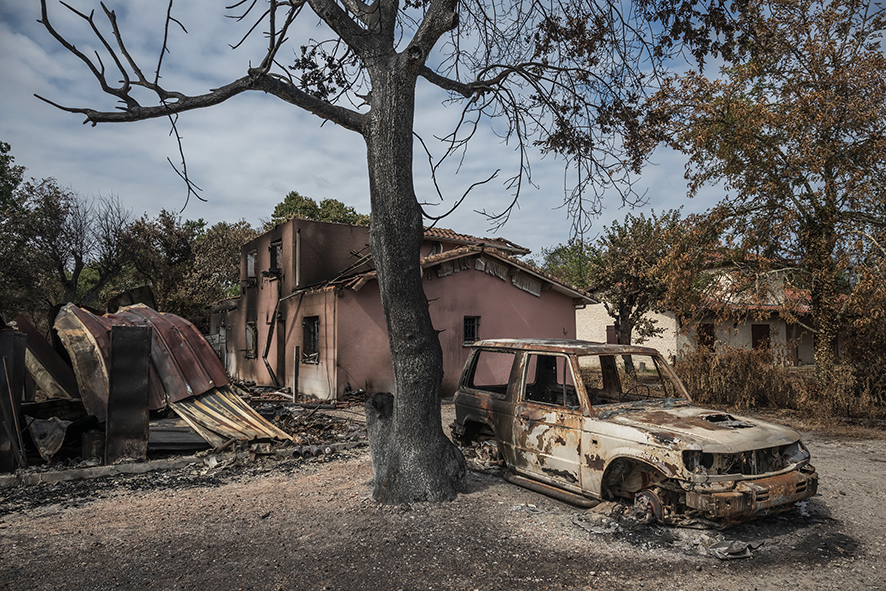
Explaining these dangerous trends, the environmental historian Stephen Pyne coined the concept of “the Pyrocene”. He argues that the human race has lived through three fires: wildlife ignition from nature; controlled burning of landscapes by early humans to clear land and cook; and the industrial burning of fossil fuels. This last episode – which has been the energetic basis of capitalist civilisation since the 19th century, and remains essential to most of what is produced and consumed – is what is hastening a dangerous planetary rupture: the Pyrocene age.
However, climate change is not the only “anthropogenic” factor in this. Across Europe, land has been abandoned and depopulated under the pressure of agricultural consolidation, creating “large, unbroken expanses of forest and scrubland that allow fires to spread unchecked”. In the depopulated interior, scrubs and plants that would have been cleared accumulate as fuel for fire. This process has been accelerated under the EU’s Common Agricultural Policy, in which subsidies are based on the total area of land farmed, thus rewarding the larger landowners. The problem is only made worse by the fact that the EU’s main response to wildfires is an ineffectual policy of suppression, which, far from stopping fires, leads to “ongoing fuel accumulation and landscape-level fuel continuity” that results in megafires. At the same time, European real estate developers build closer to the firebelt, putting more people at risk. Perhaps the worst example of this was the unlicensed construction of homes in Mati, Greece, which then suffered a lethal wildfire in 2018 that killed 91 people.
Forest monocultures, driven by the demand for timber, are also much more susceptible to wildfires as they provide a continuous fuel load with tightly packed, evenly spaced and more flammable trees such as conifers. This is exactly the case with the massive Landes de Gascogne forests burning in southern France: it is a dense, monocultural pine forest planted for harvest roughly every 40 years. The EU has made belated and underwhelming efforts to address some of these factors, but, in practice, emergency response monopolises most of the attention and funds.
These wildfires are not natural disasters: at every step they are the predictable result of decisions usually made for profit. In fact, there is no such thing as a purely natural disaster. As the disaster expert Ben Wisner and his colleagues have been documenting for years, all disasters – earthquakes, floods, storms, wildfires – are made disastrous by man-made vulnerabilities. As Mike Davis pointed out in his essay “The Case for Letting Malibu Burn”, the rich are protected even when they choose to live in wildfire zones. Meanwhile the poor and elderly tend to live in areas exposed to wildfire, and have the least resources to cope and rebuild. They also tend to be the most susceptible to the disruptions to healthcare during a disaster and the poor air quality as smoke pours out of the wildfire.
It is because these runaway wildfires are in no way natural that the ideological response of the right is constant denial and displacement. The universal tendency is to blame arsonists, much as the right reacts to extreme heatwaves by deflecting the conversation on to air conditioning. In France, even the inept centrist prime minister, Sébastien Lecornu, leaned in to this idiocy, highlighting the number of arrests for deliberately starting fires. It would be remarkable if the number and distribution of arsonists just happened to closely track global warming, declining summer rainfall, and more frequent heatwaves. But even if that were true, the forests and scrubland wouldn’t burn quite so swiftly or promiscuously if they hadn’t been primed to ignite.
It is traditional now that, as each summer brings us lethal wildfires and mass displacements, the term “apocalyptic” starts appearing in headlines. We should be wary, as the theologian Thomas Merton once warned, of confusing our own catastrophic forebodings with the apocalypse. Apart from anything else, we tend to acclimatise to apocalypse in that sense: the catastrophes show up on our feeds, generate panic and gloom, and – amid general political paralysis worsened by the repression and retreat of the climate movement since 2019 – are assimilated to a new normal. The threshold for “apocalypse” just keeps moving.
There is also a danger in being enthralled by the most visually appalling disasters. Walter Benjamin once warned that humanity’s self-alienation was so complete that it could “experience its own destruction as an aesthetic pleasure of the first order” – but for that we need a spectacle. Wildfires are the spectacular moments in longer and more lethal heatwaves: for example, the heatwave in the last week of June produced an estimated 20,000 excess deaths across Europe. These deaths, usually resulting from cardiovascular stress among the elderly, are not sudden and spectacular but happen quietly and anonymously in overstretched hospitals over several days or longer. Unlike the flames, they cannot be turned into an image for front pages or feeds for our collective titillation.
In its literal sense, however, an apocalypse is a revelation. Perhaps that’s just what this is. For decades now, the denialist right in Britain has argued that warming is to be welcomed. Relax and “enjoy the sunshine”, as Dominic Raab told Britons during 2022’s record heatwaves. It’s “mostly beneficial”, the journalist and Conservative peer Matt Ridley argued in the same year. In fact, there has long been a fantasy that heat might even make this rainy country a more convivial place, hospitable to vineyards: we could live the Mediterranean life in the suburbs of Kent. The former Tory chancellor Nigel Lawson evoked this image when he claimed, in An Appeal to Reason (2008), that climate change was less severe than in Roman and medieval periods.
Apart from the fact that southern England already has plenty of vineyards, what we are seeing in the Mediterranean today – and will see in Britain as the fire frontier moves north, – isn’t refined, bucolic splendour, but hundred-metre flames ripping through the countryside. Perhaps that is why the argument now takes a fatalist turn. In the Daily Telegraph, Allister Heath argues that we can’t do anything about climate change, and efforts to mitigate emissions impede growth, so we may as well stop trying and “learn to cope with, and whenever possible, even enjoy” a Mediterranean life.
Some people would rather watch things burn than inconvenience capitalism. But what do we really see if we look closely at the flames, belching smoke, and spiralling, cascading ecological symptoms? Look at the wildfire that produces its own catalysts, despoiling the Earth and atmosphere, dissolving all boundaries and indifferently consuming all substrates until they are exhausted. It could almost be a monstrous personification of an impersonal system that chews up nature in a spectral metabolism and belches out a yield, shareholder value, which is as evanescent as flame and smoke. It is almost as though capitalism has, through its own ceaseless, ravenous activity, trained ecosystems to behave just like it. For the denialists, of course, that is a revelation too far.
Richard Seymour’s books include The Disenchanted Earth: Reflections on Ecosocialism and Barbarism (Indigo Press)
[Further reading: Europe’s age of fire]