
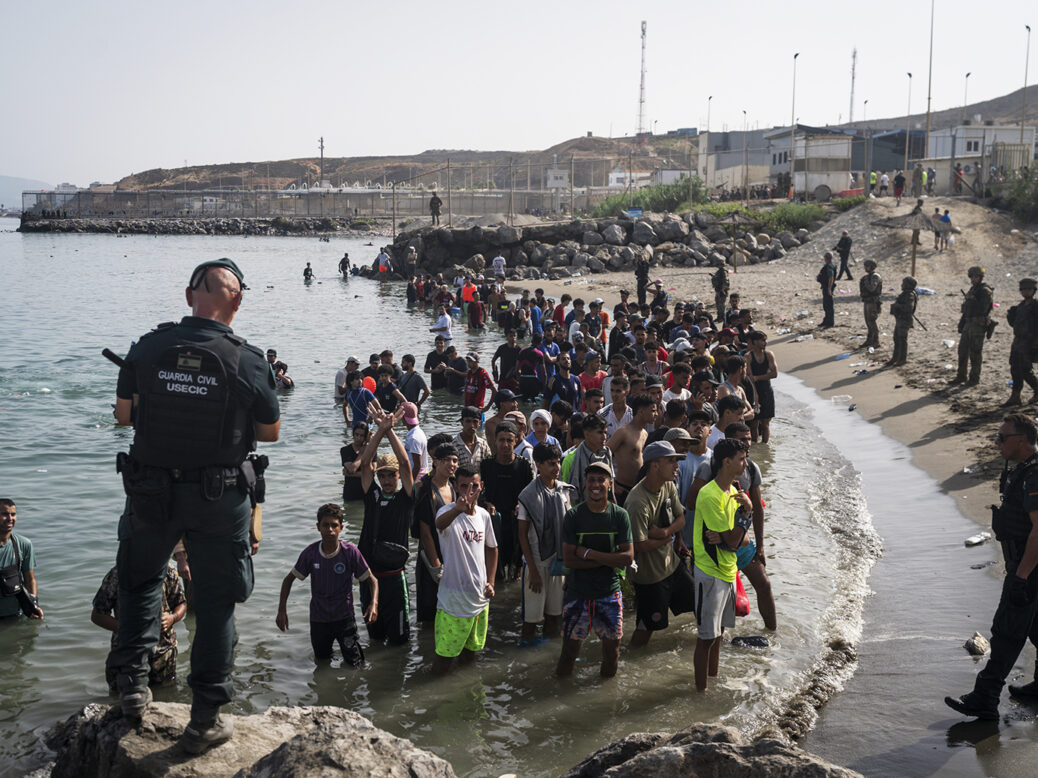
As my ferry from Algeciras inched into the port at Ceuta on Monday, the shoes and shirts of some of those who had made the crossing the week before still littered the shoreline. A sea barrier had been quickly erected at the boundary with Morocco to deter a repeat of 30 July, when an estimated 72,000 Moroccans surged into the Spanish enclave in North Africa, leading to at least 88 deaths. Though residents were still swimming in the balmy waters in the shadow of the border, yellow buoys kept them close to the shore, watched by lifeguards.
Despite warnings of an “invasion” from Donald Trump and other right-wing politicians, most of those who arrived in Ceuta have voluntarily returned across the border to Morocco. Officially, 48,000 of 50,000 have done so, though both numbers are in reality likely to be much higher. In Ceuta itself, it was clear that there were more than 2,000 left – a local policeman estimated 5,000. On 6 August, the Spanish enclave’s leader, Juan Jesús Vivas, told the European Parliament that between 3,000 and 5,000 migrants remain.
Having risked their lives to swim around the frontera in the hope of a better life in Europe, most of the Moroccans I spoke to now seemed crestfallen. Since Spain joined the Schengen Convention in 1991, Ceuta and Melilla have been treated as administratively separate entities. It is impossible to travel to Spain proper without further passport checks – and so while those who crossed to Ceuta were technically in Spain, they were no closer to Europe than when in Morocco.
Some of those who were yet to return hadn’t quite accepted this reality: they were desperately hoping they could still find a way. Aziz, an Afghan national, who looked to be in his forties, had been travelling for over a month to get to Ceuta. He told me he had been “fleeing from the government”. He said he had flown to Libya, and then had trekked across, first to Algeria, then Morocco. Although claiming asylum looked difficult, he was adamant: “I am not going back to Morocco.” Most of the remaining new entries were left either milling around Ceuta or headed for CETI, the temporary migrant processing facility in the hills above the city, in the hope that they might successfully claim for asylum.
For those wishing to make the exclave a rallying cry for the global right, the facts – both in Ceuta and across the EU’s long southern border – bear out an awkward reality. Far from an exemplar of Europe’s failures, beneath the extraordinary images and the tragic drownings lies an EU not only determined to get crossings down – but one increasingly ruthless and effective in doing so.
Since 2016, slowly, but with methodical rigour, the EU has been improvising an increasingly effective toolkit for its border control. Data suggests it has been remarkably successful. For the third successive year, irregular crossings look likely to fall significantly. According to figures released in the first half of this year, such entries are down by 37 per cent year on year – already a significant drop from a post-Covid peak.
The reasons are twofold. First, an extensive and costly effort to entice cooperation with southern neighbours through disbursement of huge lump sums of aid, cheap loans and other diplomatic benefits. In 2023, Tunisia was offered a sweetener of €1bn; in exchange for migrant cooperation Egypt has been offered at least €7.4bn.
Rewards are not just financial. As Riccardo Fabiani, North African project director of the International Crisis Group explains, Morocco “does not want to be seen begging for money to keep migrants out of Europe”. Instead, tacit support buys European goodwill for other Moroccan schemes – schemes ranging from acquiring access to European AI supercomputers, to the Moroccan leader’s ongoing attempts to cajole others into recognising its sovereignty over Western Sahara.
Second, enforcement is increasingly successful. The EU has turned to sophisticated AI-powered drones to police the seas and Libyan desert. It has beefed up its partners’ border forces out of its own pocket – on the very same day of the mass crossing, the bloc announced it would be funding a new “rescue centre” in Benghazi. Perhaps most controversially, it has learned how to get others to do what it cannot. It has been reported that the EU has shared coordinates of small boats with brutal Libyan militias like the Tareq bin Zayed brigade, which in turn have been reported to have pulled back migrants even though they are in EU waters. If true, this would contravene international law.
There are good reasons to think that last week’s migrant surge was not a spontaneous failure of the EU, but a deliberate action by Morocco. It has done so before in 2018 and 2021 – to pressure Spain on its relations with Algeria, and with the Polisario, who claim to be legitimate rulers of Western Sahara. The latest came at a similar geopolitical moment – after a Spanish diplomatic visit to Algeria, which Spain relies on for cheap gas. When asked, those who crossed into Ceuta said they found out about the plan over social media. Though it has not admitted to coordinating the mass movement, Morocco has since made references to social media activity before the crossings took place.
Yet Ceuta shows that Europe’s system holds strong in the face of advances like this. Haizam Amirah-Fernández, director of the Madrid-based Centre for Contemporary Arab Studies, tells me Morocco relies on “an element of ambiguity”. Despite good evidence that Morocco knew about the crossings, and did not deter them, its position of diplomatic dependence has meant it has to be seen to cooperate. It has willingly pivoted to assisting EU authorities after reports initially suggested its border guards aided the surge. The EU is more useful as a friend than enemy. Push too hard, particularly on migration, and Morocco risks losing out on support.
Although tens of thousands of irregular migrants made it across border lines, once they arrived in Ceuta it quickly became apparent that they could not make it further. Some migrants described facing hostility on arrival. Asif, a refugee from war-pocked Sudan who said he was 23, suggested the authorities had made it hard for the new arrivals. “They did not feed us or give us water for the first few days – many found that hard, and so they went back.”
It is the political cliché of our times that the most uncomfortable thing to admit is that you may well agree. Yet, on migration, the EU is already eschewing many of the values it says it believes in to serve the end of lowering migration. It seems to be doing so successfully, through a series of pragmatic deals with its near neighbours. But controlling the narrative is very often more important than controlling the number of entrants. Georgia Meloni has already called for a temporary suspension of Spain’s Schengen status (a move of dubious practicality). Meanwhile, Ceuta has become the site for various far-right rallies – Santiago Abascal, leader of the far-right Vox party, in a rally on Sunday called for the expulsion of the rump of the “invasion”.
Locals are still worried about the fallout. One, a lifeguard called Mohammed told me he didn’t feel safe: “Migration is important, but this is just too much.” Lifeguards were unable to help during the influx, he said, “there were just too many people”. While he believed “it was Morocco who pushed them to go”, he worried about “safety, and crime. There are still too many people here.” But the reaction to the event had disturbed him the most. “We are a very multicultural place – Vox are too Christian, they do not get us in Ceuta,” said Mohammed, who himself is Muslim. He pointed to some of those on the beach: “They are migrants, there are usually not so many people here.” As we looked north towards the rock of the Gibraltar, Europe seemed as far away as ever.
[Further reading: Spain gets migration right]