
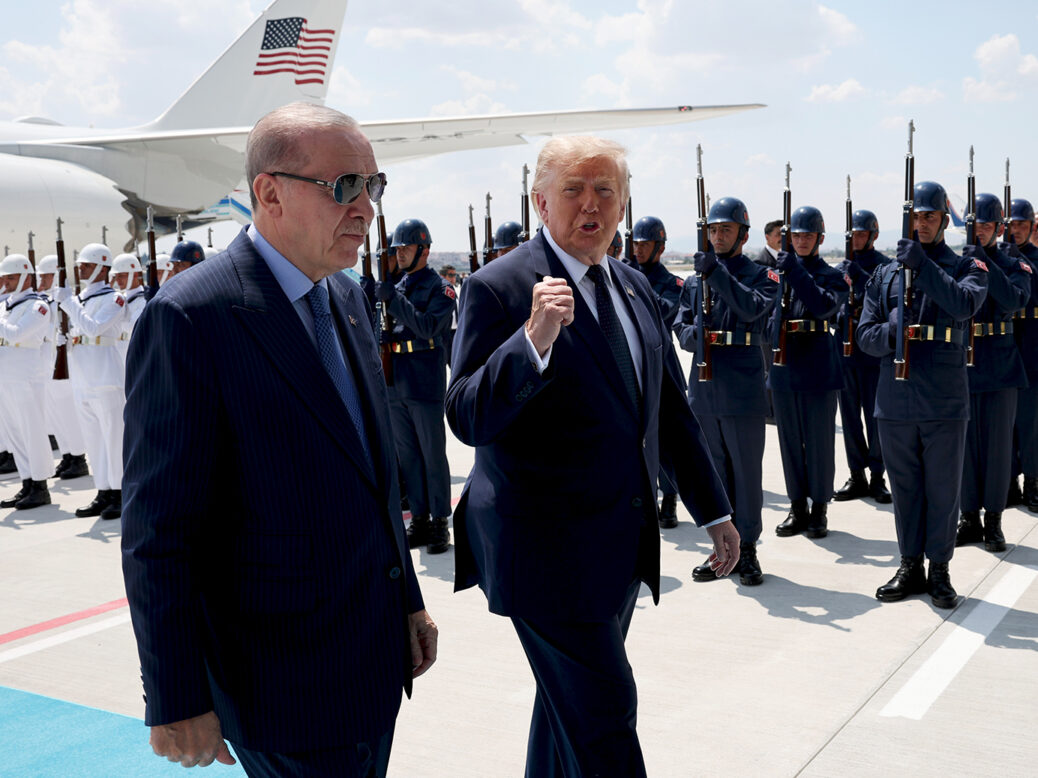
Picture the scene: an autocratic president who has been in power for 23 years gathers the leaders of the Free World in his 1,100 room, golden palace. As his biggest political opponent languishes in prison facing a 2,000-year sentence, the autocrat soaks up fawning praise from his guests. They talk of the need to build stronger ties with his country, to perhaps buy the weapons it produces, and of the vital role the autocrat plays as a global mediator and peacemaker. If any of them are discomfited by this spectacle, they will be doing their utmost to hide it.
In reality you don’t need to picture the scene: you can watch all this live, if you’re so inclined, on Nato’s website. From 7 to 8 July, the alliance’s heads of state have gathered in the Turkish capital, Ankara, for its annual summit, hosted by Turkey’s President Recep Tayyip Erdogan in the grandiose palace he built for himself. Afterwards, they will gather for the annual family photo.
The leaders’ summit is the highest-level event in Nato’s calendar and a window onto the alliance’s realpolitik. This year, the setting signals that we are firmly in the era of pragmatic autocracy, and that amoral engagement has become the West’s new norm. The combined states of Europe and North America are battling against Vladimir Putin’s aggressively hostile Russia, purportedly under the banner of Nato’s founding principle of defending democracy, individual liberty and the rule of law. Yet the commanders of Nato’s two biggest militaries, Erdogan and US President Donald Trump, are also two of the world’s most ostentatious populist strongmen, who often stand opposed to the alliance and its values.
For more than a decade, Erdogan, one of the world’s longest serving leaders, has pursued a cynical foreign policy, squaring up to his Nato and EU allies to fan jingoistic nationalism at home. He also formed bromances with anti-Western strongmen including Putin and Venezuela’s Nicolás Maduro. In 2016, Erdogan accused the US of supporting a coup attempt against him, and then purchased a Russian missile defence system, leading to Turkey’s expulsion from the F35 fighter jet programme. He ignited maritime disputes in the Aegean by sending his warships into Greek and Cypriot waters. During Trump’s first term the two strongmen clashed regularly, and analysts pondered whether Turkey might leave Nato or be kicked out.
But with the full-scale invasion of Ukraine in 2022 and Trump’s return to the White House, the world has realigned in Erdogan’s favour. In 2025, Freedom House, a non-profit organisation that promotes democracy, marked the 20th consecutive year of decline in global freedoms. Even in the democracies of western Europe, illiberal populists are rising in the polls. Erdogan’s Turkey no longer looks like an anomaly; he’s more an early model of how other countries are now evolving. And within Nato, which is locked in multiple hot and hybrid wars with Russia, pragmatism now overrides values.
Since his latest election victory in 2023, Erdogan has manoeuvred himself back into the Western circle by playing the geopolitical cards he has gathered. He offers his contact with Putin as a mediation channel in the Ukraine conflict and used his friendship with Hamas leaders to help mediate the release of 7 October hostages. Turkey’s booming defence industry, which has tripled the value of its exports since 2021, could also provide a stream of weapons to European countries that need to rearm – if Erdogan can convince EU member states to allow Turkey to access the bloc’s defence funding. Unable to rely on Trump’s fickle affections, Nato knows it needs Turkey to rearm Europe, even if that means looking away from Erdogan’s autocratic descent.
Erdogan’s hosting of Nato’s summit cements his place back in the fold. And he has done it under his own autocratic terms. “It’s a swivel back to Atlanticism (for Turkey), but the Atlanticism of Trump,” said Selim Koru, an analyst and author of New Turkey and the Far Right. “This is the Nato summit of reactionary nationalism.”
Europe and the US once criticised Erdogan for his attacks on Turkish democracy. Today, Western leaders are largely quiet on the jailing of Ekrem Imamoglu, the twice popularly elected Istanbul mayor and the opposition’s anointed presidential candidate. Imamoglu was arrested on spurious corruption charges in March 2025 and remains in Silivri prison on the outskirts of Istanbul, a high-security fortress stuffed with dissidents. In June, the courts removed the leader of Imamoglu’s party, the CHP, and reinstalled the lame former chair in his place. Police smash street protests with tear gas and monitor them with facial recognition cameras, using the data to round up the demonstrators in dawn raids.
A week after the summit, Turkey will mark the tenth anniversary of the failed putsch against Erdogan, which was led by a group of rogue generals and quashed, bloodily, within hours. Erdogan launched his crackdown immediately. Within days, tens of thousands of people in the civil service, security forces and judiciary were arrested or dismissed, and over the following years Erdogan switched Turkey from a parliamentary democracy to executive presidential system – with himself as president – gathering all state powers around himself in the palace. He has taken control of every institution that matters and calibrated the electoral system to ensure he cannot lose. Nato leaders surely know who they are dealing with. And they must know what he is doing to Turkey.
For most Turks, the latter part of Erdogan’s rule has been expensive, destructive and angry. In 2018 he appointed his son-in-law, Berat Albayrak, as treasury minister, and then proceeded to micromanage the economy through him. Erdogan, a pious Muslim, insists that interest rates are usury and therefore un-Islamic, leading him to overrule and dismiss central bank governors who tried to raise rates to cool the overheated economy. Erdogan insisted on keeping credit loose, long after Turks should have been tightening their belts. Well into the 2020s banks gave out huge consumer loans, which Turks immediately converted into foreign currency to hedge against the depreciating lira. Most of all, credit sustained Turkey’s property developers, the principal beneficiaries of Erdogan’s political patronage. The owners of the big construction firms have bought up opposition media outlets that were shut down or forced out of business, and turned them into Erdogan’s mouthpieces. In return, Erdogan awards them grandiose state construction projects under loan-structured PPI contracts, and keeps Turkey’s property sector buoyant with credit.
This policy has wrought catastrophe. Repeatedly over the past five years, Turkey’s central bank has sold off billions of its dollar reserves to stop the lira from toppling into a death spiral on the money markets. Since 2018, the lira has lost more than 90 per cent of its value against the dollar, pushing inflation up to 88.5 per cent annually at its peak in November 2022. The price of everything has skyrocketed, particularly rents, and ordinary Turks feel poorer than they did a decade ago.
On the streets, Turks are angry about everything: the price of basic goods in the markets, the number of foreigners in Turkey, now the biggest refugee-hosting nation in the world, and the difficulty of obtaining a Schengen visa to visit Europe. Some Turks find ways to leave, through education, investment or employment, and they are taking their skills and wealth with them. Athens and Berlin have become hubs for recently migrated Turkish creatives, London for intellectuals and businesspeople. They have left behind a country that is narrowing in vision and potential, constricted by Erdogan’s mismanagement.
Yet Erdogan doesn’t need to play nasty with Nato anymore. He has neutralised his domestic challengers and settled himself in a strong strategic position within the bloc. Now, as the prodigal ally, he can present himself as a bridge between Europe and Trump, and a link from the West into the Caucasus region, where Europe is competing with Russia. European defence deals could bring billions into the Turkish economy – and the pocket of Erdogan’s other son-in-law, Selcuk Bayraktar, who runs the country’s biggest drone manufacturer. Money coming in means Erdogan’s patronage keeps flowing, the country stays afloat, just about, and the autocrat-industrial complex keeps rolling.
When Nato leaders arrived ahead of the summit, they landed at the new Ankara airport, built from contract to completion in 230 days and opened three weeks ago by Erdogan and an imam, who recited prayers. Ankara already has an airport, which serves 15 million passengers a year and last year received a £200 million upgrade, including a new runway and control tower. But building has become a way for Erdogan to sustain himself, with supply based on his needs rather than market demand. This new airport, built for official, diplomatic and VIP flights, signals his ascent as a serious power broker, a message to all the visiting leaders but especially to Trump, who also loves building things.
While Keir Starmer was among the leaders in Ankara, the summit marked his last in office. What prime-minister-in-waiting Andy Burnham’s stance on foreign affairs might be is still unclear. But if he listens to his diplomats when he takes office, he is likely to maintain the UK’s dovish position on Turkey. The relationship between London and Ankara remained solid even when Erdogan was locked in disputes with Nato and Turkey’s weapons industry was under Western sanctions for abuses against the Kurds and the relationship with Russia. Bilateral trade has nearly tripled since 2010, and since the UK left the EU, Ankara is an even more important trading partner. London is now unshackled by the politics of Brussels when it deals with Turkey. Foreign office officials listen to the warnings from journalists and analysts – and then continue to do business anyway. The spoils go both ways: in March, the UK won an £8 billion deal to supply Turkey with British-built Typhoon fighter jets that will be integrated with Turkish-made weaponry, a strong endorsement of Ankara’s arms sector, and a workaround to its exclusion from the US-led F35 programme.
Last summer, a top civil servant in the foreign office told a gathering of journalists that the UK “sees no evidence of a descent into autocracy in Turkey”. The diplomat continued, saying that the opposition might stand a chance in elections against Erdogan “if only they could find a decent candidate”. Imamoglu, several months incarcerated by then, was apparently not part of the equation.
For many years, Western leaders would publicly criticise Erdogan for his jailing of journalists and dissidents and disdain for democratic liberalism. At Nato and EU summits a decade ago, his counterparts flinched from shaking his hand. But back then, Trump was new on the scene, Brexit was yet to play out, and Erdogan was just entering his autocrat era. Now we are years into Trump’s new world, and Europe knows it has few other places to turn than Turkey. When Nato’s assembled leaders pose for the alliance’s family photo this week, they greet Erdogan like one of their own.
[Further reading: World War III is here]