
Quite regularly, humans massacre one other. We inflict vast destruction and suffering on ourselves. In the 20th century we slaughtered around one hundred million people in war. This is because of our lack of rationality – our unwillingness to extend the civilisation pact that keeps us relatively safe within countries to relations between countries. Since the 1940s there has been a new factor in this game: nuclear weapons. The poisoned gift of my trade, theoretical physics, to humankind.
Nuclear weapons were conceived and realised in a great hurry by a huge economic and human investment in the middle of the heat of the Second World War. The Manhattan Project that built the first atomic bombs directly employed more than 130,000 people and indirectly involved about 500,000 – almost 1 per cent of the entire US civilian workforce. It cost about $2bn in 1945, equivalent to around $37bn today. These efforts were based on what turned out to be an inaccurate claim: that Nazi Germany was getting close to building nuclear weapons first. But nothing comparable to the Manhattan Project was happening in Germany. Extreme aggression was nourished by unfounded fear.
The warheads existing today, which are a push of a finger away from being launched, have the capacity to burn most of us alive in a few minutes, devastating the planet and destroying human civilisation.
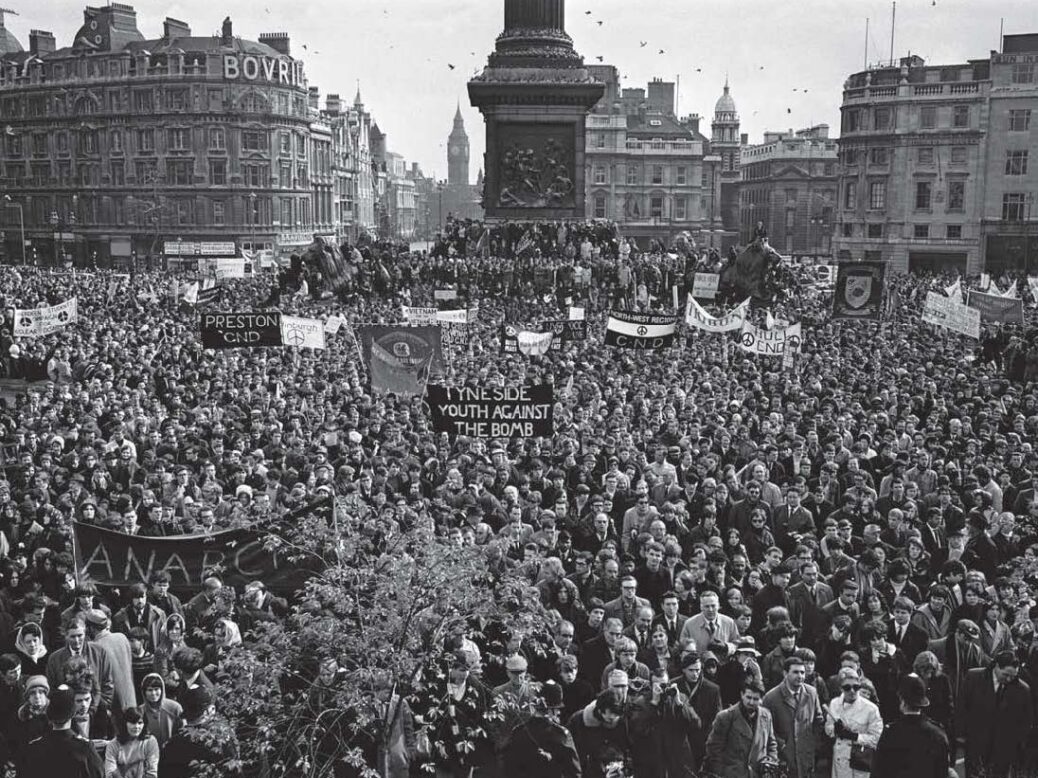
Soon after the first – so far only – utilisation of nuclear weapons in Hiroshima and Nagasaki, enlightened thinkers such as Bertrand Russell and Albert Einstein raised their voices to warn that the nuclear risk is existential. They called for global collaboration as the only path to avoid catastrophe. In 1957, an essay by JB Priestley published in the New Statesman (for an abridged version, see page 62), “Britain and the Nuclear Bombs”, led to the foundation of the Campaign for Nuclear Disarmament. A generation of scientists added their voices. Their professional understanding of the power of these weapons and the risk posed by them helped scientists acutely perceive the danger and a sense of collective moral responsibility motivated numerous scientists to get engaged in addressing the danger they had generated.
These voices were heard by the political leaders of the time. Despite the fierce ideological confrontation, leaders of the US and the Soviet Union were wise enough to avoid direct war, resolve the Cuban crisis by taking a collective step back and crafting agreements such as the Strategic Arms Reduction Treaties, under which nuclear stockpiles were cut by an astonishing 80 per cent. Mikhail Gorbachev explicitly recognised the influence of the scientists in raising his awareness of the danger. The doctrine of mutually assured destruction (or Mad) was high-risk – perhaps, as the acronym suggests, borderline crazy – but it worked: deterrence prevented direct confrontation.
The situation has changed. Emboldened by the outcome of the Cold War, then confronted by the economic rebalancing that threatens their dominance, Western nations are forsaking the hard-won wisdom. Treaties have been abandoned, international law trampled; international collaboration is evaporating.
The signs are all there: feverish surges in military spending; strategies aimed at economic decoupling; efforts to eliminate reciprocal dependency; and, most insidiously, a relentless cycle of demonisation of the enemy. The thirst for war is fed by numerous influences. Obviously, a factor is the rich and influential military industry, which is profiting immensely from the increase in expenditure. For some among the elite, there is a disheartening longing to recapture imperial supremacy: we are the ones who set the rules; we are the legitimate power. Among many others, the push for war comes from fear. Fear is ever the cynical tool for motivating people to accept conflict and die in war. We are afraid of each other, and that’s why we regularly massacre each other. Thanks to physicists, we have a definitive way to slaughter ourselves for good: nuclear power.
Increasing armaments has rarely prevented war; history assures us of that. Immediately before the First World War, military spending surged, just as it is today. Each side sought to prevent war by outgunning the other. We find ourselves once again sleepwalking into a cycle of madness.
Consider: Russia has a GDP comparable to Italy, and is not even capable of capturing Kyiv. It is childish to imagine its military could be a threat to London, Paris or Berlin. It’s even incapable of prevailing against western European weapons without western European nations engaging their own soldiers. But Russia remains a military superpower, even if it is a weakened one. It has 4,000 nuclear warheads. By coming ever closer to direct military confrontation, our leaders are playing with fire. Nuclear fire.
Once, Britain’s industrial output accounted for 80 per cent of the world’s total; today, the combined economy of the Western alliance – if such a thing still exists – makes up less than half of the global economy. Dreams of dominance are outdated, overtaken by the tides of history, and must cede to reason and reasonableness.
What the world requires today is not sabre-rattling and rearmament. We need leaders with cool, rational heads that can envision a future of coexistence and collaboration. The pressing issue is not how to be the strongest, it is how to live peacefully and prosper together. The nations of the world are far better choosing cooperation over confrontation. There are problems and conflicts, of course: there are always problems and conflicts. But reasonable beings find reasonable solutions – they don’t try to resolve everything with dreams of military supremacy.
In the nuclear era, the problem posed by the next war is not to win it, it is to prevent it from happening. Reason tells us that we must stop seeing enemies as enemies and start seeing them as partners; sometimes difficult partners, but still partners. In the nuclear era, the era of climate crises, persistent poverty, escalating conflict and widening economic disparities, the issue is not who prevails, it is how we can collaborate and solve problems together. Problems are global and require global collaboration. Believing that we can prevent war by becoming stronger and dominant only leads opposite sides to respond with an equal or greater show of force, deepening confrontation rather than fostering resolutions.
What we need is the opposite. Reconstruct the international legal order that our countries have started to demolish. Reinforce the United Nations and its authority, as the majority of the countries of the world demand. Stop supporting rogue and war-mongering regimes condemned by the majority of the planet, or regimes that dismiss international institutions. Engage in serious negotiations to end current wars, with the aim of ending them, not showing off power, or pretending to be the only arbiters of justice. Think in terms of global solutions, not increasing our own return. Put common good above petty and destructive local interest. Recognise that the common good should prevail over patriotism. This is not cheap moralism. It is about being rational instead of irrational.
This is not just what an idealistic scientist like me believes: it is what most of the world’s governments demand, including those of new powers such as Brazil or China. It is what wise spiritual leaders like the Pope or the Dalai Lama keep telling everybody. And it is what the large majority of the eight billion inhabitants of the planet desperately hope for.
Since the UN’s very first resolution in 1946, the goal of eliminating atomic weapons and all other major weapons adaptable to mass destruction has been, and still is, an objective of the General Assembly. It is the leaders that we have elected in our rich and once dominant countries that resist this idea, perhaps nostalgic for the centuries of Western imperialism.
Scientists have a special responsibility to warn humankind about our moment of danger, in part because they have the rational tools for evaluating the level of risk. But also, I believe, for the moral weight they carry as the creators of the nuclear monster. Scientists have taken up this responsibility in the past; they are doing it today and should do it more.
On 16 July, 30 Nobel laureates, AI leaders and representatives of the world’s top universities and research institutions, representing 30 countries, signed a “Declaration for an Unarmed and Disarming Peace”. It opens with the words: “Humanity stands at a defining moment in its history. More than 80 years after the dawn of the nuclear age, and at the threshold of the age of artificial intelligence, we are presented with an unprecedented challenge.” It closes with the words of Einstein and Russell: “We appeal as human beings to human beings: remember your humanity, and forget the rest.”
In 2021, more than 50 Nobel laureates signed the appeal for the “peace dividend initiative”, calling for global negotiations towards a 2 per cent reduction of military expenses across the planet. This would not only dramatically reduce the risk of confrontation, but also liberate colossal resources to face our common problems: the climate crisis, extreme poverty and pandemics. This is the direction for humankind. We need enlightened leaders seeing it.
But it is not just scientists who should call for us to step back. Humankind shares a common destiny. It is a single family that shares a common danger, and which has common problems. All countries fail or succeed together. I am sure we will arrive at a reasonable and effective shared political structure for a reasonable governance of the planet: the uncertainty is whether we get there before or after the nuclear catastrophe. It depends on us. Are there any adults in the control rooms?
[Further reading: Ignoring sex differences harms us all]