
IIn July 2015, while working at a restaurant in Vancouver, British Columbia, a guest took my arm and asked me if I was “okay” as I cheerily took their orders. I hadn’t realised I’d been crying – or at least, that tears were streaming from my red-rimmed eyes. I was hours into a shift on a busy patio during what, at the time, was one of British Columbia’s worst fire seasons in years, and the thick ash and smoke that choked the city’s waterfront had left my eyes and throat raw. When I looked across the bay toward the North Shore mountains, I saw only a thick wall of smoke, obscuring a dim red sun that cast no shadows through the thick haze.
That summer, fires across Canada burned nearly four million hectares, significantly above the country’s ten-year average. Those figures now scarcely register against the awesome destruction of recent record years – 2023 saw an unimaginable 17 million hectares across the country go up in smoke – but at the time, the wildfire season was considered severe. I remember being astonished by the scale of destruction, set in stark contrast against the mundane continuance of the everyday, as I served salads among swirls of ash.
Less than six months later, the text of the Paris Agreement on climate change was agreed, and for a brief window, it felt like a page had been turned. In the years that followed Paris, the climate movement swelled, reaching a fever pitch in 2019. In February that year, after months of high-impact organising by The Sunrise Movement, Senator Ed Markey and a newly elected Alexandria Ocasio-Cortez introduced the resolution for a Green New Deal, a concept that captured the global imagination and launched campaigns around the world. The school strikes for climate peaked at an estimated four-to-six million participants in September, while in April, Extinction Rebellion occupied central London’s bridges for over a week, culminating in over a thousand arrests. For weeks, the climate crisis filled headlines and airtime on a scale not seen before – or, arguably, since.
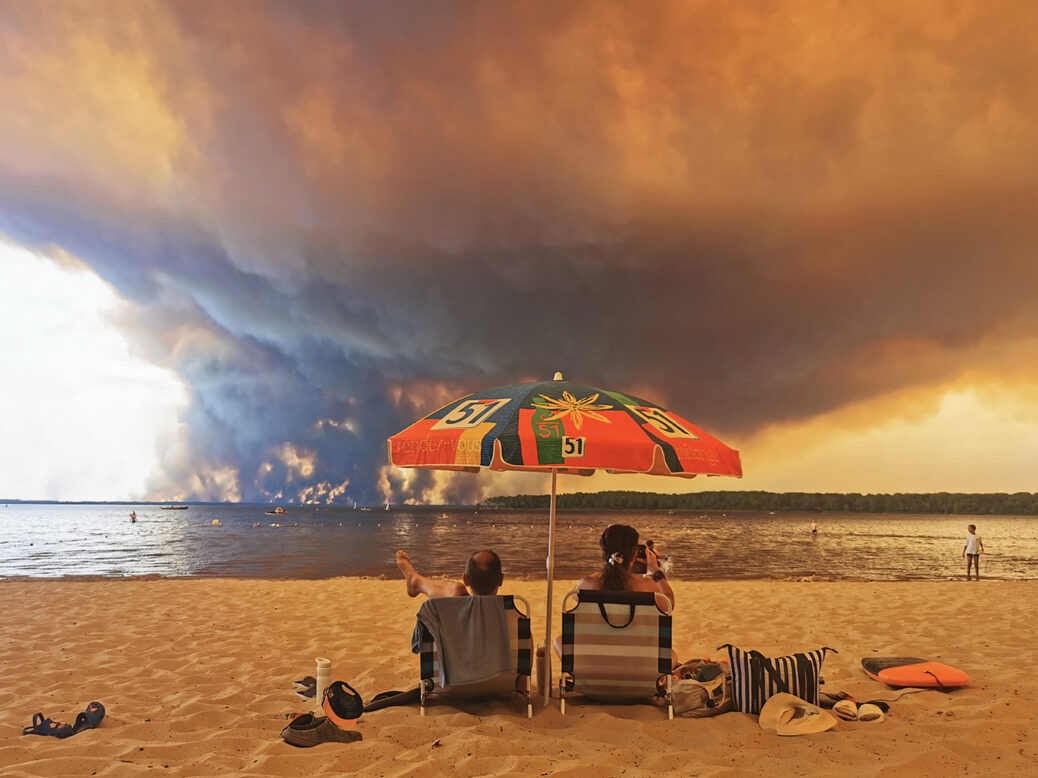
Today, evidence of that movement and moment is difficult to find, even as the world confronts disasters with a frequency and severity that can be difficult to fully grasp. As of this week, more than 300,000 residents have fled their homes across France and Spain as an unprecedented fire season tears through villages, claiming several lives and encroaching, increasingly, on major metropolitan centres including Bordeaux and Madrid. Over half a million hectares have burned so far this year across Europe – equivalent to the total annual average for the past 20 years. And the fires have reached areas previously thought immune from this sort of weather: the outbreak of a fire on Suffolk’s Dunwich Heath has led to the evacuations of hundreds of holidaymakers and a “high alert” at the nearby Sizewell B nuclear power station, which is three miles from the blaze.
Last year had already been the continent’s worst fire year on record, with over two million hectares burned by the end of the season. It’s a pattern that is unlikely to change for the fastest-warming continent on the planet, as Europe’s temperatures rise twice as fast as the rest of the world. The contrast between the growing destructiveness and frequency of these events, and the dwindling of mobilisation on climate, is profound—and it’s not entirely obvious why.
Backsliding on the part of media and business has been significant over recent years. A report from the University of Colorado found that global news coverage of climate change has fallen by 38 per cent from a peak in 2021, and prominent publications from NPR to the Washington Post have dropped their climate desks altogether. And in a precipitous decline from the headiest days of corporate “sustainability”, mentions of climate and ESG-related issues on S&P 500 earnings calls have dropped by roughly three-quarters over the same period.
In the US, the erasure of climate change from the political agenda, particularly within the Democratic Party, has proven pervasive enough to prompt a new term: “climate hushing”. Pundits and think tanks have seized on fraught political terrain and perceived failures to demand that progressives drop climate change as an issue, arguing that it alienates the working class; that it fuels polarisation, having become too tethered to a cornucopia of progressive causes; or that it does not register as a priority among voters. The prognosis? As a report published last year by the billionaire-backed Searchlight Institute in the US put it: “the first rule about solving climate change: don’t say climate change”.
Across Europe, similar sentiments have taken a different form, with right-wing parties now directly attacking climate policy, tethering their rhetoric to concerns about the cost of living or government overreach. In the UK, attacks on “net zero” have become a key political tool for Reform UK, whose deputy leader Richard Tice has described man-made climate change as “garbage”. In a cynical bid for popularity, the Conservatives have followed suit, despite their party having established net zero as a target in 2019, amending the 2008 Climate Change Act and making the UK the world’s first major economy to commit to a 2050 target. Nor is this “greenlash” limited to the parties of the right. As speculation over who would become Andy Burnham’s Chancellor raged, both the GMB and Unite unions waged a campaign against Ed Miliband, with Unite’s Sharon Graham describing his commitment to decarbonisation as a “noose around the neck” of job creation.
But does it follow from all of this that the public has lost its concern for the climate crisis? I’d venture that the answer is no. For instance, while the Searchlight report cited low concern among US voters about climate change, the report’s actual survey figures tell a different story, with nearly half of “battleground” voters convinced that climate change is personally affecting them a fair amount, and more than two-thirds believing it’s personally affecting them at least somewhat. According to the respected Yale Program on Climate Change Communication’s 2026 “Climate Change in the American Mind” report, two-thirds of registered US voters agreed that climate change is raising their home utility bills, and over 60 per cent said the same for groceries.
Perhaps most striking is a recent finding by the LR Foundation on our collective misconceptions about support for climate action. Their research found that in the UK, more than half of people think that climate change poses a “very serious” risk. But when asked whether their fellow citizens shared that belief, just 15 per cent said yes – a gap of nearly 40 per cent. In the US, the gap stood even higher at 51 versus 10 per cent. In effect: most of us gravely underestimate how much other people worry about the effects of climate change, and the public remains more climate-minded than the political class, the media – even we ourselves – believe, or seem willing to admit.
And while the decline of the “climate movement” is undeniable, it does not follow that most people have stopped caring about the climate, or that it should be abandoned as a political cause. The movement that peaked in 2019 was, in many ways, crushed by the pandemic. But there are countless developments since that explain why a movement of similar scale has failed to replace it. Urgent global crises have taken hold of the political and media cycles, as well as captured public energy, with the latter being most clear in the enormous mobilisation in response to genocide in Gaza.
Attacks on political freedoms and dissenting voices have also been chilling, from Trump’s attacks on journalists and deadly ICE raids to outrageous restrictions on the right to protest in the UK, many of which respond directly to the climate protest tactics of 2019. And as Aaron Regunberg notes in a recent essay on the subject, in some cases, many of the same organisers who previously mobilised for the climate now argue that resisting the slow creep of fascism must take priority, not least because of the many overlaps between these forces and those of climate denial.
There are questions, too, about the ways in which certain concessions by the state – whether Joe Biden’s Inflation Reduction Act, or commitments (albeit under increasing threat) to ban new licenses in the North Sea and build a public green energy company – can deflate movements. As scholar Thea Riofrancos has argued, US activists were strategically “co-opted” into the Democrats’ “grand bargain”, which hitched green policy to security concerns and competition with China while watering down many original commitments.
The process recalls Gramsci’s “passive revolution”, in which a ruling class heads off a genuine revolutionary rupture by absorbing and co-opting demands from below, granting just enough concessions to relieve pressure while leaving the essential structures of power in a society intact. The climate world is guilty of this itself, with analysts constantly lauding the explosive growth of renewable energy around the world as a settled issue and creating a false sense of inevitable progress, while sidestepping that this growth has yet to bend the global emissions curve as overall energy demand surges.
All of this leads to a strange problem for the renewal of climate activism: it is incredibly difficult to identify what the demands, today, should be. The past few years have been marked by turmoil, and the impacts on the average person’s ability just to get by has been profound. Where once the call to eliminate fossil fuels from the energy system seemed enough, the inadequacy of climate action means we live increasingly in a climate-changed world, where adaptation must now also be on the agenda.
The dizzying escalation of climate impacts and extreme weather events now regularly exceed governments’ own models and “worst case” risk scenarios, giving, for some, the sense that give the sense that we may already be too late. (The UK’s 2022 Climate Risk report, whose claim of a 0.02 per cent risk of a 40-degree plus heatwave before 2040 was undermined just months later by exactly such a heatwave, is particularly striking here.). And so powerful is the assault on freedoms, democratic institutions and human rights around the world – fragile though they already were – that it can be difficult to focus on anything but the immediate resistance to that decline.
Where the climate movement goes next is thus admittedly uncertain. What I do know for certain is that failing to talk about climate change does little but cede ground to those who would deny its existence, or deny that action must be taken in response to it. It is to abdicate our responsibility to prevent the worst versions of the future for which we may be on track, but which can yet be avoided.
There is no time for nostalgia for movements past. The conditions that fuelled 2019’s highs are gone. Instead, we must build something different to meet this moment, taking essential lessons from past failures – and successes. There is plenty of fertile ground in which to plant seeds, from climate-related surges in the cost-of-living that increasingly touch people’s lives, to the ever-clearer links between global conflict and energy. And perhaps, as the world confronts the increasing impacts of the climate crisis, from deadly heatwaves and floods storming ill-prepared cities, to the choking smoke of wildfires from Spain to Australia to Canada’s boreal forests, there is room to build not on fear or hopelessness, but on the tangible work of adapting to this new world together.
[Further reading: Supporting North Sea drilling is an extremist position]