
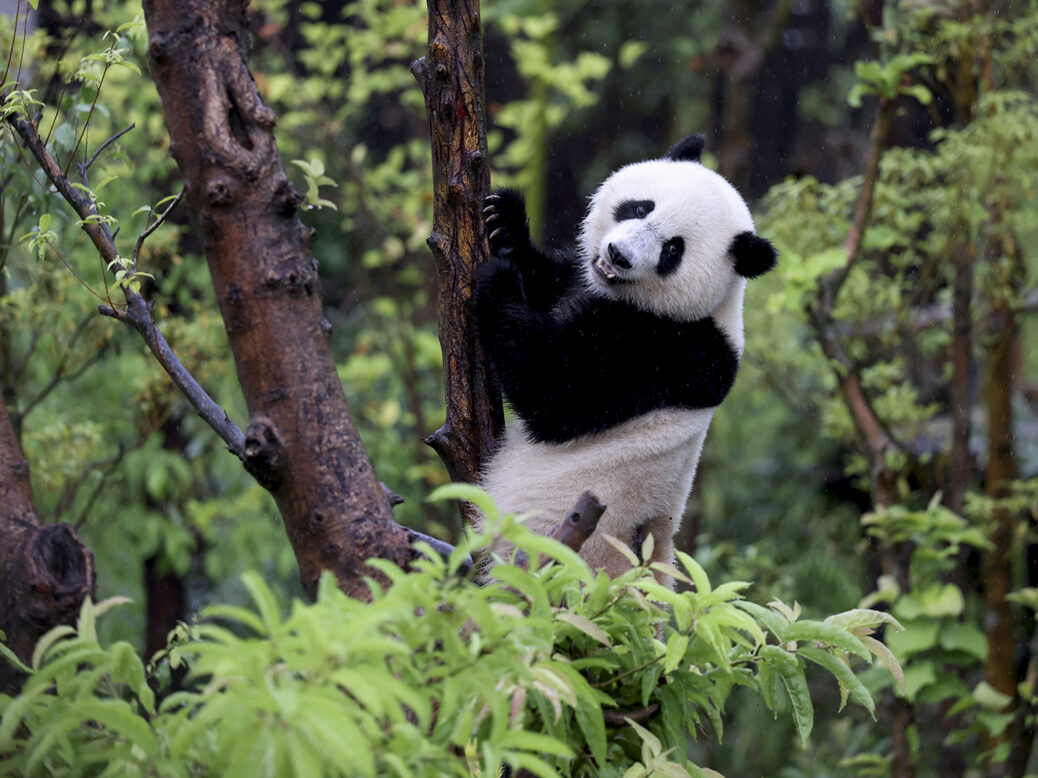
From Chengdu, Sichuan Province, I can report on the development of a dangerous new Chinese personality cult. Older readers might recall the terrible spasms of the Cultural Revolution that shook this ancient civilisation between 1966 and 1976, a near-uncontrollable outburst shaped and guided by the bloody hands of Chairman Mao. Long gone now, the totalitarian Mao has been replaced as the focus of Chinese strongman-worship by Chengdu’s most famous resident: the panda.
I cannot emphasise enough how this black-and-white bear (forgive me if that is not the correct taxonomic classification) – a slouched, scrunched, scruffy, somewhat risible animal defined by its “cuteness” and an inability to procreate – appears, to the casual tourist abroad in China, to have taken over the entire state. On the flight over from London, the safety video was performed by a smiling panda. As I left the plane, bleary and aching, I looked from the terminal window to see that a panda – rolling and, again, smiling idiotically – had been printed on the side of the passenger plane.
Chengdu turned out to be entirely pandified. The skyscrapers, the restaurants, the dim sum, the jewellery, the soft toys, the soft drinks, the hard liquor: all were in the shape of roly-poly panda bodies, or dumb adorable panda faces. I became faintly alarmed. Darkly, I imagined pandas at the nexus of Chinese power in Beijing, rolling down from the mist-hidden hills of Sichuan and Shaanxi to take their places in the politburo, constructing immense five-year plans, bent on one goal and one goal alone: the production of more bamboo.
Bamboozled
“The pandification of China has reached ludicrous heights,” posted the author Fuchsia Dunlop on her Instagram on 25 May. Dunlop, the writer who has done more to bring China into the minds and stomachs of a Western audience than any other contemporary figure, was in the country last month. (Along with Donald Trump, who, judging by the petulant/sheepish schoolboy look on his face during that state visit, had a much worse time than she did in the Middle Kingdom.) Dunlop is the culinary equivalent of an old China hand. Her succession of popular cookbooks and food histories (start with Every Grain of Rice) are responsible for the fact that I now toast Sichuan peppercorns in my spare time. Dunlop remembers a mere two panda statues in Sichuan when she was a student in the 1990s. “Now,” she wrote, “you can barely move for pandas.”
Incorrect protocol
Forcing my way through the hysterical wailing crowds at the Chengdu Research Base of Giant Panda Breeding one afternoon, I escaped to a modern concrete and glass building. Along its walls were photos of celebrity visitors cuddling pandas, almost all of whom seemed to be Western politicians. (Perhaps they know where real power lies in modern China.) There was Angela Merkel. Here was Justin Trudeau. And there, with magnificent weirdness, was a photo of Cherie Blair. The sign read: “On May 9, 2011, Cherie Blair, wife of then British prime minister, visited the Chengdu Panda Base. She learned about the lives and habits of giant pandas.” Did the Chinese think that Tony Blair was still the PM in 2011 or was it a detail lost in translation? I like to think loyal Cherie told a little fib to her Chinese hosts.
Culture-shock therapy
I avoided Beijing and Shanghai. Moved instead from Chengdu to Chongqing, through the Three Gorges Dam on a boat, into Wuhan to take a selfie by the wet market (it’s permanently closed, don’t worry), then on to Guangzhou. It was not an official tour. Nothing was stage-managed. I bumbled around with a cigarette in my mouth, mainly in search of food, always finding it, even if it was an air-dried rabbit head. The reality of this China, seen from high-speed rail and premium XL DiDi cars and the 70th floor of cyberpunk hotels, came as a terrible and diminishing shock. This is what the modern world looks, sounds and tastes like.
A shift in perspective
Fluttering from the back of the boat I took through the Three Gorges was a Chinese flag. The tourists on board would take photos beneath it, even occasionally saluting it. Perhaps that’s how you feel when you live in a country in which the median income increased 611 per cent between 1987 and 2022. I began to feel very small as the vessel entered a cathedral-sized concrete elevator and was lowered down to another section of the Yangtze. Small and awed and envious. My most comfortable ways of thought were not surviving China intact. The rest of the century, I realised at this late stage, was going to be pandas all the way down.
[Further reading: Kim Jong Un is enjoying his new nuclear power]