
Nothing suits the relentlessly arch mood of the 1990s less than a West End musical. No one was less likely to sing, or indeed dance, than Sick Boy. With this in mind, I thought Trainspotting: The Musical would be written in the spirit of the era, playing with formula the way Scream played with horror, all of it whipped up into an infinite spiral of knowingness. There’d surely be a host of musicians from back then, lining up to write the songs: like Karl Hyde from Underworld, perhaps, whose “Born Slippy” throbbed through the film, and who composed the music for the 2012 Olympics. Or Damon Albarn, who hasn’t done a stage show since his French opera was stymied by the pandemic. And the current trend for immersive theatre, headphones and quadraphonic sound, could render the heroin scenes even more intense than Ewan McGregor passing opium suppositories on the worst toilet in Scotland. Yes, this was Trainspotting The Musical as it lived in my mind.
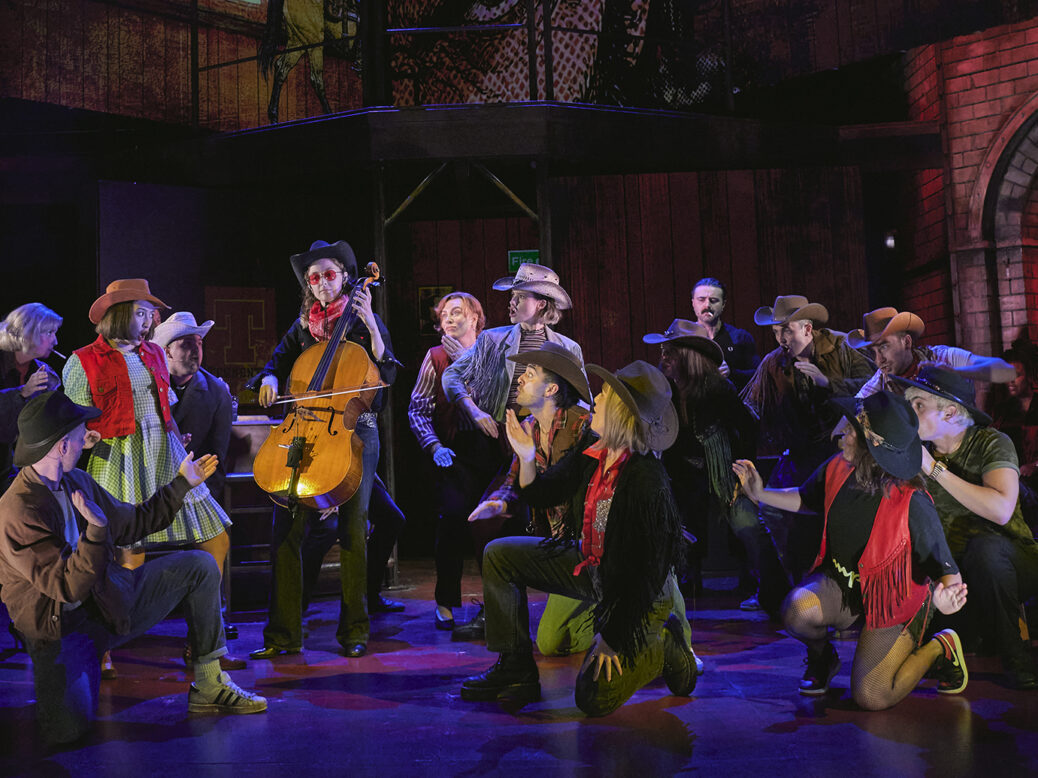
In reality, the first time Renton (Lewis Kidd) shoots up with Sick Boy (Sheridan Townsley), they rise from the floor, after that first orgasmic groan, and start line dancing. The song is called “C*nts Run The Country,” and was written by the house music DJ Steve Mac, who was behind the original music and lyrics, with some contribution from Irvine Welsh. The rest of the cast enter in Stetsons for a do-si-do. We may no longer be living through the heroin crisis of the late 1990s, but surely, we are not so far from it as to think that country music parallels the chemical experience. All those love songs to horse written over the years – “There She Goes”, “Golden Brown”, “Perfect Day” – and “C*nts Run The Country” is what we end up with.
The music in Trainspotting is the worst thing, which is a problem because it is a musical. The new songs bear not a hint of the era in which it is set: the play opens more like The Commitments, with everyone strutting and swaggering to a vaguely rockabilly beat. There are forays into 1970s disco. And there are the kind of theatrical moves mocked in Waiting For Guffman, which came out in 1996, the same year as the Trainspotting film: chairs commandeered to make bus seats, the cast bouncing along on their bums. Only this time it’s a train on the way to Blackpool to see some Northern Soul (as far as I recall there is no actual Northern Soul played).
Trainspotting was part of life in the late 1990s the way a film really couldn’t be now. It came at the tail end of the rave scene, at a time when people were getting absolutely off their nuts on all sorts of things. Heroin had a place among the Britpop elite – Albarn, Bobby Gillespie, Justine Frischmann, all did it – but Welsh’s novel was an indictment of Thatcher’s 1980s which, in Glasgow, put an end to six decades of ship building. This social commentary passed the 1990s students by, who all had the orange and white poster on their walls – or else they found the poverty glamorous, like the girl from Pulp’s “Common People”.
On Colin Richmond’s dingy stage at least, life looks realistically unbearable. The ill-fated baby is pushed around in a 1970s pram. While the film brought a lurid magic to the drug experience, on stage the thing that has always terrified me about heroin – the numinosity within, the decay without – is crystal clear. None of this sounds like the fitting subject for a musical, but I believe that good songs can render the emotional hit of a story ten times as pure.
The cast (mostly Scottish, thank god, I was so worried about bad accents) are mainly of the Gen Z, the generation that allegedly doesn’t even drink. How strange this story must seem to them, but they made a decent fist of what they had to work with. Spud (Kieran Andrew) staggers around like a newborn giraffe. After his famous bed-shitting scene, he and Renton remark on how bizarre it is that they’re singing a song – one meta moment which could have been extended throughout, for a cleverer kind of show. The second half is stronger than the first, but that’s only because it was packed with real songs – “Perfect Day”, “Bittersweet Symphony”, and surprisingly “Mad World”, which was recorded in 2001 for Donnie Darko. But even those tunes didn’t turn it around.
Trainspotting plays at Theatre Royal Haymarket, London SW1Y until 5 September
[Further reading: To Kill a Mockingbird proves that America has regressed]