
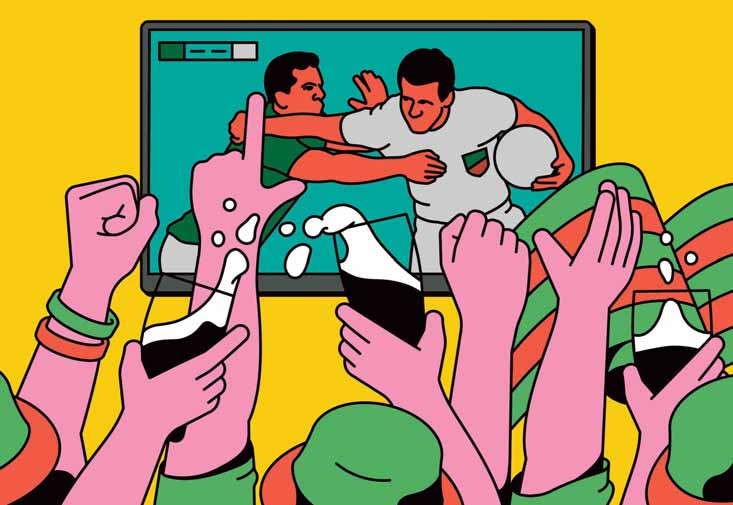
It’s customary to begin with the curse. There are many different versions, but I’ll tell you the one I was told growing up. The year is 1951, and Mayo have just won the All-Ireland Football Championship for the second year in a row. The team are travelling home when they come across a funeral procession. Rather than stop and fall silent, as was expected in Catholic Ireland, they drive straight through. Furious, the priest places a curse upon them. Mayo will never win another All-Ireland as long as any member of that team remains alive. And so the curse of ’51 was born.
The details of this story change depending on who tells it. Sometimes the curse comes from a grieving widow, sometimes from a traveller, sometimes from a witch. Yet it retained its power. In the decades that followed, Mayo reached 11 finals and left empty-handed each time. Their supporters became synonymous with heartbreak, admired for their optimism but teased for bottling it every time.
Before the curse entered Irish folklore, my family had played a small part in Mayo’s history. My great-uncle, John Joe O’Reilly, captained Cavan to victory over Mayo in the 1948 All-Ireland final. That was the golden age for Cavan football. The county won three All-Irelands in six seasons and produced players who are still remembered locally decades later.
John’s story ended with a cruel symmetry. In 1952, the year after the curse was supposedly cast, he died after receiving an injury during a football match. He was only 34 years old. Thousands of people lined the road for his funeral, his cortège more than two miles long. That same year, Cavan won their most recent All-Ireland title. As Mayo’s long wait began, so did Cavan’s. Without the mythology of a curse, however, it remains far more prosaic.
I watched Mayo’s wait finally end from a cancer ward in a Dublin hospital. My mother lay in bed, following every kick as a lifelong supporter of Kerry, the other team in the final. The most successful county in the sport’s history, Kerry had entered the match as favourites. Around us, hospital life continued. Nurses came in and out of rooms as relatives arrived carrying coffees and sandwiches. Conversations paused whenever a player broke free and sent the ball between the posts.
I had landed at Dublin Airport just hours before the throw-in. The taxi into the city passed droves of supporters making the pilgrimage towards Croke Park. Mayo jerseys filled the pavements. Outside Fagan’s in Drumcondra, people spilled onto the street, covered in Mayo’s green and red colours. Every generation seemed to be there. The last member of the 1951 team died in 2023. Whatever anyone believed about curses, the condition had finally been met, and thousands had travelled in hope that they might finally witness history.
The hospital felt no different. People wore Mayo jerseys in the lobby. In the room next door, another family had gathered around the television.
Kerry’s David Clifford drifted across the face of the goal, drawing the opposing goalkeeper towards him before slipping the ball into the net. A goal is worth three points in Gaelic football, enough to alter the mood of an afternoon in a second. It was answered by groans through the wall beside us. On screen, a sign held by Kerry supporters read “Kerry is the Kingdom and Clifford is our king”.
Still, Mayo refused to give in. Slowly, the scoreboard moved back in their favour. Every ball sent over the crossbar (worth one or two points depending on the distance it’s kicked from) brought a wilder reaction from next door.
The All-Ireland final has a way of bringing Irish people together. Gaelic football remains amateur. At the highest level the game is played between counties, each player representing the place that raised them. The best footballers in Ireland spend their weekdays at work before training in the evenings, yet they are recognised wherever they go. Physically, the athletes are in elite shape, often headhunted for other professional sports abroad.
For the Irish diaspora, the competition has long been a way of feeling connected to home. It’s hard not to feel a lump in your throat when commentators send greetings to viewers across the world. By throw-in, the means in which the game starts, pubs from New York to Hong Kong are full.
I have lived in London for eight years now and I no longer imagine that I will return to Ireland for good. Somewhere along the way I made my peace with the thought that my children will have English accents. Life has a habit of becoming settled in places you never intended it to.
I live in Kilburn, north-west London, where almost every Irish pub fills with familiar accents on championship match days. The older generation still carry that connection with them. Their children and grandchildren often don’t. They support Arsenal or Chelsea, speak with London vowels and know Ireland mostly through rainy holidays and strange family stories full of unfamiliar place names. In the US, Irishness has a habit of surviving the generations. In England it dissolves like salt in water. Given enough time, it disappears, only leaving behind a slightly sharpened aftertaste.
Living away from home means measuring your life by the milestones you miss. Children in my family have grown up in photographs. Parents get older in spurts, like the montage at the end of a film. My mother’s illness brought me home this time, and before long I will leave again. Irish culture has long made peace with that feeling. So many of its songs begin with someone leaving, and so many of its novels end with someone looking back towards home. We have left for so many reasons – because there is no work, because opportunity lies elsewhere, because generations of leaving have left many of us unable to imagine staying.
Perhaps that explains part of the curse’s power. It belonged to an older Ireland, one in which a priest’s words could determine the fate of a county and ignoring traditional values cost you dearly. The version I grew up with mixes the pagan with the Christian, the priest taking a role just as easily filled by a witch. Irish Catholicism has deeper roots than those dug by the monks who first came here. Saints and holidays were plastered over pagan gods and feasts. The same people who prayed the rosary every day would refuse to cut down a whitethorn tree. One of our patron saints, St Brigid, shares the same name, and much of the same story, with a Celtic goddess. Scratch the spiritual and the supernatural lies just beneath the surface. But as the years following the curse passed, the country changed around it. Ireland became richer, more progressive and less inclined to accept stories about broken funeral rites. With the curse’s end, another small piece of old Ireland slips away.
As Mayo edged ahead, the noise around us grew increasingly loud. Even my mother was caught up in the excitement. When the final whistle sounded, the Mayo players collapsed. Around the stadium tens of thousands of voices sang “The Green and Red of Mayo”. Elderly supporters who had spent their entire lives waiting for this day embraced strangers; one man fell to his knees, weeping. There are moments in sport that belong to the victors, but this one felt like it belonged to everyone who had carried the weight of that curse, a tale that blurred the old Ireland and the new. On an afternoon in Dublin, with families gathered in hospital rooms, pubs and living rooms across Ireland and all over the world, it finally reached its conclusion.
[Further reading: What did the Tudors ever do for us?]