
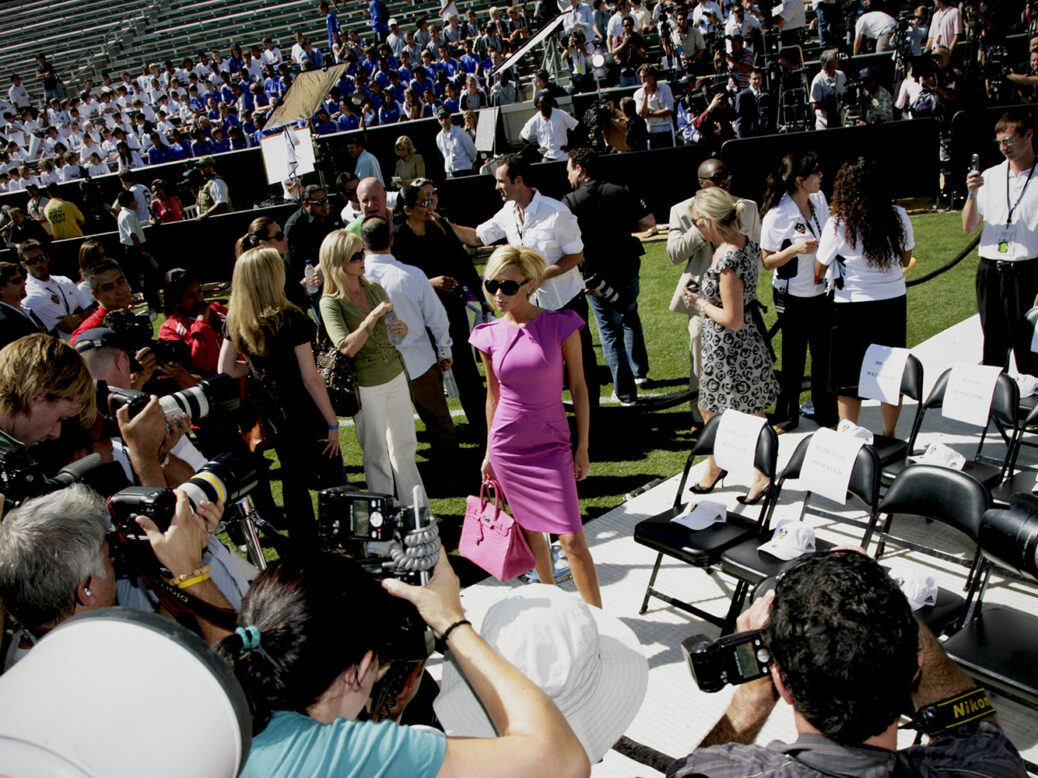
“Nothing like this will happen again,” said the head barman of Garibaldi, an Italian restaurant in the sleepy German town of Baden-Baden, crying on a journalist’s shoulder. It was the 2006 World Cup, England had just lost to Portugal on penalties, and the wags who came, shopped, and conquered, were now leaving. Peak Wag only lasted a few weeks: Coleen McLoughlin brought a spray-tan technician and spent £57,000 in an hour; Victoria Beckham packed 60 pairs of sunglasses and complained about being treated worse than a dog when her flight was delayed; Abbey Clancy was sent home early after photographs of her taking cocaine leaked. They drank vodka Red Bull, pink champagne, and pear Bellinis, and Elen Rivas climbed onto a table to belt out Gloria Gaynor’s “I Will Survive”.
Twenty years and five World Cups later, everyone is feverishly nostalgic about this good time gone by. At the time, these righteous ladettes were framed by the tabloids as ultra-feminine, ultra-gauche gold diggers who lived to spend their husbands’ money – as satirised by ITV’s Footballers’ Wives (2002), where Beckham’s proxy is a glamour model called Chardonnay. The Equality and Human Rights Commission officially criticised the word “Wag” – wives and girlfriends – as offensive and demeaning. Today, the nastiness has faded and all that’s left is a camp legend. Gen Z makes TikTok moodboards of Victoria Beckham’s outfits. Can we name any of the wives or girlfriends of any of Tuchel’s squad? Where has the Wag gone?
The Wags have migrated. They no longer inhabit the Daily Mail’s sidebar of shame. Not now that they own the means of production. On TikTok or Instagram, they share a sedate smorgasboard of M&S food shops, sunny holidays, children in miniature football shirts, beauty routines and outfits of the day.
Today’s Wags are classically aesthetically pleasing residents of the lifestyle space, able to edit and monetise peeks into their private lives. Take Morgan Riddle, the ex-girlfriend of American tennis player Taylor Fritz, who first gained recognition for a viral TikTok: “GRWM to go to a tennis match”. This winky nod to who she was dating has everywoman appeal: this could be you. It’s also a sign of the times – fandom is increasingly parasocial, concerned with the entire orbit of the athlete. By vlogging her experience at Wimbledon beyond the velvet rope, Riddle has consequently built an engaged audience of 18- to 34-year-old women (a demographic coveted by brands).
Others hide in plain sight. The internet has agreed it’s embarrassing to have a boyfriend, and a new class of Wags are not immune. Queen among them is F1 Wag Alexandra Leclerc, a history-of-art graduate who started dating Ferrari driver Charles Leclerc in 2022, just as the Netflix documentary Drive to Survive set his star soaring. Leclerc, a modern-day Grace Kelly, capitalises on discretion, sharing a gilded Riviera life of yachts and sunsets while her audience speculates on her relationship in the comment section.
Wags like Leclerc generate a feeding frenzy for brands. Paige Lorenze, who is dating American tennis player Tommy Paul, told Forbes she had as many brand deals as him during the 2024 US Open. Sponsored social media content and event appearances are the bread and butter. Entrepreneurship is common: Riddle founded the 400club, a community to champion female fans in sports, F1’s Carmen Montero Mundt co-founded skincare brand Barriers, while Tolami Benson (Bukayo Saka’s fiancée) launched a collection with high-street brand River Island just before the World Cup. Leclerc did the same earlier this year with denim brand Frame, coinciding with the Miami Grand Prix. When asked about Leclerc’s appeal, the brand’s co-founder Jens Grede said to Forbes: “She looks like a fairy tale, her life is a fairy tale, her wedding looked like a fairy tale. She’s married to the prince.”
Wags are the chosen ones. Georgina Rodríguez is working late by chance, a favour to a colleague, when Cristiano Ronaldo walks in and spins her world into a golden ensemble of private jets and chefs, Birkin bags, Bugattis and diamond rings. All of it, “thanks to love”, Rodríguez says in the opening of her eponymous 2022 Netflix reality TV series, Soy Georgina (I Am Georgina). She lives happily ever after; the series hits Netflix’s global top ten in 62 countries.
This Cinderella story, executive produced by Rodríguez, is a lightning rod for heteronormativity. In the trailer, unnamed cast members say: “Family is what makes her truly happy. The most loving and caring mother.” On Instagram, where she has 73.4m followers, she splices images of idyllic family life and children’s birthday parties between spon-con for Saudi Arabian tourism, private jets, red carpets, and high jewellery adverts. This is the headline narrative swallowed and regurgitated by her audience: a fan TikTok of Rodríguez at her stepson’s birthday, captioned “Georgina is such a good mother,” has been liked 426,600 times.
If there was ever any doubt that this is a straight fairytale, consider a recent World Cup Instagram post from Megan Pickford, wife of the England goalkeeper Jordan Pickford: “No suitcase mishap was going to stop me from supporting my husband,” she writes, beneath a picture of herself grinning in a denim cowboy hat stitched with his squad number. Football has a specific commercial climate: there are only five openly gay footballers in the world. In the women’s game, where 12 per cent of players are openly LGBTQ+ (as of the 2023 World Cup), only those with independently famous partners garner any media coverage, like I’m a Celebrity contestant GK Barry, whose girlfriend is Ipswich Town footballer Ella Rutherford.
Wags are often explicitly apolitical and overtly brand-friendly, much like Instagram’s conservative-coded trad-wives, the influencers who share happy husbands and babies, prioritise home-making, and performatively make soap from scratch. “Social media rewards certain kinds of content – polished, aspirational, often family-oriented,” says Ali Hasaan, author of “Constructing the WAG brand”’, “[Wags] are still working within a system that favours a particular image of femininity.”
Cinderella and Prince Charming are a co-brand. Morgan Riddle and Taylor Fritz combined star power for Heineken’s L0VE.L0VE marketing campaign, promoting the brand’s non-alcoholic beer. Abbey Clancy and Peter Crouch have The Therapy Crouch, a podcast where they riff off each other, diagnosing listeners’ relationship problems.
A Wag will rose-tint her partner’s world by association, particularly beneficial in this line of work: Being a good player is temporary, being an upstanding family man is forever. Just as politicians have to be married to be trusted by the electorate, Wags can broaden their partner’s appeal into a more brand-ready position – a key long-term consideration, given many retire early. “Reputational softening”, Hasaan calls it.
To some extent, this is part and parcel of wifedom in the public eye. Standing by your man has always been a defensive soft power move to take the edge off the stench of sexual impropriety, from Hillary Clinton to Coleen Rooney. In 2018, after a model publicly accused Ronaldo of sexually assaulting her in Las Vegas a decade earlier, Rodríguez took to Instagram: “You always transform the obstacles that are put in your way into impulse and strength to show how great you are…I love you @cristiano.”
Instead of being an attention-grabbing thorn in the side, a Wag is a stabilising force, an evergreen money maker, able to speak directly to a predominantly young female audience who had previously been ignored by the sports industry. You might not have noticed her because you are not necessarily her audience, and she is far too savvy to get dragged in a mainstream tabloid hoo-ha.
As culture is on the turn and marriage-and-babies are having a comeback, no Wag fits all. Plenty are lawyers, nurses, PRs, normal women with normal jobs. But the Wags defining the new class are influencers, making big money via a palatable Instagram grid, attractive to everyone from L’Oréal Paris to the Saudi Tourism Board. Cinderella is laughing her way to the bank, producing her own fairytale.
[Further reading: It’s not the phones]