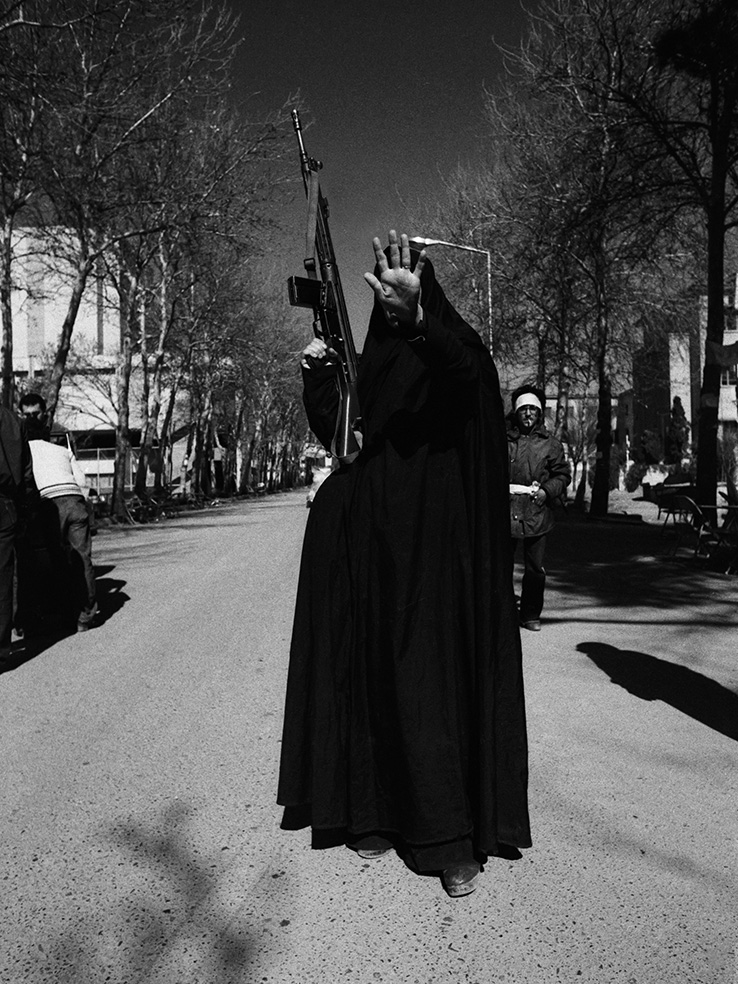
The year 1979 is the one of the seminal dates in modern political history. As one looks back over the last century of Middle Eastern history, it is more and more clear that the Islamic Revolution ranks with the French and Russian revolutions in its significance, not just to the region but also to the world. The third Gulf war is a reminder that oppressive regimes supported by loyal, murderous security forces are very rarely brought down by brave, unarmed crowds; few states are defeated purely by air power without armies; every leader dreams of a short, victorious war but few are granted; wars are easy to launch, hard to end, and even harder to predict. But one thing is certain: it is difficult to win a war against a large nation state without studying its history.
Iran and the Revolution, by Homa Katouzian, a research fellow at St Antony’s College, Oxford, and Stolen Revolution, by Bozorgmehr Sharafedin and Yeganeh Torbati, are two outstanding books that both repeatedly challenge many of the West’s preconceptions on Iran, and should be read in tandem.
Katouzian provides a superb, fascinating and essential analysis of Iranian power and society, while Sharafedin – who edited a news magazine in the Islamic Republic until he left in 2008 to work for the BBC and later the oppositionist Iran International – and Torbati – a journalist at the Washington Post – create a brilliant and compelling tapestry of humanity and history using the stories of six Iranians, researched in 130 interviews.
“The story we emerged with is this,” Sharafedin and Torbati write: “a revolution that was launched with egalitarian ideas and immense hopes has resulted in a mafia state protected by a brutal repressive apparatus. Among the key actors were some with good intentions who nonetheless, when they sacrificed accountability, inclusion and rule of law, birthed devastation.”
Iran and the Revolution explores the conundrum of Iran’s political culture: its governments traditionally required the prestige of divine blessing but the only way to get it was to succeed in establishing and maintaining an autocracy. As the tenth-century Persian poet Ferdowsi put it: “the shah’s command is as good as God’s”, but the only way rulers could secure this blessing was to seize or inherit power, and the only way to challenge the leaders was through violence, which led to chaos. Abbas the Great (1571-1629) was the most successful Safavid king but “he blinded his father, killed one of his sons, blinded two of his other sons”. Essentially, “the absence of an established inviolable legal framework” has always led not just to arbitrary government but also to what Katouzian calls an arbitrary “short-term society”.
Iran during the world wars is little known by non-experts. The Constitution Revolution of 1906 had started with hope but unleashed a civil war, while Iran was ravaged by Ottoman incursions and occupied by the British and the Russians during the First World War. Then a Cossack officer, Reza Khan, made himself an absolutist king and modernised Iran but was deposed in 1941 by the Allies for his attempts to appease both sides. His successor, Mohammad Reza, presided over chaotic democratic politics – 16 governments in ten years – while Iran was effectively occupied by Churchill and Stalin (who met Franklin D Roosevelt in Tehran in 1943, the first of three conferences).
In describing the rise of the nationalist prime minister Mohammad Mosaddeq – both populist and popular – who defied the British empire’s attempts to control Iranian oil, Katouzian blames his ultimate downfall on his rejection of a compromise deal with the Americans and British over oil rights that sent his government into freefall. The complex coup that followed was organised and led by Mosaddeq’s dismissed interior minister, General Zahedi, who in 1953 seized power with the aid of the Shiite clergy led by Ayatollah Kashani, the military and the bazaar; both the CIA and M16 were involved, although their roles are murky. Katouzian partly blames the coup on “the anarchy and governmental toleration of lawlessness”. The rebellion “gave rise to constitutional dictatorship” that lasted for ten years until the shah “became a white revolutionary” with a programme of land reform, education, female rights and industrialisation.
The shah’s successes were impressive, particularly in education and foreign policy, but some sowed the seeds of his failure: his land reforms uprooted millions of peasants who landed in Tehran’s slums; his education programme sent students to study abroad where many were radicalised. The White Revolution, launched in 1963, provoked an Islamist uprising but its crushing accelerated the emergence of the shah as autocrat “unsuspecting it had all been achieved at the cost of the total loss of legitimacy for his rule”. The shah’s folly was to arrest even secular liberals and moderate clerics. Over time, the shah’s grandiosity, the disappointments of his reforms, his pharaonic showmanship and the brutalities of Savak (the state security and intelligence agency) propagated an idea already ingrained in Iranian society: “the state was inherently incapable of doing any good for society”. The shah’s adept diplomacy made Iran the power of the Middle East but his vanities, corruption and magnificence enabled Ruhollah Khomeini to pose as the fiercely incorruptible and pious opposition. Here Stolen Revolution introduces the first of its six emblematic characters, Mehdi Karroubi, a young Shiite cleric, one of Khomeini’s students who visited the ayatollah in Iraqi exile and became a trusted disciple frequently arrested by Savak.
The Islamic Revolution was accelerated by a series of unforced errors by the shah. Both books show how the events of 1978-79 encompassed a wide coalition of democratic liberals, Marxists, Islamic Marxists, nationalists and extreme Islamist radicals: “Khomeini might not have been successful,” write Sharafedin and Torbati, “had the shah not spent a quarter century repressing every other viable opposition group especially secular forces.” Katouzian agrees: “The Revolution was not inevitable if the shah had been prepared to give up his personal control of power.”
But the 1978-79 uprising united a massive majority against the shah, whose fall was met with “absolute and unmitigated ecstasy by virtually the whole society”. Looking back, it is easy to forget that an estimated 3,000 people, including armed fighters, were killed during the shah’s 41-year reign; in January 2026, 42,000 unarmed people were killed by the current regime.
One could criticise the title Stolen Revolution in that it implies that a liberal democratic revolution was surprisingly hijacked by Khomeini’s Islamists when in fact they were the most dynamic, well-organised cadre – the best led and determined to rule. The political acumen and paternal image of Khomeini was decisive, allowing him to deceive, neutralise, bypass and then annihilate all threats to his power and establish his Islamist autocracy – an achievement of revolutionary radicalism that easily equals those of his fellow radicals Stalin and Mao, with whom he ranks as the most influential and brutal revolutionary leaders of the 20th century. It is a strange idiosyncrasy of our anxious secular society with its inherent respect for – and fear of – religious authority and belief that such comparisons are rarely made.
Khomeini exploited the alliance of leftists, Islamists and bien-pensant Westerners who believed he would be a Gandhi-esque pacifist. Instead he used successive crises and rebellions to impose his bold innovation – Velayat-e Faqih, or the Guardianship of the Jurist, a doctrine that justifies clerical rule in God’s name during the long absence of the 12th Imam who had been in occultation (hiding) since AD 874 but would later return as Madhi in a messianic rapture and apocalyptic war that would annihilate enemies (including, of course, the Jews) before delivering justice and peace. Yet the revolution’s hybrid constitution – elected parliament and presidency – gave it flexible depth.
Saddam Hussein’s invasion of Iran in 1980 was described by Khomeini as “the blessing from God”: it enabled him to mobilise young martyrs and recruit praetorians – Revolutionary Guards and the Basij volunteer militia – and crush his leftist allies in gleeful spasms of violence. His first president, Bani-Sadr, later compared Khomeini’s megalomania to “watching my father slowly turn into an alcoholic – the drug was power”. One of the regime’s leaders, Mehdi Karroubi, adored Khomeini but increasingly disapproved of the mass murders carried out by the security forces – and later exposed their barbaric mass rapes that often led to the removal of their victims’ wombs in order for them to be released to their families. Karroubi was close to Ayatollah Montazeri, Khomeini’s heir who would denounce Khomeini’s massacres “as worse than the shah”. When challenged, Khomeini declared:
Islamic government which stems from the absolute velayat (prerogative) of Prophet Mohammad, is a prime injunction in Islam, taking precedence over other precepts like prayer, fasting and Haj.
No moral limits. This was quoted by torturers and executioners in the repressions of 1999, 2019, 2022, 2026. When Montazeri called Khomeini “bloodthirsty and brutal”, Khomeini dismissed him. The two candidates for the succession were his top henchmen, the former president Ali Khamenei, a good speaker, competent organiser, and fanatical Khomeiniist, and the exuberant pragmatist and pistachio billionaire President Ali-Akbar Rafsanjani. On the imam’s death in 1989, Rafsanjani proposed Khamenei who claimed he was not worthy. Rafsanjani believed the supreme leadership would become a religious office while he as elected president would rule. A fatal mistake. “Unforgiving, harsh, self-righteous,” as Stolen Revolution describes him, Khamenei would rule catastrophically and murderously for 37 years.
The inside story of Iranian politics is little known and often viewed with rose-tinted blinkers by sympathetic Westerners. Stolen Revolution tells it clear-sightedly and grippingly. Khamenei ruled in tense partnership with Rafsanjani, who could have been an Iranian Deng Xiaoping. After two terms, Rafsanjani backed “a Muslim democrat”, Mohammed Khatami, for the presidency. Elected with nearly 70 per cent of the vote in 1997, Khatami tried to liberalise society, the press and economy, supported by young liberals like the poet Hila Sedighi, another of Stolen Revolution’s key characters. In 1999 his failed reforms inspired a student rebellion. Guards generals, including Ahmad Vahidi and Mohammad Ghalibaf, who today rule Iran, demanded repression: many protesters were killed. As Karroubi, now parliamentary speaker, tried to lead an opposition to the violence, his old friend Khamenei concentrated power to “create a unique brand of clerical crony capitalism… as state firms were ‘privatised’ they were handed over to companies controlled by the Revolutionary Guards – all of whom answered to Khamenei… He enhanced his sway within the armed forces, particularly the Revolutionary Guards.”
In 2005, Rafsanjani and Karroubi both ran for president, but Khamenei and the Guards backed a Madhist blacksmith’s son, Mahmoud Ahmadinejad – “bombastic buffoonish and cheeky” and drunk on his own “messianic righteousness”. Khamenei’s son Mojtaba fixed the election, after which Rafsanjani confided in Karroubi: “The Islamic Republic is finished. With this level of power they’ll no longer submit to elections. We should never have allowed it reach this point.”
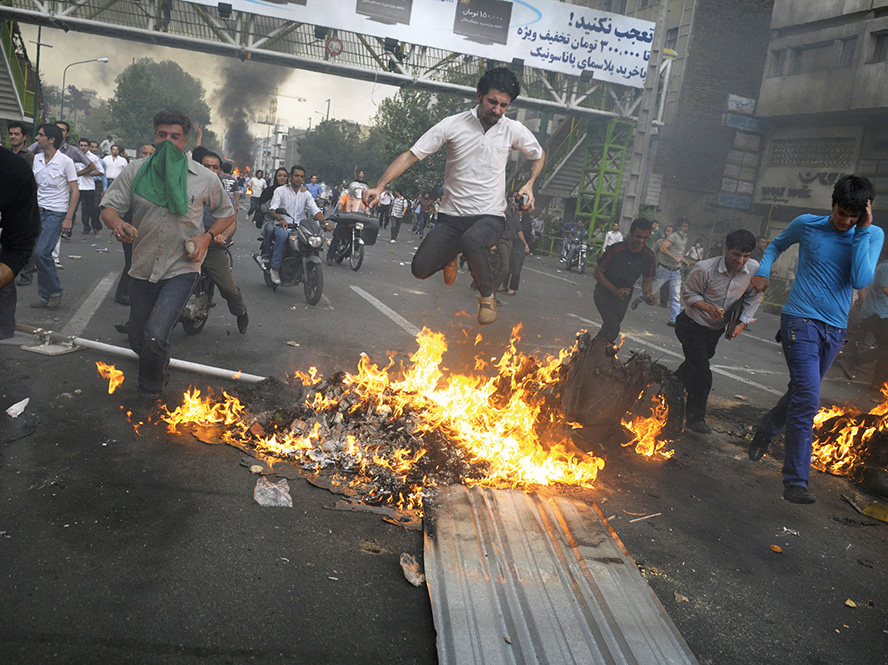
It was the start of Khamenei’s Guards-backed autocracy. But Ahmadinejad was inept, cruel and soon hated. In 2009, Karroubi ran for president with a former premier, Mir-Hossein Mousavi, leader of the Green Movement. They probably won the election but Khamenei ordered vast falsifications to the count, provoking a revolution supported by Sedighi. Karroubi and Mousavi were arrested, protesters were raped, mutilated and killed. On the run, Hila Sedighi sometimes recited her beautiful poetry to illegal gatherings:
You and I were the wingless generation, caught
By a lock-clawed bird of prey
The same bird who with fingertip blades
Killed you right before my eyes.
The workings of the mafia state are told in Stolen Revolution through a young fixer, Amir Maghadam. As Khamenei and Ahmadinejad pushed for a nuclear weapon, the Obama administration instituted strong sanctions that forced the only compromise in Khamenei’s career – a nuclear deal that could alleviate the economic crisis without giving up internal control. He ensured the “reformist” Hassan Rouhani was elected in 2013, and he negotiated the Joint Comprehensive Plan of Action (JCPOA) deal that delayed the nuclear project for ten years without the necessity of a US war against Iran. The deal also consolidated Khamenei’s power, leaving him free to enforce his “Shia Crescent” neo-empire, dominated by proxy militias in Iraq, Lebanon, Gaza and Yemen, plus the Assads in Syria.
Yet outsiders returned from the US, such as the tech entrepreneur Said Rahmani who came back only to have his company stolen at gunpoint by Guards; he scarcely escaped with his life. While the billionaire families who owned everything paraded their austere piety, their flashy offspring, the Aghazadeb (noble-born), flaunted private jets, sports cars and bikini bodies on Instagram. Westerners believed in the “Reformists”; Iranians knew they were a mask for the rulers. Sedighi regretted voting for Rouhani who “neutered the Green Movement: Reformism is not longer anything but power grabbing”. Maghadam leaked the scandals and only just escaped Iran with his life. Stolen Revolution argues that, until Trump was elected and pulled out of JCPOA, “the deal provided some stability… but was too threatening to the clerical security establishment”.
The book tells the story of the tragic 2020s through two female teenagers, Rozhin Yousefzadeh, from Iranian Kurdistan, and Kosar Eftekhari from Iranian Azerbaijan. Khamenei installed as president Ebrahim Raisi, a former hanging judge, whose crackdown led to the killing in 2022 of a Kurdish girl, Mahsa Amini for not wearing a hijab. That unleashed the Woman, Life, Freedom movement that was brutally rerepessed. Yousefzadeh was arrested, Eftekhari shot in the eye.
On 7 October, 2023, Iran’s strategy of fighting its wars with Arab blood in Arab countries reached its peak when its vassal Hamas attacked Israel. In June 2025, when Israeli jets strafed Iran, Yousefzadeh was “delighted by the attacks hoping they would weaken and perhaps bring down the Islamic Republic”, while those Iranians who opposed it “were rallying not behind the Islamic Republic but rather in aid of one another”.
Both books end there. “Arbitrary despotism described in the Bible as pharaonic defines the Iranian system of government in history,” concludes Hatouzian. Stolen Revolution delivers this indictment:
Over the 36 years, Khamenei had eliminated his critics, overseen the stealing and hoarding of the country’s wealth, elevated incompetent loyalists who drove the country into the ground. There had been dozens of turning points when he could have opted to widen the political system. But he had consistently chosen not to do so. He steered the county to a form of clerical military oligarchy that infused the Republic with greed at every level… it had evolved, becoming more repressive than at its inception. The accumulation of wealth by loyalists, formation of powerful intelligence agencies and indoctrination of security forces had made it more rigid, intrusive and aggressive than ever.
The harsh yet mutating Islamic Republic has repeatedly seemed doomed, but it is founded on a cult of messianic sacrifice, bloody resistance and apocalyptic struggle almost designed for war: with every crisis, its people bleed but its ruling kernel hardens and hardens.
Simon Sebag Montefiore’s The Cauldron: The Making of the Modern Middle East will be published in August by Weidenfeld & Nicolson
Iran and the Revolution
Homa Katouzian
Yale University Press, 352pp, £25
Stolen Revolution
Bozorgmehr Sharafedin and Yeganeh Torbati
Viking, 496pp, £22
Purchasing a book may earn the NS a commission from Bookshop.org, who support independent bookshops
[Further reading: Donald Trump’s war on Iran was an incoherent failure]
Content from our partners

Related