
Halfway through Ann Patchett’s new novel, Whistler, a therapist remarks, “The problem with having too many parents is having to watch them all die.” Patchett should know, having written unforgettable essays in the last decade about growing up with three fathers – her mother married twice more after divorcing her biological father – and bearing witness to a loved one struggle with a terminal disease. Her novels invariably revolve around large families, be it the six stepsiblings in Commonwealth who learn to get on with one another after their parents have an affair, or the wealthy Conroys in The Dutch House, suffering under the machinations of a mythically wicked stepmother. In a 2016 interview, Patchett reflected that she’d been writing “the same book my whole life – that you’re in one family, and all of a sudden, you’re in another family and it’s not your choice and you can’t get out”.
Daphne, the narrator of Whistler, isn’t looking to get out. At 53, she is happily married to Jonathan, a retired hospital administrator, and the two of them are on a visit to the Museum of Metropolitan Art in New York, when Jonathan spots an elderly man following the couple. The man turns out to be Eddie, Daphne’s former stepfather, whom she’d last seen when she was a child. Despite the estrangement, they are soon completing each other’s sentences and singing old songs together, because “our hearts were forever stitched together, mine and Eddie’s”.
Towards the beginning of the novel, Daphne contemplates telling her husband that she is happy living in the moment. She’d rather spend her days reading Madame Bovary with her students – she teaches English at a girls’ prep school in the city – and going to dinner parties and the opera with Eddie. But the past creeps up in insidious ways. Following his mother’s death, Jonathan flies to Wisconsin to clear out her house and finds himself overwhelmed by “a lifetime’s possessions”. Daphne’s mother, who lives in a Boston suburb, loses her spouse of 40 years and visits New York to meet Eddie again. And then there is Leda, Daphne’s younger sister and a therapist, who insists that Daphne tell her the story of how Eddie ended up being “scrubbed out” of their lives all those years ago.
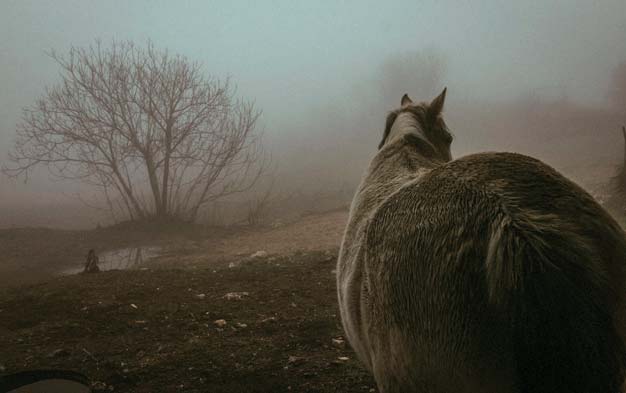
In flashbacks we learn about a car accident involving Eddie and Daphne four decades ago and a wintry night that the two of them spent stuck inside an upturned Chevrolet in the middle of nowhere. To distract little Daphne, Eddie tells her the story of a horse called Whistler who lived on a ranch in Wyoming and helped save the life of her owner. Years later, when Eddie is undergoing chemotherapy, Daphne returns the favour by distracting him with the story of her biological father’s last days. “People have no understanding of how love works,” Eddie tells her. “They don’t think about gratitude. They don’t think about relief.”
Patchett’s characters, by contrast, come across as perpetually grateful. In Whistler, parents gracefully embrace old age and reckon gently with mortality. They don’t wear embarrassing wigs nor do they queue up for monthly Botox appointments. Their middle-aged children are also “all decent people, smart people”. Daphne, for instance, is single-minded about being a good stepmother to Jonathan’s daughters from his first marriage. “My invisibility was the proof of my deference,” she says unironically at one point. “I was so good that they didn’t see me at all.” Eddie, too, is a kind soul, preternaturally able to articulate what the other person wants to hear. Even a lunchroom worker in little Daphne’s high school is noble enough to pick up a vomiting child in her arms without minding “the inevitable consequence for her own shirt and slacks”.
You’d think that the presence of so many well-adjusted characters might lower the dramatic stakes, but Patchett doesn’t need the theatricality because she writes so credibly about the ravages of time. You are in the car with Eddie and Daphne when they tell each other stories to get through the night, but then there is also Jonathan who still mourns his first wife by holding on to her esoteric collection of paintings of rabbits, and Buddy, Daphne’s biological father, whose life is spent working on fishing boats on the Atlantic Ocean and tells his daughter that he wants to see the Pacific once before he dies. Patchett teases out her characters’ desires and regrets in a way that rarely feels intrusive. Indeed, her authorial invisibility is the proof of her triumph.
Whistler
Ann Patchett
Bloomsbury, 304pp, £20
Purchasing a book may earn the NS a commission from Bookshop.org, who support independent bookshops
[Further reading: Living with and without Paul Auster]
Content from our partners


Related


This article appears in the 17 Jun 2026 issue of the New Statesman, The Race