
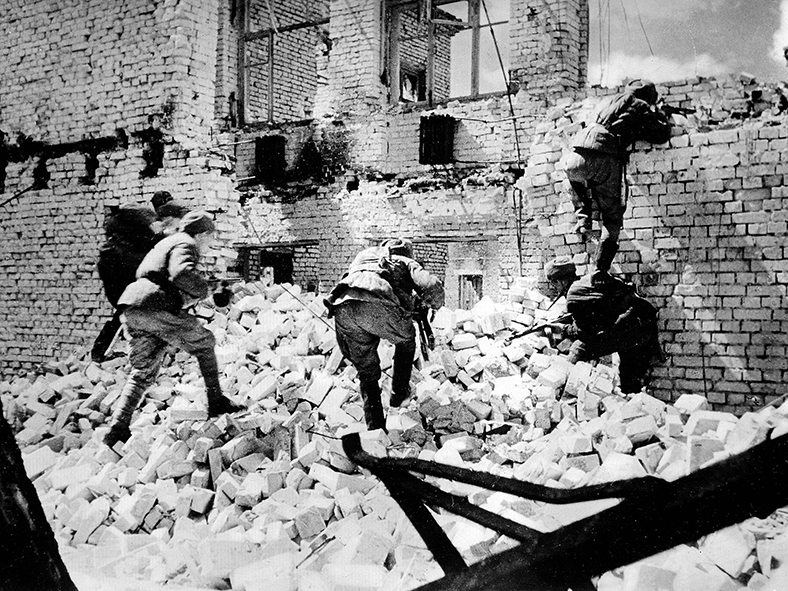
Late in the summer of 1942, Vasily Grossman was working as a special correspondent reporting on the clashes between German and Russian forces at Stalingrad when his party passed through Yasnaya Polyana, Leo Tolstoy’s estate. The Germans had occupied the place, but Grossman was struck by how little impression they had left, picking out “bald spots where the Germans had buried 80 of their dead close to Tolstoy’s grave”. Swamp grass was already covering the craters, made by bombs, to which the German bodies had been moved, and the party drove on “through beautiful countryside gripped by the fever of war”.
The episode comes early in From the Front Line, a new compilation and translation of Grossman’s mostly brilliant, sometimes euphoric and sometimes agonised reportage from the war. He read War and Peace twice during the conflict and his immense postwar novels, Stalingrad and Life and Fate, became its great heirs in both artistic force and scope of vision. Their richness seems to emanate not just from his confrontation with the war’s vastness, but also from the complexity of moral response that it provoked in him. For example, as he travels towards Stalingrad, he notices how important a role women had in daily life: “It was they who laboured away with their spades to level the endless road now needed by tanks,” he writes. His sensuous feel for the Earth’s plenitude is what made him close to being that unthinkable thing – a writer ready for wartime Stalingrad.
Of course, his wartime writing tells a story of victory. He observes the turnaround in Russia’s fortunes at Stalingrad with precision, finding a dazzling, complex alter ego in a sniper named Anatoly Chekhov, who figures out how “to remain invisible” by always firing “with a white wall behind him” to hide his rifle’s flash. Grossman is insightful on the mobilisation of Soviet society that went in to defeating Hitler; it is uplifting and devastating now to confront how some elements of large-scale socialism’s dream really did come true under the necessities of war.
Bold arguments, rich observations and dramatic vignettes appear throughout. Stalin’s generals, according to Grossman, proved capable of an experimental flexibility that their Nazi counterparts could not match. One astute speculation results from dwelling on what all these Germans – with their rich, developed, comfortable homeland – wanted in invading the backward giant to their east; Nazi rapacity is rooted for him precisely in “the cult of comfort, of pretty cushions and rugs”, in “the pathos of cosiness”.
On the day of Berlin’s capitulation, Grossman visits Hitler’s devastated office, and observes with sombre punctiliousness how nemesis is everywhere: “Beneath a layer of fallen plaster lies a crushed globe that used to stand near his desk.” Victory was for Grossman a zenith that brought ambiguity and torment. The weightiest single text in this volume is “The Hell of Treblinka”, one of the first attempts to reckon with the details and scale of the Nazis’ zeal for extermination. The thoroughness of Nazi criminality, the raging pointlessness of the war, the dark sides of Stalin’s war policy and of the conduct of his troops were staring Grossman in the face by the conflict’s end, as they were confronting the world.
Grossman was a Jew from Ukraine and reading this volume today can open up ways of reckoning with the new iterations of antisemitism that we face now, and Vladimir Putin’s and Benjamin Netanyahu’s acts of aggression. Included in From the Front Line is the extraordinary short story from the 1950s “Tiergarten”, in which Grossman reimagines the fall of Berlin through the ruins of the city’s zoo – in the minds, physiques and yearnings of its captive creatures. Grossman’s animals yearn for release and connection, and the destruction of the great city carries, for them, the “smell of rebellion, of storms, of freedom”. The visionary, compassionate alertness typical of Grossman’s realism is found scattered across the animal kingdom in this story; now, once again, we are in need of it.
Patrick Mackie is a poet and the author of Mozart in Motion (Granta)
From the Front Line 1941-45
Vasily Grossman, trs by Robert and Elizabeth Chandler
MacLehose Press, 512pp, £25
[Further reading: Samuel Beckett’s Proustian moment]